What this do I have religious trauma quiz measures
This do I have religious trauma quiz estimates how often religious trauma pattern signals show up when you reflect on your spiritual background. Twenty-two original frequency items group into four domains drawn from Marlene Winell's religious trauma syndrome framework and trauma-informed spiritual recovery literature: spiritual shame and guilt, divine punishment fear, authority and control pressure, and identity or autonomy suppression. Your religious trauma index averages these patterns into a 0 to 100 score with plain-language bands. A parallel fear-of-intimacy stack chart shows how fear-based teaching may shape closeness habits today. It reflects your self-report, not a clinical label for your faith community.
Spiritual shame and guilt
Feeling fundamentally flawed, replaying past sins, hiding authentic self, and treating shame as proof of faith.
Divine punishment fear
Fear of damnation or exile, moral scorekeeping, assuming pain is payback, and panic after ordinary mistakes.
Authority and control pressure
Deferring to harmful leaders, silencing dissent, rigid rule-following for belonging, and fear of leaving.
Identity suppression
Suppressing sexuality or gender, editing goals for purity codes, shame around intimacy, and distrust of body or desire.
How it works
Three steps from first question to your religious trauma report with fear-of-intimacy stack. Click Start Quiz to open the interactive quiz in a full-screen modal.
Answer 22 frequency items
Rate how often each spiritual pattern shows up when you think about your religious or spiritual background, from Never to Very often. You click Next after each answer; nothing auto-advances.
Items map to four trauma domains
Your answers accumulate percentages for shame, punishment fear, authority pressure, and identity suppression, plus a fear-of-intimacy stack index across four closeness layers.
View band, domain bars, and stack chart
Results show Lower, Mixed, or Higher Religious Trauma Signals with domain bars, stack layers, and reflection prompts. Higher bands include crisis resources.
Take the do I have religious trauma quiz
Rate 22 statements about spiritual shame, punishment fear, authority pressure, and identity suppression linked to your faith background. Your answers produce a religious trauma index from 0 to 100, four domain scores, a fear-of-intimacy stack chart, and a band label for reflection or therapy conversation.
Opens in a focused modal. No account required. Results stay on screen.
What your result means
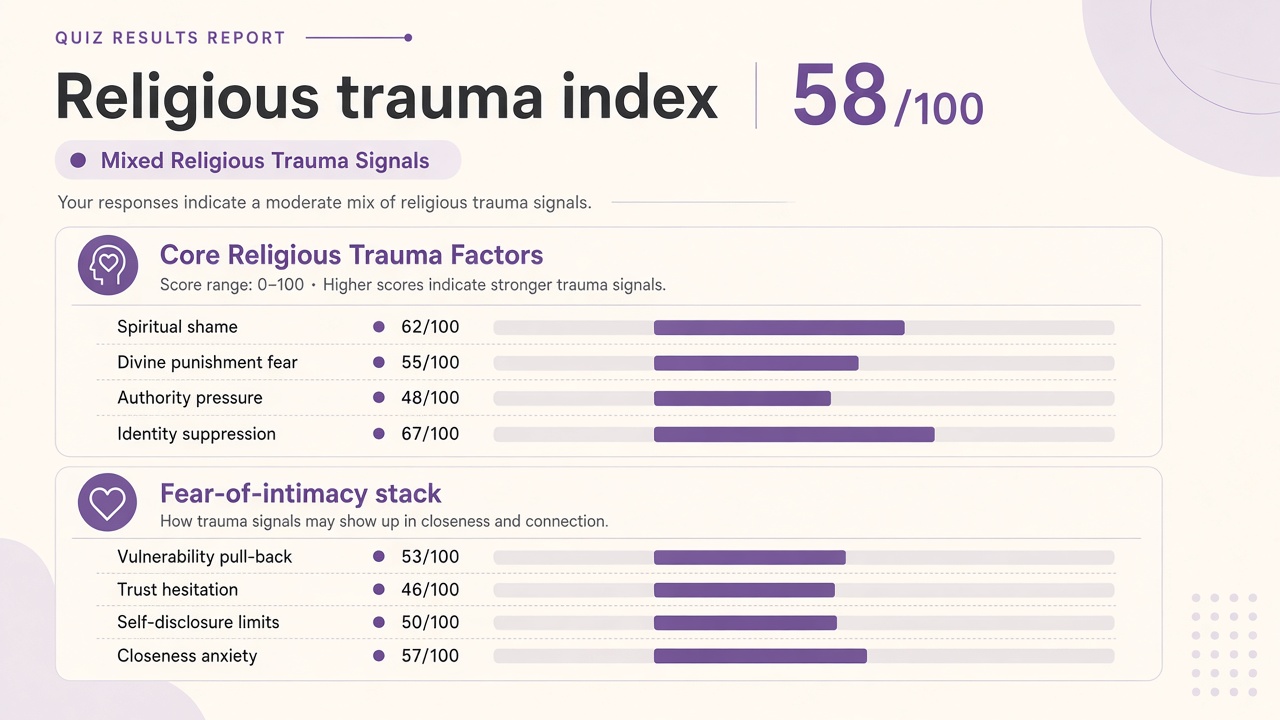
Your religious trauma index is the normalized total across all 22 items on a 0 to 100 scale, with reverse scoring on protective items so higher scores mean more trauma pattern concern overall. Domain bars show endorsement rates so you can see whether spiritual shame, punishment fear, authority pressure, or identity suppression drives your result most. The fear-of-intimacy stack index summarizes parallel closeness guarding layers that often travel with fear-based spiritual teaching.
| Band | Index range | Typical reading |
|---|---|---|
| Lower Religious Trauma Signals | 0 to 35 | Fewer fear-based spiritual pattern signals; normal faith questions or cultural devotion may still appear |
| Mixed Religious Trauma Signals | 36 to 65 | Blend of meaningful faith history and shame or authority strain; worth tracking if persistent across seasons |
| Higher Religious Trauma Signals | 66 to 100 | Frequent shame, punishment fear, or identity suppression; trauma-informed therapy may help |
What your religious trauma report looks like
After all 22 items, you get a religious trauma index from 0 to 100, a band label, four domain bars for spiritual shame, punishment fear, authority pressure, and identity suppression, plus a fear-of-intimacy stack chart with vulnerability pull-back, trust hesitation, self-disclosure limits, and closeness anxiety layers. Percentages reflect how you experience your spiritual background, not a clinical verdict.
What this quiz can and cannot tell you
Can tell you
- How often religious trauma pattern signals show up when you reflect on faith background
- A religious trauma index, four domain bars, and a fear-of-intimacy stack chart
- Which trauma domain or stack layer feels strongest in your current experience
- A starting point for therapy conversation or retaking after deconstruction or recovery work
Cannot tell you
- Whether you have PTSD, spiritual abuse, or any clinical diagnosis
- Whether your faith community is abusive without your own judgment and professional support
- Whether spiritual healing can happen without honest dialogue and mutual effort
- What treatment you need without a licensed clinician's evaluation
Marlene Winell, religious trauma syndrome, and spiritual recovery
Psychologist Marlene Winell published work on religious trauma syndrome (RTS) naming how chronic fear of punishment, spiritual shame, and conditional belonging in rigid faith settings can shape adult anxiety, relationships, and self-trust. The Religious Trauma Institute and trauma-informed therapists distinguish RTS from ordinary doubt or grief after leaving a community. Survivors often learn to hide needs, distrust desire, and fear intimacy because closeness once felt spiritually dangerous.
The Quiz Hub built this do I have religious trauma quiz as an original self-report screener inspired by those themes, not a reproduction of Winell's books or any single published instrument. Readers often compare it to sibling tools on this site. Our fear of intimacy quiz measures vulnerability pull-back in romantic bonds without a religious shame lens. The trauma bond quiz screens hot-cold cycle intensity in relationships rather than spiritual authority pressure. The am I a bad person quiz screens moral self-criticism and guilt loops that can overlap with religious scrupulosity.
| The Quiz Hub test | What it adds |
|---|---|
| Fear of intimacy quiz | FOIS-inspired closeness avoidance in romantic bonds, not spiritual shame frequency items |
| Trauma bond quiz | Hot-cold cycles and reunion craving in relationships, not divine punishment fear |
| Am I a bad person quiz | Moral guilt and harm pattern screen without spiritual authority domains |
| Anxiety test | General worry and tension over two weeks, not faith-background shame items |
| Abandonment issues quiz | Attachment distress and fear of being left, not punishment hypervigilance from teaching |
| This religious trauma quiz | Four-domain religious trauma index plus fear-of-intimacy stack for spiritual background impact |
Sample item types include frequency ratings such as whether you fear damnation when questioning doctrine, or whether you suppress sexuality to stay acceptable in your community. High spiritual shame with high divine punishment fear scores often lands in Mixed or Higher Religious Trauma Signals. Holidays, family visits, dating, and medical decisions can spike scores temporarily. Read how we review quizzes in our editorial policy or browse more screeners on our mental health and clinical hub.
Do I have religious trauma quiz FAQ
What is religious trauma?
Religious trauma describes lasting distress linked to fear-based teaching, spiritual shame, rigid authority, or identity suppression in a faith community. Psychologist Marlene Winell coined religious trauma syndrome to name how chronic fear of punishment and conditional belonging can shape adult mental health. This do I have religious trauma quiz measures how often those pattern signals show up when you reflect on your spiritual background. It is not proof of spiritual abuse and it is not a clinical diagnosis.
What does this do I have religious trauma quiz measure?
Twenty-two original frequency items ask how often you notice spiritual shame, fear of divine punishment, authority pressure, or suppressed identity when you think about your religious or spiritual background. Scores map to four religious trauma domains plus a parallel fear-of-intimacy stack with vulnerability pull-back, trust hesitation, self-disclosure limits, and closeness anxiety layers. You receive a religious trauma index from 0 to 100 where higher scores mean more trauma pattern signals, plus a band from Lower through Higher Religious Trauma Signals.
What is the fear-of-intimacy stack on this quiz?
The fear-of-intimacy stack is a second results chart inspired by FOIS-style intimacy avoidance themes, adapted to religious trauma framing. Each of the 22 items also maps to one of four stack layers: vulnerability pull-back, trust hesitation, self-disclosure limits, and closeness anxiety. The stack index summarizes how often you hide struggles, doubt forgiveness, silence dissent, or fear intimacy because of fear-based spiritual teaching.
How is this different from the anxiety test?
The anxiety test screens persistent worry, tension, and functional interference over two weeks with PHQ-style framing. This do I have religious trauma quiz focuses on spiritual shame, punishment fear, authority obedience, and identity suppression tied to faith background. It adds a fear-of-intimacy stack chart that general anxiety screeners do not include.
Can this quiz prove I experienced spiritual abuse?
No. The religious trauma index describes self-reported pattern signals on this abbreviated screener. Devout faith, cultural tradition, grief after leaving a community, or scrupulosity can raise scores without abuse. Only you plus trusted professionals can assess safety and spiritual harm. Online quizzes cannot confirm or deny spiritual abuse or PTSD.
Who reviewed this content?
Dr. Elena Vasquez, PhD, reviewed the test framing and result explanations. See our editorial policy for review standards.
Reviewed by