What this cupioromantic meaning quiz measures
This cupioromantic meaning quiz screens six reflection domains associated with aromantic spectrum experiences. Four items cover wanting partnership without romantic attraction. Three items cover split attraction understanding. Three items cover cupioromantic label comfort. Three items cover partnership structure desire. Three items cover invalidation distress. Three items cover aro community resonance.
Desire without attraction
Wanting commitment, couplehood, and romantic partnership when butterflies or limerence toward a specific person feel absent or rare.
Split attraction
Whether romantic, sexual, and companionship desires feel separable and whether that model clarifies your relationship goals.
Partnership and invalidation
Enjoyment of anniversaries and date nights without crush narratives, plus pressure from others who dismiss your desires.
Label fit and community
Whether cupioromantic or aro spectrum language feels resonant and whether aro community stories feel validating.
How it works
Three steps from first statement to your reflection band. Click Start Quiz to open the interactive screener in a full-screen modal.
Answer 19 statements
Rate how much you agree with each item on a five-point scale from strongly disagree to strongly agree. There is no timer and no auto-advance between items.
Items map to six domains
Your answers accumulate percentages for desire without attraction, split attraction, label comfort, partnership structure, invalidation distress, and aro community, plus cupio core, label resonance, split attraction, and invalidation flags.
View reflection band and next steps
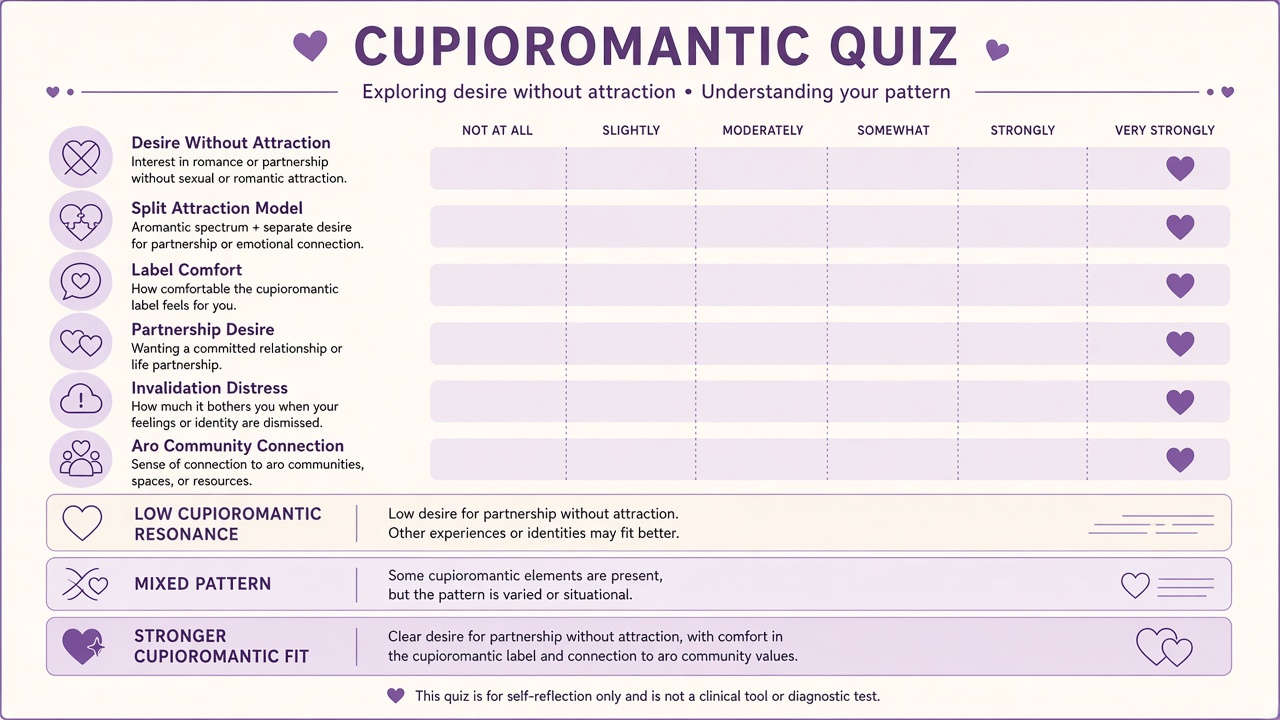
Results show Low Cupioromantic Resonance, Mixed Pattern, or Stronger Cupioromantic Fit with domain bars and affirming guidance on gray-romantic and quoiromantic as related identities.
Take the cupioromantic meaning quiz
Rate 19 statements about wanting romantic partnership without romantic attraction, split attraction understanding, cupioromantic label comfort, couple milestones, invalidation from others, and aro community connection. Your answers produce an overall pattern score, six domain bars, and three reflection bands with plain-language next steps.
Opens in a focused modal. No account required. Results stay on screen.
What your result means
Your overall pattern score is the average of six domain percentages, each normalized to 0 through 100. The band groups that average into plain-language reflection signals. Domain bars show whether desire without attraction, split attraction, label comfort, partnership structure, invalidation distress, or aro community resonance drive your result. Flags highlight cupio core, label resonance, split attraction, and invalidation distress patterns.
| Reflection band | Score range | Typical reading |
|---|---|---|
| Low Cupioromantic Resonance | 0 to 35% | Fewer cupioromantic patterns on these items; questioning and curiosity still normal |
| Mixed Pattern | 36 to 65% | Mixed domain scores worth sitting with; gray-romantic and quoiromantic paths valid |
| Stronger Cupioromantic Fit | 66 to 100% | Stronger cupioromantic pattern; identity valid with any sexual orientation or occasional attraction |
Six cupioromantic reflection domains
The diagram below shows how domain scores appear in your results. High invalidation distress with moderate desire scores, for example, can still matter even if your overall average sits in a lower band.
What this quiz can and cannot tell you
Can tell you
- Whether your self-reported patterns lean limited, mixed, or stronger on this screener
- Six domain scores for desire, split attraction, label comfort, partnership, invalidation, and community
- Cupio core, label resonance, split attraction, and invalidation flags for reflection
- A starting point for conversations with trusted friends or aro community resources
Cannot tell you
- Whether you are cupioromantic, gray-romantic, quoiromantic, alloromantic, or any fixed label
- Whether you must come out, change relationships, or adopt a specific identity word
- Official clinical scores comparable to published research norms
- How others perceive your orientation or whether you belong in LGBTQ spaces
Cupioromantic identity and the split attraction model
Cupioromantic entered aromantic spectrum vocabulary to describe people who want romantic partnership or couplehood without experiencing romantic attraction toward a specific person. Community advocates built on the split attraction model, which treats romantic orientation, sexual orientation, and companionship needs as separable axes. That framework helps explain why someone might enjoy anniversaries, commitment rituals, and building a life together without butterflies, limerence, or crush narratives. Cupioromantic people can hold any sexual orientation, including asexual, allosexual, or fluid identities.
The Quiz Hub built this cupioromantic meaning quiz as an affirming reflection screener inspired by those themes. It uses original agree-disagree items across six domains with three result bands and explicit reminders that gray-romantic and quoiromantic sit on the same spectrum. That trade-off favors readable self-reflection for casual users while naming split attraction and aro community language as historical context honestly. The Trevor Project notes that LGBTQ youth benefit from language that treats diverse attraction patterns as valid rather than disorders to fix.
| The Quiz Hub test | What it adds |
|---|---|
| Am I asexual quiz | Low sexual attraction, ace label comfort, and intimacy without sex, not partnership desire without romantic pull |
| Sexuality test | Broader orientation reflection across emotional, physical, and fluidity domains, not cupioromantic-specific invalidation items |
| Sexual orientation test | Multidimensional attraction to men, women, and non-binary people, not desire-without-attraction framing |
| This cupioromantic meaning quiz | Partnership desire without romantic attraction, split attraction, label comfort, couple milestones, invalidation, and aro community with three affirming bands |
Sample item: agreeing that you want a romantic partnership when romantic attraction feels absent raises your desire-without-attraction domain score. Agreeing that words like cupioromantic feel resonant raises label comfort. Pair results with our am I asexual quiz, sexuality test, or sexual orientation test when you want sibling lenses. Browse more quizzes on our sexuality and LGBTQ+ hub or read how we review content in our editorial policy.
Cupioromantic meaning quiz FAQ
What does this cupioromantic meaning quiz measure?
This cupioromantic meaning quiz measures self-reported agreement with statements about wanting romantic partnership without romantic attraction, split attraction understanding, cupioromantic label comfort, partnership structure desire, invalidation distress, and aro community resonance. Nineteen items produce an overall pattern score, six domain bars, cupio core and label resonance flags, and one of three reflection bands. It is not a clinical diagnosis or a certificate of orientation.
Does a high score mean I am cupioromantic?
A higher band means your answers suggest stronger cupioromantic patterns on this screener. Only you can decide whether cupioromantic, cupio, gray-romantic, quoiromantic, or another label fits. Cupioromantic identity is valid with occasional romantic attraction and with any sexual orientation. A lower band does not disprove cupioromantic identity or any other label.
What is cupioromantic and how does split attraction help explain it?
Cupioromantic describes wanting a romantic relationship or partnership structure without experiencing romantic attraction toward a specific person. The split attraction model separates romantic desire from sexual desire and from companionship needs. That framework helps explain why someone might want anniversaries, commitment, and couplehood without butterflies or limerence. This quiz educates on that model but cannot tell you which label fits best.
Can I be cupioromantic and still feel occasional romantic attraction?
Yes. Many people on the aromantic spectrum experience fluid or situational romantic attraction. Cupioromantic often describes a stable pattern of wanting partnership without strong romantic pull, but individual experiences vary. Gray-romantic and quoiromantic are related identities worth exploring if your feelings feel mixed or hard to name.
How long does the cupioromantic meaning quiz take?
Most people finish in about five minutes. There are 19 agree-disagree items on a five-point scale. You can pause and return in the same browser session thanks to autosave.
Who reviewed this content?
Dr. Morgan Chen, PhD, reviewed the test framing and result explanations. See our editorial policy for review standards.
Reviewed by