What this anxiety questionnaire measures
This anxiety questionnaire estimates how often anxiety symptom patterns appear in your daily life. Twenty-two original frequency items group into physical symptoms, cognitive worry, emotional tension, and behavioral avoidance following themes from the GAD-7 (Spitzer and colleagues, 2006) and related screening research. Each item also maps to a fear-of-intimacy stack layer. A second results chart inspired by FOIS-style intimacy avoidance themes from Descutner and Thelen (1991), adapted to this topic. Your anxiety symptom index averages these patterns into a 0 to 100 score where higher numbers mean more frequent endorsement on this screener, not proof of disorder.
Physical symptoms
Muscle tension, racing heart, stomach upset, shakiness, and breathlessness when worry rises.
Cognitive worry
Multi-topic worry, worst-case thinking, rumination loops, and difficulty redirecting thoughts.
Emotional tension
Nervousness, dread before plans, irritability, and feeling keyed up without clear cause.
Behavioral avoidance
Canceled plans, avoided triggers, delayed decisions, and reassurance seeking before acting.
How it works
Answer 22 frequency items
Rate each frequency statement from Never to Very often. You click Next after each answer; there is no auto-advance.
Items map to domains and intimacy stack
Answers accumulate percentages for four primary domains plus four fear-of-intimacy stack layers.
View index, band, and charts
Results show Lower, Mixed, or Higher signal bands with domain bars and stack chart.
Take the anxiety questionnaire
Complete 22 items to receive your anxiety symptom index, four domain bars, fear-of-intimacy stack chart, and band label for clinician conversations.
What your result means
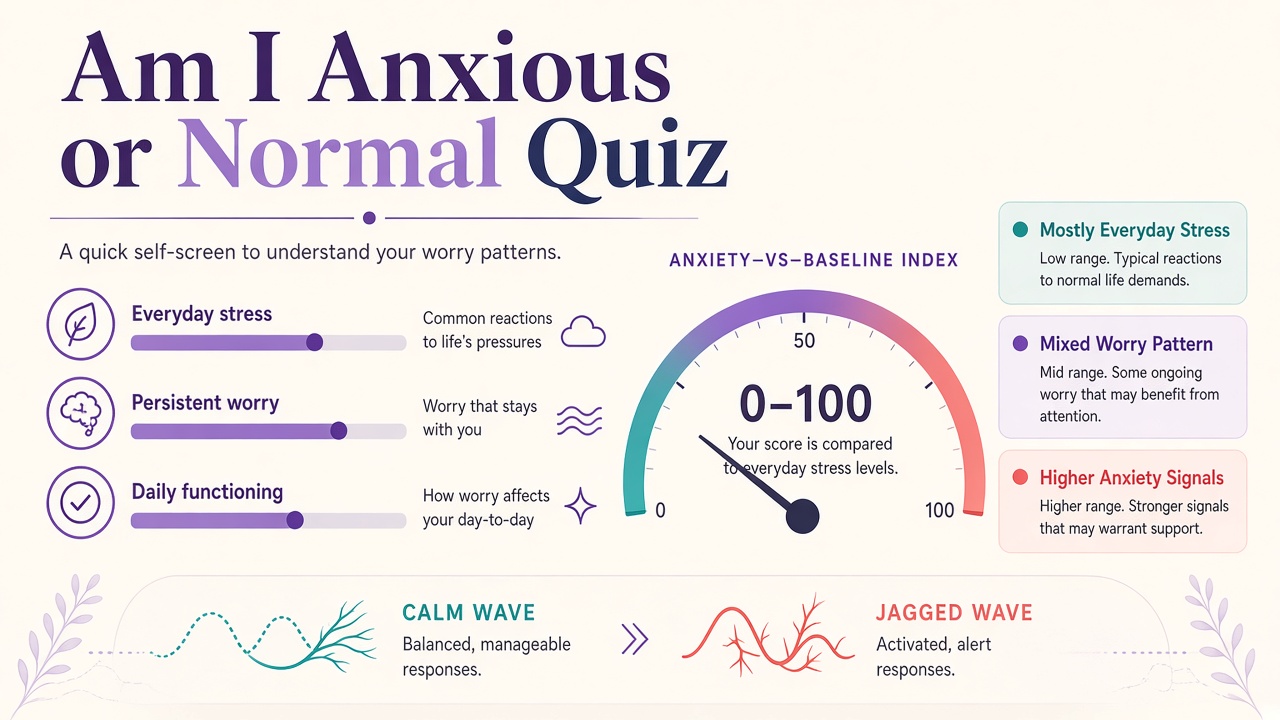
Your anxiety symptom index is the normalized total across all 22 items on a 0 to 100 scale. Higher scores mean more frequent symptom endorsement on this screener. Domain bars show which symptom family drives your result most. The fear-of-intimacy stack chart shows parallel closeness-guarding layers that sometimes pair with anxiety.
| Band | Index range | Typical reading |
|---|---|---|
| Lower Anxiety Symptom Signal | 0 to 35 | Fewer endorsed anxiety symptom patterns; situational stress can still raise scores briefly |
| Mixed Anxiety Symptom Signal | 36 to 65 | Blend of occasional and recurring anxiety symptom signals worth tracking with a clinician if persistent |
| Higher Anxiety Symptom Signal | 66 to 100 | Frequent anxiety symptom signals; schedule professional evaluation, not self-diagnosis |
What your report looks like
What this quiz can and cannot tell you
Can tell you
- How often you report anxiety symptom patterns on this screener
- An anxiety symptom index and four domain bars plus fear-of-intimacy stack
- Which domain (physical, cognitive, emotional, behavioral) feels strongest today
- A baseline before therapy visits or after lifestyle changes
Cannot tell you
- Diagnose generalized anxiety disorder, panic disorder, or any mental health condition
- Replace structured clinical interviews or licensed evaluation
- Predict whether you need medication or specific treatment
- Provide emergency care for panic attacks or self-harm thoughts
GAD-7 themes vs this anxiety questionnaire
Clinicians often use the GAD-7 (Generalized Anxiety Disorder 7-item scale) to screen worry frequency in primary care. Online lists rarely show domain bars or intimacy-stack patterns that appear when anxiety shapes closeness. This quiz adds a 0 to 100 index with four symptom domains inspired by GAD-7 and related screening research, not a reproduction of the published instrument.
Sample items ask how often muscle tension, multi-topic worry, or plan cancellation appear over two weeks. Pair results with our am I anxious or normal quiz for baseline comparison or the depression test when mood symptoms overlap. Browse the mental health and clinical hub for related screeners.
| Test | Focus |
|---|---|
| Am I anxious or normal quiz | Everyday stress vs persistent worry baseline comparison |
| Anxiety test | GAD-7 inspired screener with equivalent score mapping |
| Depression test | Mood symptoms that often co-occur with anxiety |
Anxiety Questionnaire FAQ
What does this anxiety questionnaire measure?
22 original frequency items map to four symptom domains plus a fear-of-intimacy stack. You receive an anxiety symptom index from 0 to 100 where higher scores mean more frequent endorsement on this screener. Not a diagnosis.
Can this quiz diagnose generalized anxiety disorder?
No. Your responses suggest symptom patterns for self-reflection only. Licensed clinicians use structured interviews and history to evaluate anxiety disorders.
What is the fear-of-intimacy stack?
A second results chart with vulnerability pull-back, trust hesitation, self-disclosure limits, and closeness anxiety layers adapted to anxiety symptom topics.
How is this different from the anxiety test?
The anxiety test maps closely to GAD-7 scoring. This questionnaire uses four custom domains with an intimacy stack for broader symptom reflection.
What should I do if my score is in the higher band?
Consider evaluation with a licensed therapist or primary care clinician. Call or text 988 (US) if distress feels overwhelming.
Who reviewed this content?
Dr. Elena Vasquez, PhD, reviewed the test framing and result explanations. See our editorial policy for review standards.
Reviewed by