
What this six parties quiz measures
This America six parties quiz estimates agreement with statements tied to four political clusters drawn from Pew Research Center typology research. Twenty original items map progressive left, establishment liberal, committed conservative, and populist right domains. Your six-party political alignment index averages these patterns into a 0 to 100 score.
Progressive left
Structural reform, climate urgency, and skepticism toward corporate Democrats
Establishment liberal
Institutional trust, incremental policy, and coalition-building across groups
Committed conservative
Traditional values, limited government rhetoric, and national strength framing
Populist right
Anti-elite anger, culture war heat, and distrust of institutions and experts
How it works
Three steps from first question to your political alignment report.
Answer 20 agreement items
Rate how much you agree with each political attitude statement, from Strongly disagree to Strongly agree.
Items map to party clusters and intimacy stack
Your answers accumulate four cluster percentages plus fear-of-intimacy stack layers.
View band and dual charts
Results show Lighter, Mixed, or Stronger cluster alignment with domain and stack charts.
Take the America six parties quiz
Rate 20 statements about political attitudes. Get a six-party alignment index from 0 to 100, intimacy stack index, and domain bars.
Opens in a focused modal. No account required. Results stay on screen.
What your six-party result means
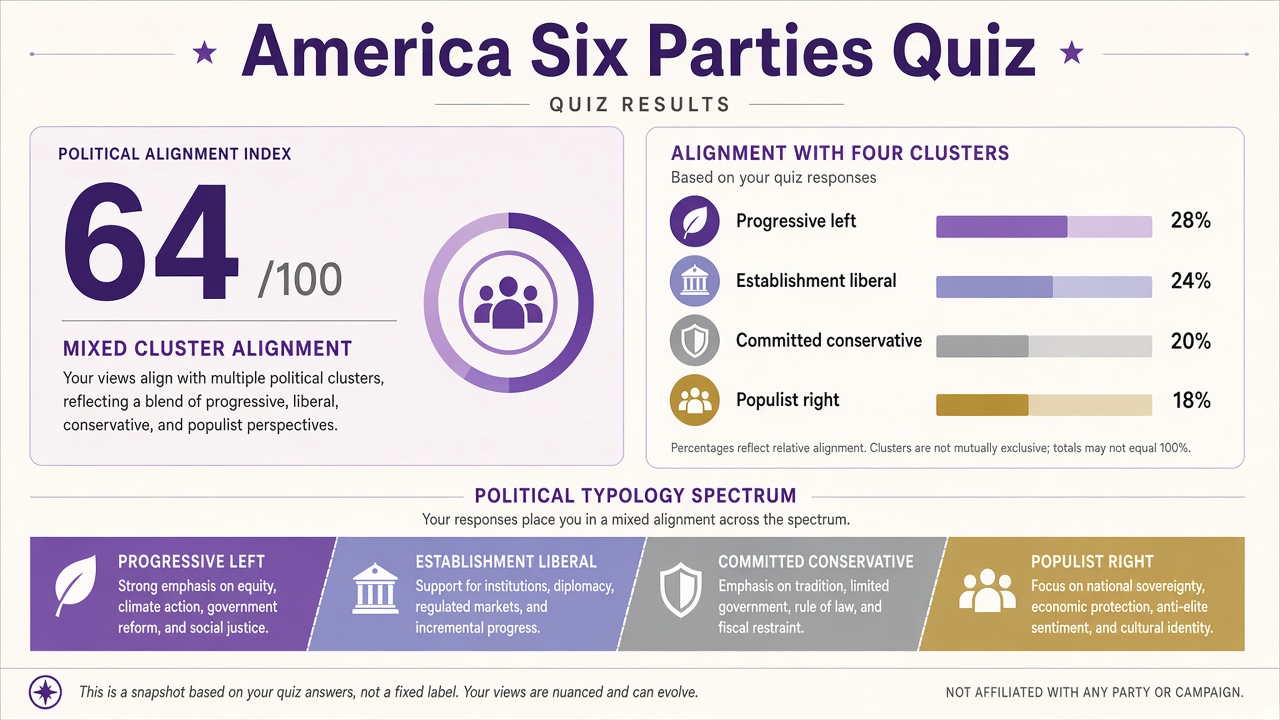
Your six-party political alignment index is normalized across all 20 items on a 0 to 100 scale. Domain bars show which cluster pulled strongest, not a single party registration label.
| Band | Index range | Typical reading |
|---|---|---|
| Lighter Cluster Alignment | 0 to 35 | Lighter alignment with measured progressive, liberal, conservative, and populist clusters |
| Mixed Cluster Alignment | 36 to 65 | Mixed pulls across party clusters; domain chart shows strongest alignment |
| Stronger Cluster Alignment | 66 to 100 | Stronger alignment with one or more measured party clusters |
What your six-party report looks like
After 20 items, you get a six-party political alignment index, band label, four domain bars, and a fear-of-intimacy stack chart.
What this quiz can and cannot tell you
Can tell you
- Which political clusters your self-report aligned with most
- A six-party alignment index and fear-of-intimacy stack with domain bars
- Conversation starter about mixed views across economics and culture
Cannot tell you
- Official party registration or how you should vote in any election
- Prediction of swing state outcomes or candidate matchups
- Full Pew nine-cluster typology from twenty items alone
Pew typology, six party clusters, and mixed alignment
Pew Research Center political typology reports sort Americans into clusters such as Progressive Left, Establishment Liberals, Committed Conservatives, and Populist Right, with additional groups like Ambivalent Right and Stressed Sideliners in fuller models. Clusters bundle economic, cultural, and institutional trust attitudes that do not always follow binary party labels.
The Quiz Hub simplified four clusters into twenty original agreement items for a quick alignment read. Our moral alignment test frames ethical choices, not party typology. The am I a socialist quiz uses a different economic ideology framing if you want a single-axis contrast.
| The Quiz Hub test | What it adds |
|---|---|
| Moral alignment test | Ethical decision framing, not Pew party clusters |
| Am I a socialist quiz | Economic ideology framing, not six-cluster typology |
| American culture quiz | Pop culture fluency, not political alignment |
| This quiz | Four-cluster six-party political alignment index plus fear-of-intimacy stack for typology curiosity |
Sample items ask whether corporate influence in both major parties frustrates you or whether elites in media look down on ordinary Americans. High populist right with high progressive left scores can land in Mixed bands when anti-establishment feelings cross party lines. Read our editorial policy or browse the fun and novelty hub.
America Six Parties Quiz FAQ
What are the six parties in this quiz?
Pew Research Center typology includes more than six clusters in full reports. This quiz simplifies four major clusters (progressive left, establishment liberal, committed conservative, populist right) into twenty items for a quick alignment read.
What does the six-party political alignment index measure?
Twenty agreement items map to four cluster domains. You receive an index from 0 to 100 where higher scores mean stronger alignment signals across measured clusters on this screener.
Will this tell me how to vote?
No. This quiz describes self-reported attitude patterns for curiosity. It cannot replace reading platforms, local candidate records, or your own priorities.
How is this different from a political compass test?
Political compass tests often plot economic and social axes. This quiz uses Pew-inspired cluster statements about institutions, culture, and policy urgency.
What is the fear-of-intimacy stack?
A shared Quiz Hub results chart pattern with vulnerability pull-back, trust hesitation, self-disclosure limits, and closeness anxiety layers mapped to the same items.
Who reviewed this content?
Dr. James Whitfield, reviewed the test framing and result explanations. See our editorial policy for review standards.
Reviewed by
