What this sus vibe quiz measures
This am I sus quiz estimates how strongly you agree with statements about impostor anxiety, secretive habits, side-eye triggers, and Among Us meme self-awareness. Twenty original agreement items group into four domains inspired by impostor phenomenon research from Pauline Clance and Suzanne Imes (1978) reframed through 2020 Among Us meme culture about voted-out suspicion. Each item also maps to a fear-of-intimacy stack layer. Your sus vibe index averages these patterns into a 0 to 100 score where higher numbers mean more sus signals on this screener.
Impostor anxiety
Feeling like you are faking competence, hiding mistakes, and waiting to get exposed
Secretive habits
Lurking in group chats, dodging cameras, and acting jumpy when someone asks what you are doing
Side-eye triggers
Behavior that makes friends side-eye you, vent in DMs, or joke that you would get voted out
Among Us self-awareness
Meme-level self-awareness about sus vibes, emergency meetings, and impostor jokes about yourself
How it works
Three steps from first question to your sus vibe report with domain bars and fear-of-intimacy stack.
Answer 20 agreement items
Rate how much you agree with each statement about impostor and lurker habits, from Strongly disagree to Strongly agree. You click Next after each answer; nothing auto-advances.
Items map to sus domains and intimacy stack
Your answers accumulate percentages for impostor anxiety, secretive habits, side-eye triggers, and Among Us self-awareness, plus four fear-of-intimacy stack layers.
View band and dual charts
Results show Lower, Mixed, or Higher Sus Vibe with domain bars and a fear-of-intimacy stack chart. Higher index means stronger self-reported sus patterns on this screener.
Take the am I sus quiz
Rate 20 statements about impostor feelings, lurker habits, side-eye moments, and sus memes. Your answers produce a sus vibe index from 0 to 100, a fear-of-intimacy stack index, four domain scores, and a band label for entertainment reflection.
Opens in a focused modal. No account required. Results stay on screen.
What your sus vibe result means
Your sus vibe index is the normalized total across all 20 items on a 0 to 100 scale. The fear-of-intimacy stack index uses inverted scoring on the same answers so higher stack scores mean more closeness-guarding patterns on these items.
| Band | Index range | Typical reading |
|---|---|---|
| Lower Sus Vibe | 0 to 35 | Fewer impostor anxiety and secretive habit signals |
| Mixed Sus Vibe | 36 to 65 | Context-dependent sus vibes; domain chart shows strongest pattern |
| Higher Sus Vibe | 66 to 100 | Frequent impostor anxiety, secretive habits, or side-eye triggers on this screener |
What your sus vibe report looks like
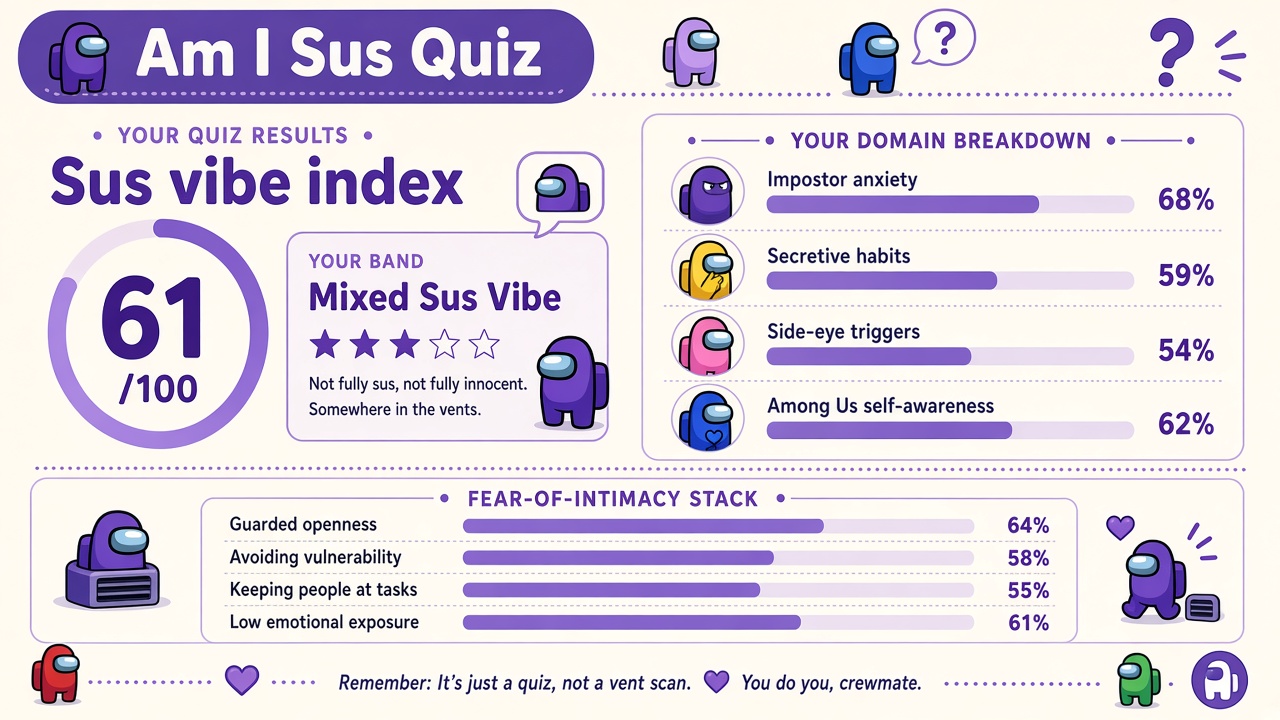
After all 20 items, you get a sus vibe index from 0 to 100, a band label, four domain bars, and a fear-of-intimacy stack chart with vulnerability pull-back, trust hesitation, self-disclosure limits, and closeness anxiety layers.
What this quiz can and cannot tell you
Can tell you
- How strongly impostor anxiety, secretive habits, side-eye triggers, and meme self-awareness showed up in your self-report
- A sus vibe index and fear-of-intimacy stack index with domain bars
- Which sus domain feels strongest in your current social habits
- Screenshot-friendly meme reflection for group chat banter
Cannot tell you
- Whether you are actually untrustworthy in real life or relationships
- Whether friends should vote you out of a friend group
- Whether secretive phone habits hide harm versus privacy preference
- Whether you are good or bad at Among Us the video game
Impostor feelings, lurker culture, and Among Us memes
Psychologists Pauline Clance and Suzanne Imes coined impostor phenomenon in 1978 to describe competent adults who fear exposure as frauds. Separately, Among Us exploded in 2020 as a social deduction game where players call one another sus when behavior looks shady. Internet culture merged both ideas into jokes about emergency meetings and getting voted out.
The Quiz Hub built this am I sus quiz as an original agreement screener plus FOIS-style intimacy avoidance layers from Descutner and Thelen (1991). Our am I fake quiz screens performance masking rather than lurker sus vibes. The am I high quiz focuses on intoxication habit memes, not impostor anxiety.
| The Quiz Hub test | What it adds |
|---|---|
| Am I fake quiz | Performance masking and inauthenticity, not lurker sus memes |
| Am I high quiz | Intoxication habit memes, not impostor anxiety |
| Am I mysterious quiz | Enigmatic reserve, not voted-out side-eye habits |
| Fear of intimacy quiz | General intimacy avoidance without sus meme domains |
| This quiz | Sus vibe index plus fear-of-intimacy stack for impostor anxiety, secretive habits, side-eye triggers, and meme self-awareness |
Sample items include whether friends joke you would get voted out first, or whether you close apps when someone walks behind you. High secretive habits with high self-disclosure limits on the stack often land in Mixed bands when privacy guards vulnerability. Read our editorial policy or browse the fun and novelty tests hub.
Am I Sus Quiz FAQ
What does the am I sus quiz measure?
Twenty original agreement items ask about impostor anxiety, secretive habits, side-eye triggers, and Among Us meme self-awareness. Each item also maps to a fear-of-intimacy stack layer. You receive a sus vibe index from 0 to 100 where higher scores mean more sus signals on this screener.
Is this quiz connected to Among Us the game?
This quiz uses Among Us meme language for entertainment self-reflection. It is not affiliated with Innersloth or the game. Scores describe self-reported habits, not game skill or crewmate status.
Does a higher sus vibe index mean I am untrustworthy?
No. On this screener, a higher index means you endorsed more impostor anxiety, secretive, or side-eye items. Many introverts land in Mixed bands because privacy habits overlap with sus memes. Only people in your life can speak to real trust.
What is the fear-of-intimacy stack on this quiz?
The fear-of-intimacy stack is a second results chart inspired by FOIS-style intimacy avoidance themes from Descutner and Thelen (1991), adapted to sus framing. Higher stack scores may reflect using secrecy or distance to avoid emotional vulnerability.
How is this different from the am I fake quiz?
The am I fake quiz screens performance masking, social conformity facades, and self-alienation. This sus quiz focuses on impostor meme vibes, lurker habits, and emergency-meeting group chat energy.
Who reviewed this content?
Dr. James Whitfield, reviewed the test framing and result explanations. See our editorial policy for review standards.
Reviewed by