What this am I socially awkward quiz measures
This am I socially awkward quiz estimates how often timing freezes, presence tension, feedback spirals, and group-entry hesitation show up in your self-report about everyday social life. Twenty-two original agreement items group into four domains drawn from social anxiety research and everyday language about awkwardness: conversational timing, physical presence, feedback loop, and group dynamics. Each item also maps to a fear-of-intimacy stack layer so you can see whether vulnerability pull-back, trust hesitation, self-disclosure limits, or closeness anxiety rides alongside self-monitoring habits. Your social awkwardness index averages these patterns into a 0 to 100 score where higher numbers mean more frequent endorsement.
Conversational timing
Staying silent to avoid stiff lines, long pauses, abrupt topic shifts, over-explaining, and replaying past conversations afterward.
Physical presence
Avoiding eye contact, mismatched personal space, nervous fidgeting, greeting energy mismatch, and tense posture with strangers.
Feedback loop
Missing exit cues, repeated apologies, asking if you are awkward, assuming upset from brief texts, and taking teasing personally.
Group dynamics
Hovering at circle edges, laughing without understanding, dominating side chats, relief at group endings, and skipping quieter members.
How it works
Three steps from first question to your social awkwardness report with fear-of-intimacy stack. Click Start Quiz to open the interactive quiz in a full-screen modal.
Answer 22 agreement items
Rate how much you agree with each timing, presence, feedback, or group-entry statement, from Strongly disagree to Strongly agree. You click Next after each answer; nothing auto-advances.
Items map to awkwardness domains and intimacy stack
Your answers accumulate percentages for conversational timing, physical presence, feedback loop, and group dynamics, plus four fear-of-intimacy stack layers.
View band, domain bars, and stack chart
Results show Lower, Mixed, or Higher Social Awkwardness Signals with domain bars, stack layers, and reflection prompts.
Take the am I socially awkward quiz
Rate 22 statements about conversational timing, physical presence, feedback loops, and group dynamics. Your answers produce a social awkwardness index from 0 to 100, four domain scores, a fear-of-intimacy stack chart, and a band label for reflection.
Opens in a focused modal. No account required. Results stay on screen.
What your social awkwardness result means
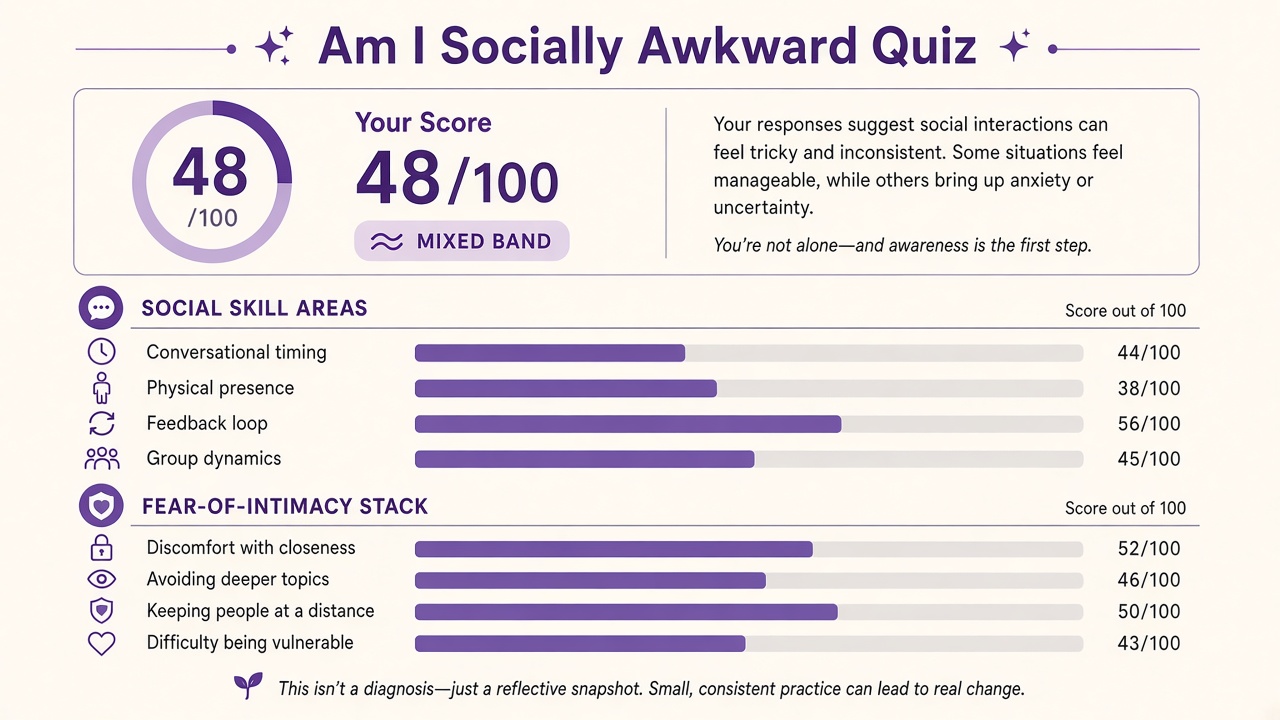
Your social awkwardness index is the normalized total across all 22 items on a 0 to 100 scale. Higher scores mean more frequent endorsement of conversational timing, physical presence, feedback loop, and group dynamics items on this screener. Domain bars show endorsement rates so you can see whether freezing in talk, body language tension, spiraling after neutral replies, or group-edge hovering drives your result most. The fear-of-intimacy stack chart shows parallel layers for vulnerability pull-back, trust hesitation, self-disclosure limits, and closeness anxiety when awkwardness habits include guarded closeness.
| Band | Index range | Typical reading |
|---|---|---|
| Lower Social Awkwardness Signals | 0 to 35 | Fewer timing or presence signals; introversion after long days can still score here |
| Mixed Social Awkwardness Signals | 36 to 65 | Blend of social ease and self-monitoring habits; domain and stack charts show where you struggle most |
| Higher Social Awkwardness Signals | 66 to 100 | Frequent timing freezes or feedback spirals; check stack if closeness feels guarded too |
What your socially awkward trait report looks like
After all 22 items, you get a social awkwardness index from 0 to 100, a band label, four domain bars for conversational timing, physical presence, feedback loop, and group dynamics, plus a fear-of-intimacy stack chart with vulnerability, trust, disclosure, and closeness anxiety layers.
What this quiz can and cannot tell you
Can tell you
- How often timing, presence, and feedback-loop patterns showed up in this self-report screener
- A social awkwardness index and four domain bars for timing, presence, feedback, and group dynamics
- A fear-of-intimacy stack showing which closeness-guarding layer feels strongest
- A starting point for therapy, coaching, or comparing with sibling tests
Cannot tell you
- Whether you are permanently awkward, unlikable, or incapable of social growth
- Whether awkwardness is rooted in social anxiety, neurodivergence, or insecurity without professional context
- Whether friends or partners agree with your self-view
- What treatment you need without licensed professional guidance
Social awkwardness, self-monitoring, and guarded closeness
People search am I socially awkward when they catch themselves freezing in group talk, replaying stiff phrases afterward, or hovering at the edge of a circle without knowing how to join. Psychologist Mark R. Leary and colleagues study social anxiety and self-presentational concerns as patterns where fear of negative evaluation outruns actual social skill. Karen K. Dion and colleagues documented how observers label some people as awkward based on timing and presence cues even when intent is benign, though everyday awkwardness in self-help language often means self-monitoring rather than clinical social anxiety disorder.
The Quiz Hub built this am I socially awkward quiz as an original self-report screener inspired by those themes plus FOIS-style intimacy avoidance layers from Descutner and Thelen (1991), not a reproduction of any single published instrument. Readers often compare it to sibling tools on this site. Our am I cringe quiz screens try-hard energy, oversharing, and online posts rather than timing freezes and physical presence tension. The social anxiety test focuses on broader social inhibition and approach avoidance rather than feedback-loop spirals. The fear of intimacy quiz measures general vulnerability pull-back across closeness, not awkwardness domain bars.
| The Quiz Hub test | What it adds |
|---|---|
| Am I cringe quiz | Try-hard energy, oversharing, awkward timing jokes, and online posts without presence or group-entry domains |
| Social anxiety test | Social inhibition and approach avoidance without conversational timing or feedback-loop domain bars |
| Am I boring quiz | Flat conversation and low curiosity patterns, not self-monitoring or group-edge hovering domains |
| Fear of intimacy quiz | General intimacy avoidance across vulnerability and trust, not awkwardness or group dynamics domains |
| Big Five personality test | OCEAN trait percentiles including extraversion without awkwardness domain bars |
| This am I socially awkward quiz | Social awkwardness index plus fear-of-intimacy stack for conversational timing, physical presence, feedback loop, and group dynamics |
Sample item types include agreement ratings such as whether you replay past conversations and fixate on stiff phrases, or whether you notice when someone's tone shifts and adjust how you respond. High conversational timing with high closeness anxiety on the stack often lands in Mixed or Higher Social Awkwardness Signals bands. Grounded introversion after long work weeks can score in Lower Social Awkwardness Signals even when you still prefer smaller groups. Read how we review quizzes in our editorial policy or browse more tools on our personality psychology hub.
Am I socially awkward quiz FAQ
What does socially awkward mean on this quiz?
Socially awkward here means your self-reported answers lean toward freezing in conversation, mismatched body language, misreading social feedback, or struggling at group edges more than toward natural timing and ease. It does not mean you are unlikable, broken, or incapable of growth. This am I socially awkward quiz maps those patterns to a social awkwardness index from 0 to 100 for reflection, not a character verdict.
What does this am I socially awkward quiz measure?
Twenty-two original agreement items ask how much you relate to conversational timing slips, physical presence tension, feedback-loop spirals, and group dynamics strain. Each item also feeds a parallel fear-of-intimacy stack with vulnerability pull-back, trust hesitation, self-disclosure limits, and closeness anxiety layers. You receive a social awkwardness index from 0 to 100 and a band from Lower through Higher Social Awkwardness Signals.
What is the fear-of-intimacy stack on this quiz?
The fear-of-intimacy stack is a second results chart inspired by FOIS-style intimacy avoidance themes, adapted to social awkwardness framing. Each of the 22 items also maps to one of four stack layers: vulnerability pull-back, trust hesitation, self-disclosure limits, and closeness anxiety. The stack index summarizes how often guarded closeness rides alongside self-monitoring or group-entry hesitation.
How is this different from the am I cringe quiz?
The am I cringe quiz uses frequency items about try-hard energy, oversharing moments, awkward timing jokes, and online posts that miss the room. This am I socially awkward quiz focuses on agreement with timing freezes, physical presence tension, feedback misreads, and group-edge hovering with a parallel fear-of-intimacy stack chart rather than performative cringe habits.
Can this quiz tell me if I have social anxiety disorder?
No. The social awkwardness index describes self-reported pattern signals on this abbreviated screener. It cannot diagnose social anxiety disorder, autism spectrum traits, or any clinical condition. Introversion, cultural norms, and situational nerves can all raise scores without meaning you are stuck forever.
Who reviewed this content?
Dr. James Whitfield, PhD, reviewed the test framing and result explanations. See our editorial policy for review standards.
Reviewed by