What this am I in a cult quiz measures
This am I in a cult quiz estimates how often high-control group patterns show up in your self-report about a community you belong to. Twenty-two original frequency items group into four domains drawn from Steven Hassan BITE model education and Robert Jay Lifton thought reform themes: behavior control over schedules and relationships, information control that discourages outside sources, thought reform through confession and rigid doctrine, and exploitation demands around money, loyalty tests, or recruitment pressure. Each item also maps to a fear-of-intimacy stack layer so you can see whether vulnerability pull-back, trust hesitation, self-disclosure limits, or closeness anxiety rides alongside isolation habits. Your cult involvement signal index averages these patterns into a 0 to 100 score where higher numbers mean more frequent endorsement.
Behavior control
Monitored schedules, leader approval over relationships and life choices, mandatory rituals, and punishment for dissent.
Information control
Discouraging outside sources, secrecy from outsiders, shunning language, and us-versus-them portrayals of non-members.
Thought reform
Required confession, moralizing normal doubts, rigid doctrine, shame after leader contradictions, and rushed belief adoption.
Exploitation demands
Pressure to donate beyond comfort, loyalty tests that cut relationships, blurred authority boundaries, and recruitment quotas.
How it works
Three steps from first question to your cult involvement report with fear-of-intimacy stack. Click Start Quiz to open the interactive quiz in a full-screen modal.
Answer 22 frequency items
Rate each statement from Never to Almost always about your group or community. You click Next after each answer; nothing auto-advances.
Items map to control domains and intimacy stack
Your answers accumulate percentages for behavior control, information control, thought reform, and exploitation demands, plus four fear-of-intimacy stack layers.
View band, domain bars, and stack chart
Results show Lower, Mixed, or Higher Cult Involvement Signals with domain bars, stack layers, and reflection prompts.
Take the am I in a cult quiz
Rate 22 statements about monitored schedules, discouraged outside information, confession pressure, loyalty tests, and financial or recruitment demands. Your answers produce a cult involvement signal index from 0 to 100, four domain scores, a fear-of-intimacy stack chart, and a band label for reflection.
Opens in a focused modal. No account required. Results stay on screen.
What your cult involvement result means
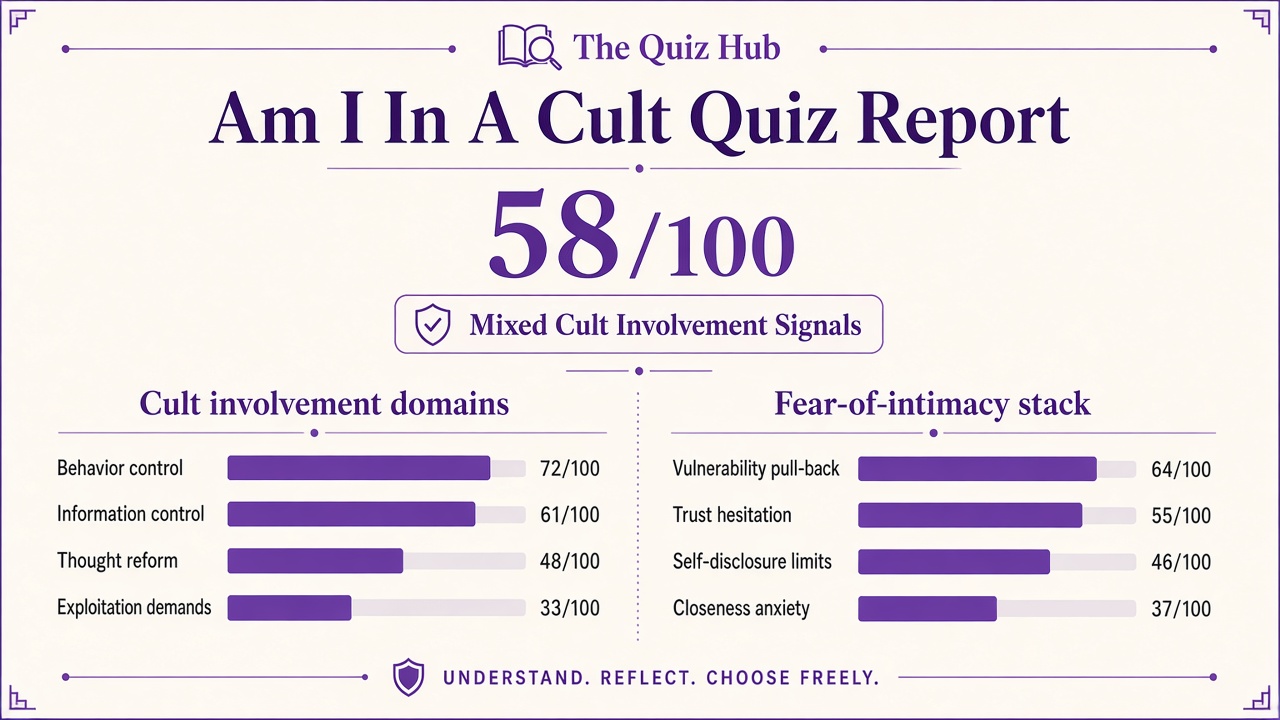
Your cult involvement signal index is the normalized total across all 22 items on a 0 to 100 scale. Higher scores mean more frequent endorsement of behavior control, information control, thought reform, and exploitation demand items on this screener. Domain bars show endorsement rates so you can see whether monitored schedules, secrecy from outsiders, confession pressure, or loyalty tests drive your result most. The fear-of-intimacy stack chart shows parallel layers for vulnerability pull-back, trust hesitation, self-disclosure limits, and closeness anxiety when group loyalty includes guarded closeness outside the community.
| Band | Index range | Typical reading |
|---|---|---|
| Lower Cult Involvement Signals | 0 to 35 | Fewer high-control group signals; devoted communities with real autonomy can still score here |
| Mixed Cult Involvement Signals | 36 to 65 | Blend of meaningful belonging and recurring secrecy, confession pressure, or loyalty tests; domain and stack charts show where you struggle most |
| Higher Cult Involvement Signals | 66 to 100 | Frequent control, isolation, thought reform, or exploitation patterns; check stack if leaving feels like losing your only safe bonds |
What your cult involvement report looks like
After all 22 items, you get a cult involvement signal index from 0 to 100, a band label, four domain bars for behavior control, information control, thought reform, and exploitation demands, plus a fear-of-intimacy stack chart with vulnerability, trust, disclosure, and closeness anxiety layers.
What this quiz can and cannot tell you
Can tell you
- How often high-control group patterns showed up in this self-report screener
- A cult involvement signal index and four domain bars for behavior control, information control, thought reform, and exploitation demands
- A fear-of-intimacy stack showing which closeness-guarding layer feels strongest alongside group loyalty pressure
- A starting point for cult-aware education, boundary setting, or comparing with sibling tests
Cannot tell you
- Whether your group is legally a cult or whether you must leave immediately
- Whether your faith, therapy circle, or team is abusive without professional context
- Whether former members or family agree with your self-view
- What safety planning you need without honest conversation with trusted outsiders
High-demand groups, BITE patterns, and belonging needs
People search am I in a cult when a tight-knit church, wellness retreat, political cell, or online community starts feeling less like chosen belonging and more like fear of leaving. Counselor Steven Hassan groups warning signs into behavior control, information control, thought reform, and exploitation demands in his BITE model, while psychiatrist Robert Jay Lifton documented thought reform patterns in high-pressure groups decades earlier. The International Cultic Studies Association (ICSA) publishes education for people weighing whether a group is healthy or coercive.
The Quiz Hub built this am I in a cult quiz as an original self-report screener inspired by Hassan and Lifton themes plus FOIS-style intimacy avoidance layers, not a reproduction of any single published cult checklist. Readers often compare it to sibling tools on this site. Our am I a fascist quiz maps political authoritarian ideology leanings rather than group secrecy or loyalty tests. The am I toxic quiz screens interpersonal harm habits toward others, not leader control inside a community. The fear of intimacy quiz measures general vulnerability pull-back across closeness, not information control or exploitation demands.
| The Quiz Hub test | What it adds |
|---|---|
| Am I a fascist quiz | Political authoritarian ideology leanings across conventionalism and anti-pluralism, not group control domains |
| Am I toxic quiz | Interpersonal harm and boundary violation habits toward others, not leader secrecy or shunning language |
| Difficult person test | Callousness and manipulation trait patterns in everyday relationships, not cult involvement domains |
| Am I narcissistic quiz | Grandiosity and entitlement self-report themes, not monitored schedules or loyalty tests |
| Fear of intimacy quiz | General intimacy avoidance across vulnerability and trust, not cult involvement domains |
| This am I in a cult quiz | Cult involvement signal index plus fear-of-intimacy stack for behavior control, information control, thought reform, and exploitation demands |
Sample item types include frequency ratings such as whether leaders discourage news that criticizes the group, or whether loyalty tests ask you to cut contact with someone the leader dislikes. High information control with high closeness anxiety on the stack often lands in Mixed or Higher Cult Involvement Signals bands. Strong belonging with real autonomy and outside friendships can score in Lower Cult Involvement Signals even when rituals feel intense. Read how we review quizzes in our editorial policy or browse more tools on our personality psychology hub.
Am I in a cult quiz FAQ
What counts as a cult in everyday language?
Researchers and counselors often describe cults as high-demand groups that use intense loyalty, secrecy, and control over behavior or beliefs. The label is contested and legally sensitive. This am I in a cult quiz measures self-reported pattern signals inspired by Steven Hassan BITE model themes plus a parallel fear-of-intimacy stack, not a courtroom verdict.
What does this am I in a cult quiz measure?
Twenty-two original frequency items ask about monitored schedules, discouraged outside information, confession pressure, loyalty tests, and financial or recruitment demands. Scores map to four cult involvement domains plus a parallel fear-of-intimacy stack with vulnerability pull-back, trust hesitation, self-disclosure limits, and closeness anxiety layers. You receive a cult involvement signal index from 0 to 100 where higher scores mean more high-control group pattern signals on this screener, plus a stack index for intimacy guarding patterns.
What is the fear-of-intimacy stack on this quiz?
The fear-of-intimacy stack is a second results chart inspired by FOIS-style intimacy avoidance themes from Descutner and Thelen (1991), adapted to high-demand group framing. Each of the 22 items also maps to one of four stack layers: vulnerability pull-back, trust hesitation, self-disclosure limits, and closeness anxiety. The stack index summarizes how often guarded closeness rides alongside isolation or loyalty pressure.
How is this different from the am I a fascist quiz?
The am I a fascist quiz screens political authoritarian ideology leanings such as conventionalism and anti-pluralism. This am I in a cult quiz measures group control habits like information secrecy, thought reform pressure, and exploitation demands inside a community you belong to. They answer different search intents.
Can this quiz tell me if I am in a cult forever?
No. Group dynamics can change with leadership turnover, boundaries, and outside support. This screener describes pattern signals you notice right now, not a permanent membership verdict or legal classification. Treat results as a starting point for honest reflection and trusted outside perspective.
Who reviewed this content?
Dr. James Whitfield, PhD, reviewed the test framing and result explanations. See our editorial policy for review standards.
Reviewed by