
What this gross habit quiz measures
This am I gross quiz estimates how often hygiene lapses, bodily habits, mess tolerance, and public boundary blur patterns show up in how you report handling daily upkeep and shared spaces. Twenty original frequency items group into four domains inspired by hygiene psychology from Valerie Curtis on disgust and disease avoidance and roommate conflict research on cleanliness norms: hygiene lapses, bodily habits, mess tolerance, and public boundary blur. Each item also maps to a fear-of-intimacy stack layer so you can see whether vulnerability pull-back, trust hesitation, self-disclosure limits, or closeness anxiety pairs with hiding your real living conditions. Your gross habit index averages these patterns into a 0 to 100 score where higher numbers mean more gross habits on this screener.
Hygiene lapses
Skipped showers, reworn clothes, missed tooth brushing, and avoiding wash-ups before closeness.
Bodily habits
Nose picking, loud burps, spitting, and leaving clippings or flakes in shared bathrooms.
Mess tolerance
Piled dishes, unwashed linens, spoiled fridge items, and bathrooms you would not show a date.
Public boundary blur
Open-mouth chewing, grooming in shared spaces, sharing drinks without asking, and messy public restrooms.
How it works
Three steps from first question to your gross habit report with fear-of-intimacy stack. Click Start Quiz to open the interactive quiz in a full-screen modal.
Answer 20 frequency items
Rate how often each gross habit pattern shows up in your hygiene and shared-space life, from Never to Almost always. You click Next after each answer; nothing auto-advances.
Items map to gross domains and intimacy stack
Your answers accumulate percentages for hygiene lapses, bodily habits, mess tolerance, and public boundary blur, plus four fear-of-intimacy stack layers.
View band and dual charts
Results show Lower, Mixed, or Higher Gross Habits with domain bars and a fear-of-intimacy stack chart. Higher index means more gross habits on this screener.
Take the am I gross quiz
Rate 20 statements about skipped washes, bodily habits, tolerated mess, and public grooming. Your answers produce a gross habit index from 0 to 100, a fear-of-intimacy stack index, four domain scores, and a band label for roommate talks or honest habit reflection.
Opens in a focused modal. No account required. Results stay on screen.
What your gross habit result means
Your gross habit index is the normalized total across all 20 items on a 0 to 100 scale, with reverse scoring on self-aware items so higher scores mean more gross habits overall. The fear-of-intimacy stack index uses the same answers mapped to vulnerability, trust, disclosure, and closeness anxiety layers where higher stack scores mean more avoidance patterns. Domain bars show endorsement rates so you can see whether hygiene lapses, bodily habits, mess tolerance, or public boundary blur drives your result most.
| Band | Index range | Typical reading |
|---|---|---|
| Lower Gross Habits | 0 to 35 | Fewer skipped washes, bodily habits around others, or piled mess; burnout can still lower standards without high scores here |
| Mixed Gross Habits | 36 to 65 | Blend of tidy moments and habits that miss social cues; domain and stack charts show where closeness anxiety pairs with mess |
| Higher Gross Habits | 66 to 100 | Frequent hygiene lapses, tolerated mess, bodily habits around others, or public grooming that roommates may notice on this screener |
What your gross habit report looks like
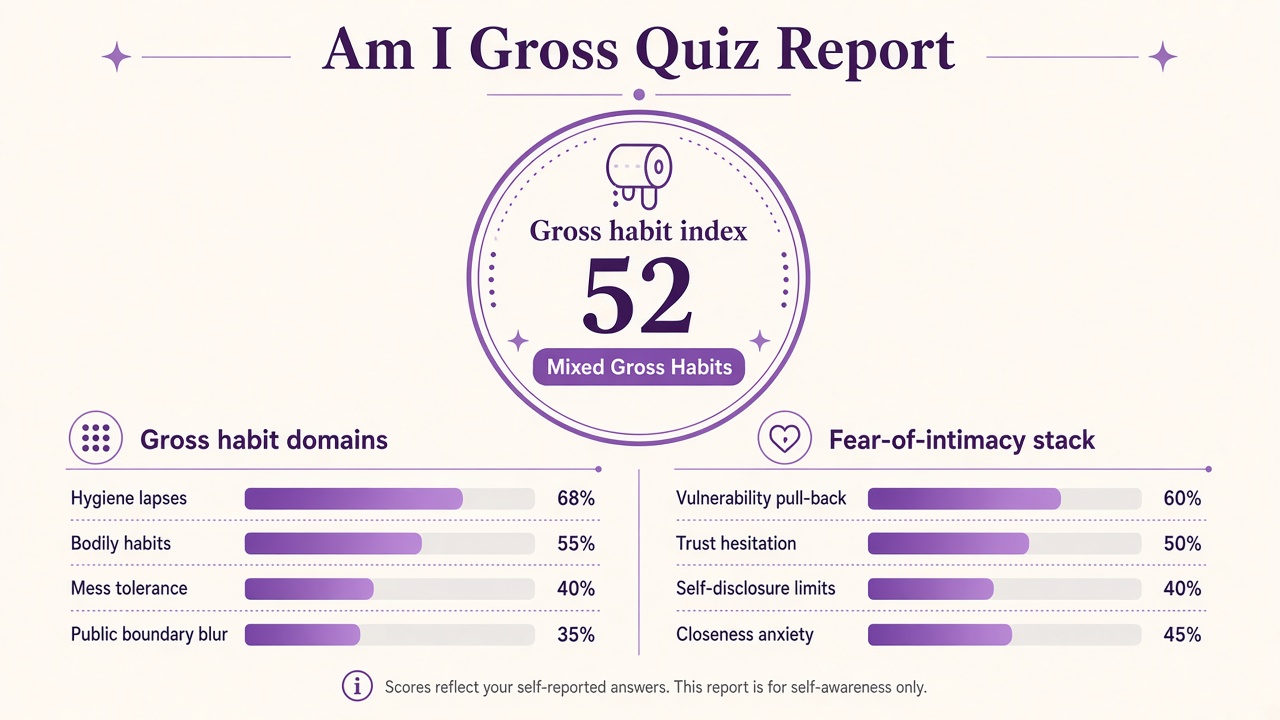
After all 20 items, you get a gross habit index from 0 to 100, a band label, four gross domain bars, and a fear-of-intimacy stack chart with vulnerability pull-back, trust hesitation, self-disclosure limits, and closeness anxiety layers. Percentages reflect how you report hygiene and shared-space habits, not a permanent label.
What this quiz can and cannot tell you
Can tell you
- How often hygiene lapses, bodily habits, mess tolerance, and public boundary blur patterns showed up in your self-report
- A gross habit index and fear-of-intimacy stack index with domain bars
- Which gross domain or intimacy stack layer feels strongest in your current habits
- A starting point for roommate talks, habit reflection, or therapy conversation about shame and shared-space standards
Cannot tell you
- Whether every roommate or date finds you gross without their side of the story
- Whether you are unlovable, disgusting forever, or a bad partner
- Whether private goblin-mode habits are wrong when nobody shares your space
- What specific changes others want without honest conversation and trusted guidance
Hygiene norms, goblin-mode habits, and the fear-of-intimacy stack
Public health researcher Valerie Curtis argued in her work on disgust that humans evolved sensitivity to bodily waste and spoiled food to avoid disease, yet modern roommate life stretches those norms across shared kitchens, bathrooms, and dating visits. Conflict researchers note that cleanliness disputes rank among the top reasons college roommates clash, often because one person treats mess as temporary and another treats it as disrespect. TikTok goblin-mode jokes celebrate private grime as self-care rebellion, but the same habits feel different when a date walks into your bathroom unannounced.
The Quiz Hub built this am I gross quiz as an original self-report screener inspired by those hygiene norm themes plus FOIS-style intimacy avoidance layers from Descutner and Thelen (1991), not a reproduction of any single published cleanliness scale. Readers often compare it to sibling tools on this site. Our am I lazy quiz screens task procrastination and comfort-first deferral rather than hygiene and mess habits. The am I cringe quiz covers try-hard jokes and oversharing rather than bodily habits around others. The am I creepy quiz maps boundary-crossing behavior rather than skipped showers or piled dishes.
| The Quiz Hub test | What it adds |
|---|---|
| Am I lazy quiz | Task procrastination and motivation waiting, not hygiene lapses or mess tolerance |
| Am I cringe quiz | Try-hard jokes and online oversharing, not bodily habits or public grooming |
| Am I creepy quiz | Boundary-crossing and stare habits, not hygiene lapses or fridge mess |
| Am I bougie quiz | Status taste and luxury preference, not gross habit frequency |
| Fear of intimacy quiz | General intimacy avoidance across vulnerability and trust, not gross habit framing |
| This gross quiz | Gross habit index plus fear-of-intimacy stack for hygiene lapses, bodily habits, mess tolerance, and public boundary blur |
Sample item types include frequency ratings such as whether you let dirty dishes pile up past when guests might visit, or whether you clip nails in a living room or transit seat. High mess tolerance with high closeness anxiety on the stack often lands in Mixed or Higher Gross Habits bands. Tidy public habits with private goblin-mode mess can split domain scores. Read how we review quizzes in our editorial policy or browse more tools on our fun and novelty hub.
Am I gross quiz FAQ
What does the am I gross quiz measure?
Twenty original frequency items ask how often hygiene lapses, bodily habits, mess tolerance, and public boundary blur patterns show up in how you report handling daily upkeep and shared spaces. Each item also maps to a fear-of-intimacy stack layer: vulnerability pull-back, trust hesitation, self-disclosure limits, and closeness anxiety. You receive a gross habit index from 0 to 100 where higher scores mean more gross habits on this screener, plus a parallel stack index.
Does a higher gross habit index mean I am disgusting?
No. On this screener, a higher index means you endorsed more skipped washes, bodily habits around others, tolerated mess, or public grooming items. Burnout, depression, ADHD, and busy seasons can all lower standards without reflecting your worth. This quiz cannot prove how every roommate or date experiences you or replace honest feedback from people who share your space.
What is the fear-of-intimacy stack on this quiz?
The fear-of-intimacy stack is a second results chart inspired by FOIS-style intimacy avoidance themes from Descutner and Thelen (1991), adapted to gross habit framing. Each of the 20 items maps to one of four stack layers showing how closeness guarding may pair with hiding your real living conditions: hiding vulnerability, testing trust, limiting disclosure, or worrying about being too close. Higher stack scores mean more avoidance patterns on these items.
How is this different from the am I lazy quiz?
The am I lazy quiz uses frequency items about task procrastination, motivation waiting, comfort seeking, and responsibility deferral from procrastination research themes. This am I gross quiz focuses on hygiene lapses, bodily habits, mess tolerance, and public boundary blur with a parallel fear-of-intimacy stack chart in one report.
How is this different from the am I cringe quiz?
The am I cringe quiz screens try-hard jokes, oversharing, awkward timing, and online posts that miss the room with a cringe habit index. This gross quiz focuses on skipped washes, bodily habits around others, piled mess, and public grooming rather than secondhand embarrassment habits.
Can this quiz tell me if my roommate thinks I am gross?
No. The gross habit index describes self-reported patterns on this abbreviated screener. Cultural norms, private quirks, and relationship history all shape how habits land. Only people in your life can tell you how your space and hygiene feel, ideally through honest conversation.
Who reviewed this content?
Dr. James Whitfield, PhD, reviewed the test framing and result explanations. See our editorial policy for review standards.
Reviewed by
