What this awesome confidence quiz measures
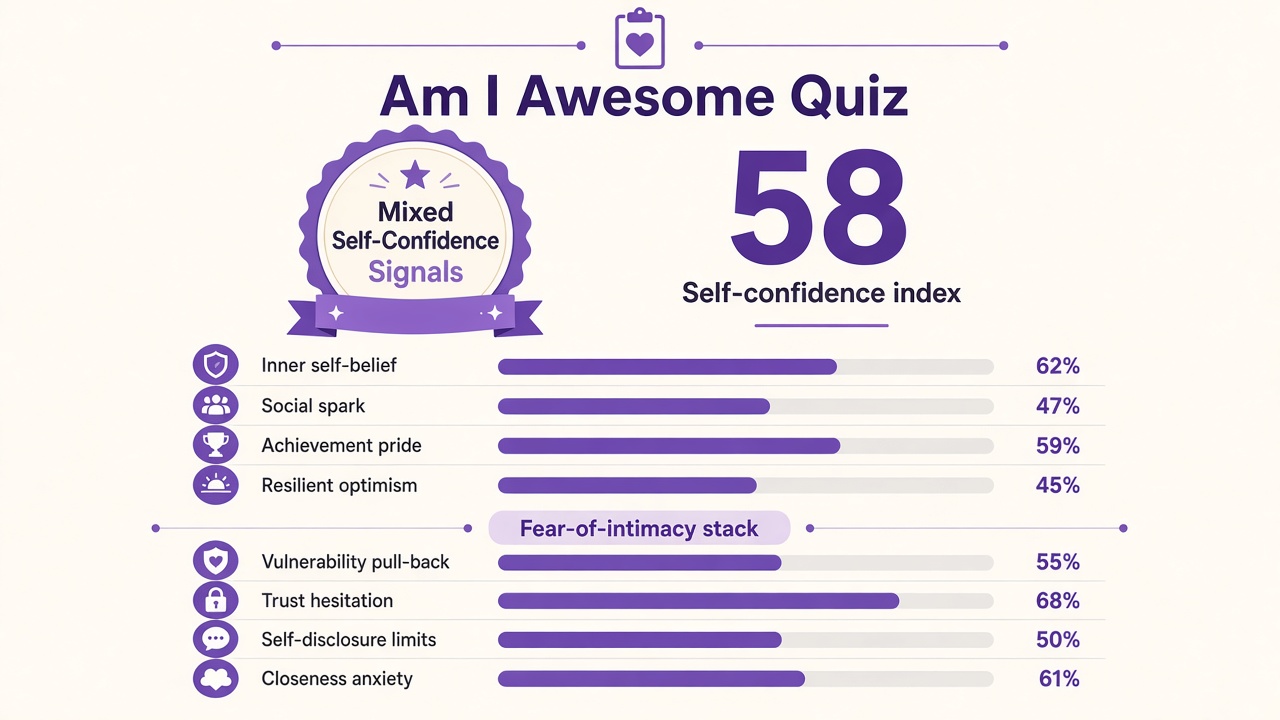
This am I awesome quiz estimates how much your self-report leans toward inner self-belief, social spark, achievement pride, and resilient optimism. Twenty original agree-or-disagree items group into four domains inspired by Rosenberg self-esteem research (1965) and everyday confidence habits: feeling worthwhile, showing up socially, owning wins, and bouncing back after setbacks. Each item also maps to a fear-of-intimacy stack layer so you can see whether vulnerability pull-back, trust hesitation, self-disclosure limits, or closeness anxiety pairs with confident public habits. Your self-confidence index averages these patterns into a 0 to 100 score where higher numbers mean stronger confidence habit endorsement.
Inner self-belief
Feeling worthwhile in rooms you enter, trusting your judgment, naming strengths, and resisting default self-doubt.
Social spark
Sharing in groups, brief center-stage comfort, confident introductions, and volunteering ideas before others.
Achievement pride
Accepting compliments, telling friends about wins, celebrating small victories, and feeling deserving after effort.
Resilient optimism
Expecting setbacks to pass, bouncing back quickly, trying again after rejection, and noticing progress along the way.
How it works
Three steps from first question to your self-confidence report with fear-of-intimacy stack. Click Start Quiz to open the interactive quiz in a full-screen modal.
Answer 20 agree-or-disagree items
Rate how much you agree with each statement about self-belief, social spark, achievement pride, and resilient optimism, from Strongly disagree to Strongly agree. You click Next after each answer; nothing auto-advances.
Items map to confidence domains and intimacy stack
Your answers accumulate percentages for inner self-belief, social spark, achievement pride, and resilient optimism, plus four fear-of-intimacy stack layers.
View band and dual charts
Results show Lower, Mixed, or Higher Self-Confidence Signals with domain bars and a fear-of-intimacy stack chart. Higher index means stronger confidence habit signals on this screener.
Take the am I awesome quiz
Rate 20 statements about self-belief, social spark, achievement pride, and resilient optimism. Your answers produce a self-confidence index from 0 to 100, a fear-of-intimacy stack index, four domain scores, and a band label for reflection or therapy conversation.
Opens in a focused modal. No account required. Results stay on screen.
What your self-confidence result means
Your self-confidence index is the normalized total across all 20 items on a 0 to 100 scale, with reverse scoring on pull-back items so higher scores mean stronger confidence habit signals overall. The fear-of-intimacy stack index uses the same answers mapped to vulnerability, trust, disclosure, and closeness anxiety layers where higher stack scores mean more avoidance patterns. Domain bars show endorsement rates so you can see whether self-belief, social spark, achievement pride, or resilient optimism drives your result most.
| Band | Index range | Typical reading |
|---|---|---|
| Lower Self-Confidence Signals | 0 to 35 | More shrinking, deflecting, or comparison habits; stress or recent rejection can still play a role |
| Mixed Self-Confidence Signals | 36 to 65 | Blend of confident habits in some settings and pull-back in others; domain and stack charts show where you guard closeness |
| Higher Self-Confidence Signals | 66 to 100 | Frequent self-belief, social spark, achievement pride, or resilient optimism on this screener |
What your awesome confidence report looks like
After all 20 items, you get a self-confidence index from 0 to 100, a band label, four domain bars, and a fear-of-intimacy stack chart with vulnerability pull-back, trust hesitation, self-disclosure limits, and closeness anxiety layers. Percentages reflect your self-report, not a verdict on your worth.
What this quiz can and cannot tell you
Can tell you
- How much self-belief, social spark, achievement pride, and resilient optimism patterns showed up in your self-report
- A self-confidence index and fear-of-intimacy stack index with domain bars
- Which confidence domain or intimacy stack layer feels strongest in your current habits
- A starting point for therapy conversation about assertiveness, warmth, and self-trust
Cannot tell you
- Whether you are awesome enough, cool enough, or morally superior to others
- Whether confidence is healthy or harmful without your own context and values
- How every person experiences your tone without their side of the story
- What specific changes others want without honest conversation and trusted guidance
Self-confidence, self-esteem research, and the fear-of-intimacy stack
Psychologist Morris Rosenberg published the Rosenberg Self-Esteem Scale in 1965, showing that global self-worth and specific confidence habits can be measured with short self-report items. Pop-culture awesome language often mixes that warmth with social spark, which can read as magnetic in public and guarded in private. Psychologists Karen M. Descutner and Mark H. Thelen published the Fear-of-Intimacy Scale in 1991, linking guarded closeness to vulnerability avoidance and trust hesitation that can sit underneath a confident exterior.
The Quiz Hub built this am I awesome quiz as an original self-report screener inspired by those research themes, not a reproduction of any single published instrument. Readers often compare it to sibling tools on this site. Our am I cool quiz screens social image coolness across style and peer comparison habits. The confidence test measures self-presentation and self-trust habits with growth-oriented bands. The am I a cheerleader quiz focuses on pep positivity and team spirit energy rather than general self-belief.
| The Quiz Hub test | What it adds |
|---|---|
| Am I cool quiz | Social image coolness across style and calm under pressure, not general self-confidence domains |
| Confidence test | Self-efficacy and performance confidence with growth bands, not fear-of-intimacy stack chart |
| Am I a cheerleader quiz | Pep positivity and team spirit energy, not inner self-belief or achievement pride |
| Am I badass quiz | Bold composure and boundary backbone framing, not warm awesome self-confidence habits |
| Fear of intimacy quiz | General intimacy avoidance across vulnerability and trust, not self-confidence domain bars |
| This am I awesome quiz | Self-confidence index plus fear-of-intimacy stack for self-belief, social spark, achievement pride, and resilient optimism |
Sample item types include agree-or-disagree statements such as whether you accept compliments about your work without immediately deflecting, or whether you stay on the sidelines at parties so nobody notices if you feel awkward. High achievement pride with high closeness anxiety on the stack often lands in Mixed Self-Confidence Signals bands. Strong social spark at work with people-pleasing at home can split domain scores. Read how we review quizzes in our editorial policy or browse more tools on our fun and novelty hub.
Am I awesome quiz FAQ
What does awesome mean on this quiz?
Awesome here means your self-reported answers lean toward inner self-belief, social spark, achievement pride, and resilient optimism more than toward shrinking, deflecting compliments, or assuming others outshine you. It is playful confidence language for group-chat reflection, not a moral ranking or proof strangers admire you. This am I awesome quiz maps those patterns to a self-confidence index from 0 to 100 for entertainment and self-reflection.
What does this am I awesome quiz measure?
Twenty original agree-or-disagree items ask how much you believe in yourself, show up socially, own wins, and bounce back after setbacks. Each item also feeds a parallel fear-of-intimacy stack with vulnerability pull-back, trust hesitation, self-disclosure limits, and closeness anxiety layers. You receive a self-confidence index from 0 to 100 and a band from Lower through Higher Self-Confidence Signals.
What is the fear-of-intimacy stack on this quiz?
The fear-of-intimacy stack is a second results chart inspired by FOIS-style intimacy avoidance themes from Descutner and Thelen (1991), adapted to self-confidence framing. Each of the 20 items also maps to one of four stack layers. The stack index summarizes how often guarded closeness rides alongside confident public habits, such as downplaying wins or hiding embarrassing failures.
How is this different from the am I cool quiz?
The am I cool quiz screens social image coolness across style, calm under pressure, and peer comparison habits. This am I awesome quiz uses agree-or-disagree items about general self-belief, social spark, achievement pride, and resilient optimism, plus a fear-of-intimacy stack chart rather than coolness domain profiles alone.
Does a higher self-confidence index mean I am a better person?
No. On this screener, a higher index means you endorsed more self-belief, social spark, achievement pride, and resilient optimism items. That can help in friendships or solo goals and still strain close relationships if intimacy stack scores are high. This quiz cannot rank your worth, predict dating success, or replace honest feedback from people who know you.
Who reviewed this content?
Dr. James Whitfield, PhD, reviewed the test framing and result explanations. See our editorial policy for review standards.
Reviewed by