
What this am I brave quiz measures
This am I brave quiz estimates how often you act despite fear or hesitation in your self-report about scary tasks, ethical voice, social risk, and uncertain outcomes. Twenty original frequency items group into four domains drawn from courage psychology research and everyday language about backbone: physical fear-facing, moral courage, social boldness, and uncertainty tolerance. Each item also maps to a fear-of-intimacy stack layer so you can see whether vulnerability pull-back, trust hesitation, self-disclosure limits, or closeness anxiety rides alongside guarded hesitation when closeness and risk overlap. Your courage trait index inverts fear-avoidance patterns into a 0 to 100 score where higher numbers mean more frequent brave-action signals.
Physical fear-facing
Facing health steps, reasonable physical risk, tense settings, and scary but necessary tasks instead of automatic avoidance.
Moral courage
Speaking up against unfair treatment, admitting mistakes, defending someone targeted, and telling hard truths.
Social boldness
Asking someone out, sharing creative work, joining new groups, and initiating repair after conflict.
Uncertainty tolerance
Starting projects before plans feel perfect, changing paths with incomplete data, and acting when outcomes stay unclear.
How it works
Three steps from first question to your courage trait report with fear-of-intimacy stack. Click Start Quiz to open the interactive quiz in a full-screen modal.
Answer 20 frequency items
Rate how often each fear, hesitation, or avoidance habit shows up, from Never to Almost always. You click Next after each answer; nothing auto-advances.
Items map to courage domains and intimacy stack
Your answers accumulate percentages for physical fear-facing, moral courage, social boldness, and uncertainty tolerance, plus four fear-of-intimacy stack layers.
View band, domain bars, and stack chart
Results show Lower, Mixed, or Higher Courage Signals with domain bars, stack layers, and reflection prompts.
Take the am I brave quiz
Rate 20 statements about fear avoidance, moral hesitation, social withdrawal, and uncertainty paralysis. Your answers produce a courage trait index from 0 to 100, four domain scores, a fear-of-intimacy stack chart, and a band label for reflection.
Opens in a focused modal. No account required. Results stay on screen.
What your courage trait result means
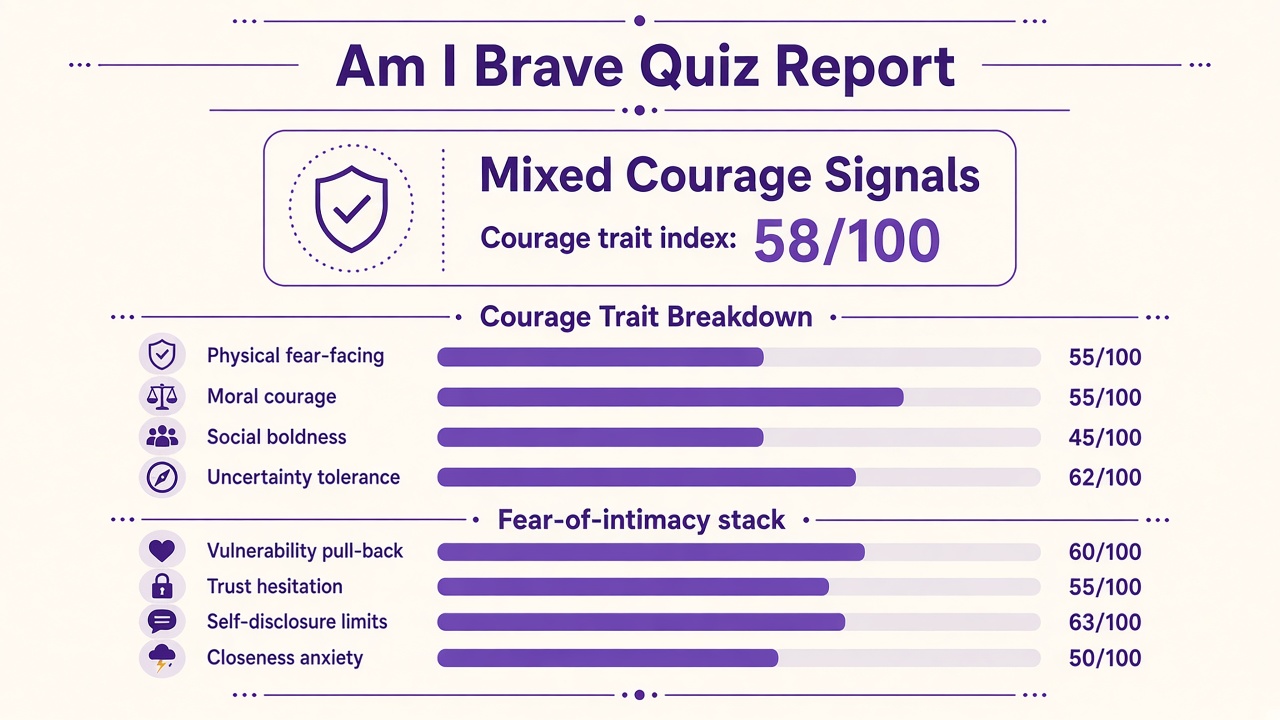
Your courage trait index is the inverted total across all 20 fear and hesitation items on a 0 to 100 scale. Higher scores mean fewer avoidance signals and more brave-action habits on this screener. Domain bars show courage levels so you can see whether physical fear-facing, moral voice, social risk, or uncertainty tolerance drives your result most. The fear-of-intimacy stack chart shows parallel layers for vulnerability pull-back, trust hesitation, self-disclosure limits, and closeness anxiety when hesitation includes guarded closeness.
| Band | Index range | Typical reading |
|---|---|---|
| Lower Courage Signals | 0 to 35 | More hesitation and fear-driven pull-back; wise caution and trauma history can still play a role |
| Mixed Courage Signals | 36 to 65 | Blend of brave action in some settings and avoidance in others; domain and stack charts show where you struggle most |
| Higher Courage Signals | 66 to 100 | Frequent values-based action despite discomfort; check stack if closeness still feels guarded |
What your brave trait report looks like
After all 20 items, you get a courage trait index from 0 to 100, a band label, four domain bars for physical fear-facing, moral courage, social boldness, and uncertainty tolerance, plus a fear-of-intimacy stack chart with vulnerability, trust, disclosure, and closeness anxiety layers.
What this quiz can and cannot tell you
Can tell you
- How often fear, hesitation, and avoidance patterns showed up in this self-report screener
- A courage trait index and four domain bars for physical, moral, social, and uncertainty courage
- A fear-of-intimacy stack showing which closeness-guarding layer feels strongest
- A starting point for therapy, coaching, or comparing with sibling tests
Cannot tell you
- Whether you are permanently timid, cowardly, or incapable of growth
- Whether hesitation is rooted in trauma, anxiety, or wise risk assessment without professional context
- Whether you would act bravely in a real emergency or combat setting
- What treatment you need without licensed professional guidance
Courage traits, fear, and guarded closeness
People search am I brave when they freeze before hard conversations, dodge scary but necessary tasks, or wonder why others seem bolder in dating, work, or family conflict. Psychologist Cynthia Pury and colleagues study courage as intentional action toward a worthy goal despite fear, not as the absence of fear. Susan Jeffers popularized the phrase feel the fear and do it anyway in self-help literature, though clinical courage often includes moral voice and social risk rather than thrill alone. The Generalized Self-Efficacy Scale from Jerusalem and Schwarzer measures confidence in handling novel tasks, which overlaps with uncertainty tolerance but does not replace domain-specific courage screeners.
The Quiz Hub built this am I brave quiz as an original self-report screener inspired by those themes plus FOIS-style intimacy avoidance layers, not a reproduction of any single published instrument. Readers often compare it to sibling tools on this site. Our am I intimidating quiz screens how others may shrink around your presence rather than your own fear and hesitation habits. The fear of intimacy quiz measures general vulnerability pull-back across closeness, not fear-facing in work or public settings. The confidence test focuses on self-presentation and self-trust habits rather than ethical voice or physical fear domains.
| The Quiz Hub test | What it adds |
|---|---|
| Am I intimidating quiz | How others read your presence and blunt speech, not your own fear-facing or moral voice habits |
| Fear of intimacy quiz | General intimacy avoidance across vulnerability and trust, not physical fear-facing or moral voice domains |
| Am I afraid of love quiz | Romantic love avoidance frequency, not everyday courage across health, ethics, and social risk |
| Am I anxious or normal quiz | Anxiety symptom frequency with clinical framing, not courage trait domains or intimacy stack chart |
| Big Five personality test | OCEAN trait percentiles including neuroticism without courage domain bars |
| This am I brave quiz | Courage trait index plus fear-of-intimacy stack for physical fear-facing, moral courage, social boldness, and uncertainty tolerance |
Sample item types include frequency ratings such as whether you delay a needed change until every detail feels guaranteed, or whether you defend someone who is being mocked when you disagree with the crowd. High fear-of-intimacy stack with low moral courage often lands in Lower or Mixed Courage Signals bands. Grounded caution after real setbacks can score in Mixed Courage Signals even when you still act bravely in familiar settings. Read how we review quizzes in our editorial policy or browse more tools on our personality psychology hub.
Am I brave quiz FAQ
What does brave mean on this quiz?
Brave here means your self-reported answers lean toward acting despite fear, speaking up for values, risking social discomfort, or moving forward without full guarantees more than toward habitual avoidance. It does not mean you never feel scared, that you are reckless, or that quiet people lack depth. This am I brave quiz maps those patterns to a courage trait index from 0 to 100 for reflection, not a heroism certificate.
What does this am I brave quiz measure?
Twenty original frequency items ask how often fear avoidance, moral hesitation, social withdrawal, or uncertainty paralysis show up in everyday life. Each item also feeds a parallel fear-of-intimacy stack with vulnerability pull-back, trust hesitation, self-disclosure limits, and closeness anxiety layers. You receive a courage trait index from 0 to 100 and a band from Lower through Higher Courage Signals.
What is the fear-of-intimacy stack on this quiz?
The fear-of-intimacy stack is a second results chart inspired by FOIS-style intimacy avoidance themes, adapted to courage trait framing. Each of the 20 items also maps to one of four stack layers: vulnerability pull-back, trust hesitation, self-disclosure limits, and closeness anxiety. The stack index summarizes how often guarded closeness rides alongside hesitation when emotional risk is involved.
How is this different from the intimidating quiz?
The am I intimidating quiz screens how others may shrink around your presence, blunt speech, and emotional reserve rather than your own fear habits. This am I brave quiz uses a self-report frame focused on whether you face scary tasks, speak ethically, risk rejection, or act without guarantees, plus the fear-of-intimacy stack chart rather than how you read to others.
Can this quiz tell me if I have an anxiety disorder?
No. The courage trait index describes self-reported pattern signals on this abbreviated screener. It cannot diagnose generalized anxiety disorder, phobias, avoidant attachment, or any clinical condition. Trauma history, burnout, and wise caution can all lower scores without meaning you are stuck forever.
Who reviewed this content?
Dr. James Whitfield, PhD, reviewed the test framing and result explanations. See our editorial policy for review standards.
Reviewed by
