What this alpha male quiz measures
This alpha male quiz estimates how often pop-culture alpha male trait patterns show up in your self-view. Twenty-four original agree-disagree items group into four domains inspired by online alpha framing and leadership psychology from researchers such as Alice Eagly on assertive men in groups: leadership presence, assertive communication, social dominance, and visible confidence. Each item also maps to a fear-of-intimacy stack layer so you can see whether vulnerability pull-back, trust hesitation, self-disclosure limits, or closeness anxiety rides alongside your alpha signals. Your alpha male trait index averages these patterns into a 0 to 100 score where higher numbers mean more alpha-coded endorsement.
Leadership presence
Stepping in to direct groups, organizing stalled plans, speaking first, and owning outcomes.
Assertive communication
Saying what you mean plainly, addressing tension directly, enforcing standards, and ending over-open interactions.
Social dominance
Tracking status in rooms, competing for visibility, steering group energy, and claiming space in hierarchy games.
Visible confidence
Entering new rooms with poise, presenting ideas clearly, staying composed under emotion, and public self-assurance.
How it works
Three steps from first question to your alpha male trait report with fear-of-intimacy stack. Click Start Quiz to open the interactive quiz in a full-screen modal.
Answer 24 agree-disagree items
Rate how much each statement fits you, from Strongly disagree to Strongly agree. You click Next after each answer; nothing auto-advances.
Items map to alpha domains and intimacy stack
Your answers accumulate percentages for leadership presence, assertive communication, social dominance, and visible confidence, plus four fear-of-intimacy stack layers.
View band, domain bars, and stack chart
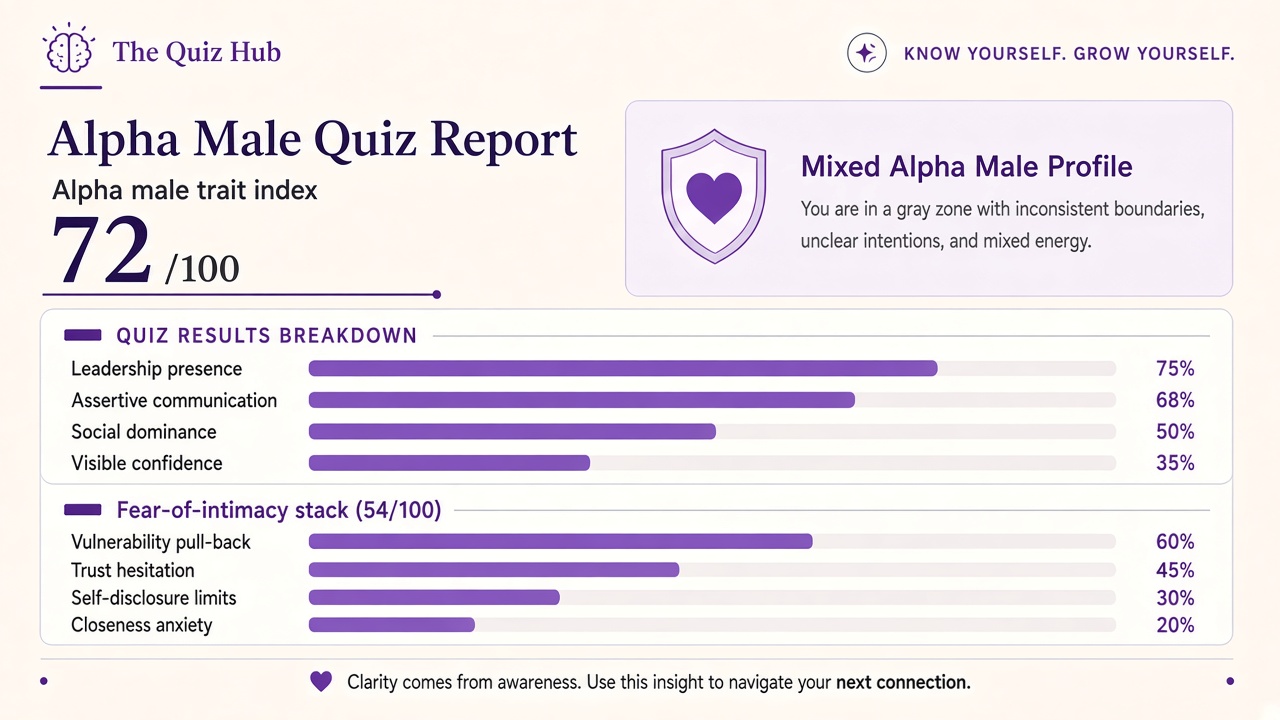
Results show Moderate Alpha Male Signals, Mixed Alpha Male Profile, or Strong Alpha Male Profile with domain bars, stack layers, and reflection prompts.
Take the alpha male quiz
Rate 24 statements about leadership, communication, dominance, and confidence. Your answers produce an alpha male trait index from 0 to 100, four domain scores, a fear-of-intimacy stack chart, and a band label for reflection.
Opens in a focused modal. No account required. Results stay on screen.
What your alpha male trait result means
Your alpha male trait index is the normalized total across all 24 items on a 0 to 100 scale. Higher scores mean more frequent endorsement of leadership presence, assertive communication, social dominance, and visible confidence items on this screener. Domain bars show endorsement rates so you can see whether taking charge, speaking plainly, tracking status, or public poise drives your result most. The fear-of-intimacy stack chart shows parallel layers for vulnerability pull-back, trust hesitation, self-disclosure limits, and closeness anxiety when alpha habits include guarded closeness.
| Band | Index range | Typical reading |
|---|---|---|
| Moderate Alpha Male Signals | 0 to 35 | Fewer alpha-coded trait signals; collaborative or situational leadership can still score here |
| Mixed Alpha Male Profile | 36 to 65 | Blend of direct habits and softer responses; domain and stack charts show where you lead versus guard |
| Strong Alpha Male Profile | 66 to 100 | Frequent leadership, communication, dominance, and confidence signals; check stack if closeness feels guarded too |
What your alpha male report looks like
After all 24 items, you get an alpha male trait index from 0 to 100, a band label, four domain bars for leadership presence, assertive communication, social dominance, and visible confidence, plus a fear-of-intimacy stack chart with vulnerability, trust, disclosure, and closeness anxiety layers.
What this quiz can and cannot tell you
Can tell you
- How often alpha-coded trait patterns showed up in this self-report screener
- An alpha male trait index and four domain bars for leadership, communication, dominance, and confidence
- A fear-of-intimacy stack showing which closeness-guarding layer feels strongest
- A starting point for coaching, therapy, or comparing with sibling tests
Cannot tell you
- Whether you are officially an alpha male type in any scientific sense
- Whether assertiveness is healthy or harmful without your own context and values
- Whether you will succeed in dating or career based on a pop-culture label
- What treatment or coaching you need without licensed professional guidance
Alpha male framing, leadership, and intimacy guarding
Alpha male entered online vocabulary as shorthand for men who lead, speak plainly, track status, and project confidence in rooms that still reward quiet compliance. Social psychologist Alice Eagly documented how assertive men are often judged differently than assertive women, which helps explain why alpha language spread as a meme even though wolf-pack biology metaphors do not map cleanly onto human personality.
The Quiz Hub built this alpha male quiz as an original self-report screener inspired by pop-culture alpha framing plus FOIS-style intimacy avoidance layers, not a reproduction of any single published instrument. Readers often compare it to sibling tools on this site. Our alpha male test scores four male-coded archetype dimensions across 40 items without an intimacy stack. The fear of intimacy quiz measures general vulnerability pull-back across closeness, not leadership presence. The beta male test screens cooperative support and hierarchy awareness rather than dominance-forward habits.
| The Quiz Hub test | What it adds |
|---|---|
| Alpha male test | 40-item male-coded archetype inventory without intimacy stack chart |
| Alpha female quiz | 22-item female-coded trait screener with parallel intimacy stack |
| Sigma personality test | Lone-wolf independence outside hierarchy, not alpha male leadership framing |
| Fear of intimacy quiz | General intimacy avoidance across vulnerability and trust, not alpha trait domains |
| Big Five personality test | Validated OCEAN trait percentiles, not pop-culture alpha labels |
| This alpha male quiz | Alpha male trait index plus fear-of-intimacy stack for leadership, communication, dominance, and confidence |
Sample item types include agree-disagree statements such as whether you track who holds status in a room before you commit, or whether you perform confidence publicly while feeling unsure privately. High leadership with high closeness anxiety on the stack often lands in Mixed or Strong Alpha Male Profile bands. Quiet competence with selective assertiveness can score in Moderate Alpha Male Signals even when others see you as capable. Read how we review quizzes in our editorial policy or browse more tools on our personality psychology hub.
Alpha male quiz FAQ
What is an alpha male in pop culture?
Online communities use alpha male to describe men who lead groups, speak directly, track status dynamics, and project visible confidence. The label comes from wolf-pack metaphors and meme culture, not peer-reviewed personality psychology. This alpha male quiz measures self-reported patterns on those themes plus a parallel fear-of-intimacy stack.
What does this alpha male quiz measure?
Twenty-four original agree-disagree items ask how much you identify with leadership presence, assertive communication, social dominance, and visible confidence habits. Scores map to four alpha trait domains plus a parallel fear-of-intimacy stack with vulnerability pull-back, trust hesitation, self-disclosure limits, and closeness anxiety layers. You receive an alpha male trait index from 0 to 100 where higher scores mean more alpha-coded signals on this screener, plus a stack index for intimacy guarding patterns.
What is the fear-of-intimacy stack on this quiz?
The fear-of-intimacy stack is a second results chart inspired by FOIS-style intimacy avoidance themes, adapted to alpha male framing. Each of the 24 items also maps to one of four stack layers: vulnerability pull-back, trust hesitation, self-disclosure limits, and closeness anxiety. The stack index summarizes how often guarded leadership, private needs, or closeness pull-back show up alongside your alpha trait signals.
How is this different from the alpha male test?
The alpha male test uses 40 agree-disagree items across four male-coded archetype dimensions without an intimacy stack chart. This alpha male quiz uses 24 items written for men who search alpha male language, adds a fear-of-intimacy stack layer, and compares leadership habits with closeness guarding in one report.
Is the alpha male archetype scientifically validated?
No. Alpha, beta, and sigma labels are pop-culture shorthand. They are not formal constructs in personality psychology like the Big Five or validated type inventories. Treat results as casual self-reflection, not proof of type or worth.
Who reviewed this content?
Dr. James Whitfield, PhD, reviewed the test framing and result explanations. See our editorial policy for review standards.
Reviewed by