
What this four introvert types quiz measures
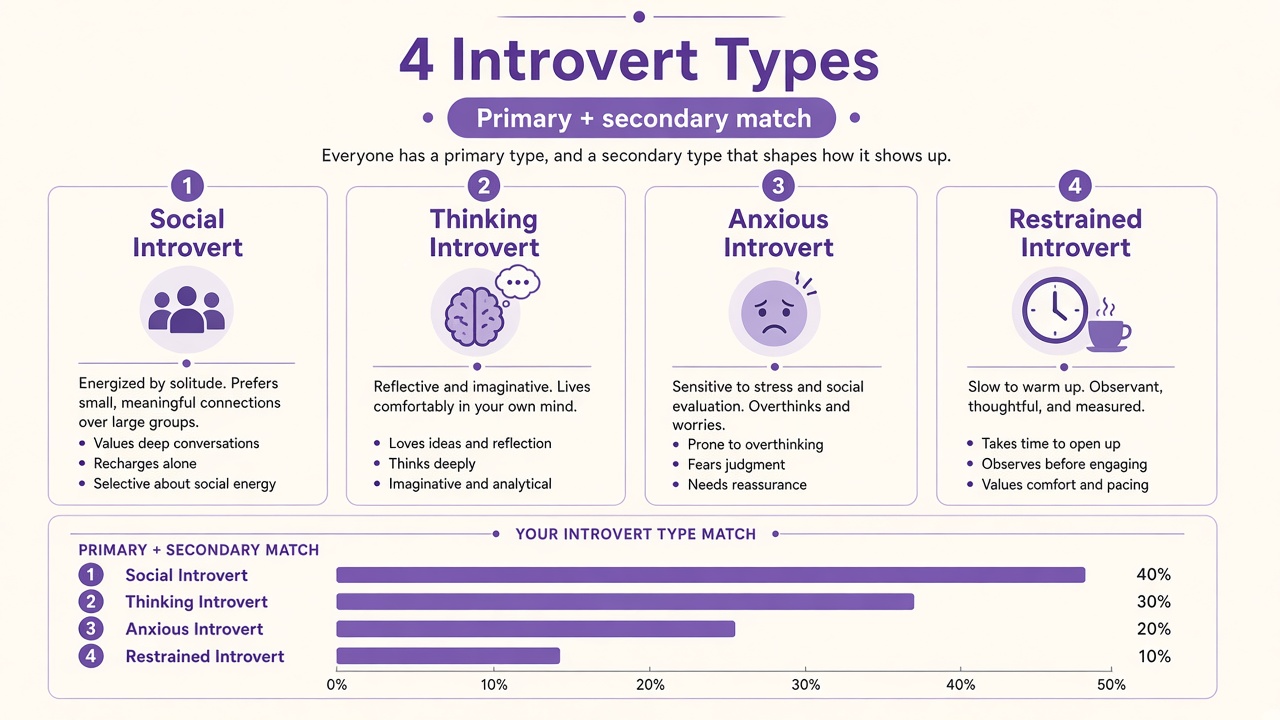
Carl Jung described introversion as inward energy flow, but modern researchers split introverted behavior into distinct motives. Jonathan Cheek and Jennifer Melchior's four-type model (2009) maps social (selective people time), thinking (reflective inner life), anxious (fear of judgment), and restrained (slow warm-up) patterns. This quiz is not their official STAR scale; it is a shortened self-report inspired by those domains for casual insight.
-
Social Introvert
You enjoy people in small doses and recharge best with intentional solitude.
-
Thinking Introvert
You live much of life inwardly: ideas, imagination, and careful reflection.
-
Anxious Introvert
Social settings can spike worry about judgment, awkwardness, or saying the wrong thing.
-
Restrained Introvert
You open up gradually and prefer a predictable pace before sharing personal details.
How scoring works
-
Rate 24 statements
Each item uses a five-point agree-disagree scale. Six statements map to each introvert type. Reverse-scored items catch social-desirability fluff.
-
We sum per type
Raw totals convert to match percentages (0 to 100). Your highest score becomes the primary type; the runner-up is your secondary influence.
-
Read blend warnings
Neutral-heavy or straight-line responding triggers quality warnings. If top two types tie within one raw point, both profiles deserve a read.
Take the 4 types of introverts quiz
Answer every item honestly. Progress autosaves in your browser and opens in a focused modal.
What your introvert type report looks like
After all 24 items, you see a primary introvert type, secondary influence, match percentage, and four horizontal bars for social, thinking, anxious, and restrained scores. Percentages reflect agreement with items in each domain, not clinical severity.
What this quiz can and cannot tell you
Can
- Highlight which introvert pattern you endorsed most on these items
- Show when two types blend closely on your answers
- Flag cautious answering that may flatten type differences
Cannot
- Replace the Cheek STAR scale or any validated clinical instrument
- Diagnose social anxiety disorder or personality disorders
- Prove you will always behave the same way in every social setting
Cheek four-type model vs MBTI, Big Five, and introvert spectrum tests
Listicles often name four introvert types without measuring them. Cheek and Melchior gave researchers a framework: social introverts budget people time, thinking introverts live inwardly, anxious introverts fear awkward evaluation, and restrained introverts warm up slowly. The model extends Jung's broad introversion label with motives that explain why two quiet people can feel completely different at a party.
If you are unsure whether you are introverted at all, start with our introvert vs extrovert test for a spectrum snapshot. For four-letter preference language, try our MBTI type test. For continuous trait scores across openness, conscientiousness, extraversion, agreeableness, and neuroticism, use our Big Five personality test. This four-type quiz sits between those tools: it assumes inward energy and asks which introvert flavor fits your habits today.
Sample items include social preference ("I prefer a long talk with one friend over mingling at a large party"), thinking reflection ("I need quiet time to connect the dots before I know what I really think"), anxious caution ("I worry I will say something awkward when someone new talks to me"), and restrained pacing ("I need several meetings with someone before I share personal stories"). Your highest domain becomes the headline result; read the secondary profile when scores sit close.
| Quiz | Best for |
|---|---|
| This four introvert types quiz | Social vs thinking vs anxious vs restrained patterns |
| Introvert-extrovert test | Single spectrum placement before subtype detail |
| MBTI test | Four dichotomies and sixteen type profiles |
| Big Five test | Continuous OCEAN trait percentiles |
For the original research framing, see Cheek and Melchior's work on four meanings of introversion (2009) via Psychology Today Introvert's Corner and peer summaries of the STAR model. Treat any online quiz as a conversation starter, not a permanent label.
4 types of introverts quiz FAQ
What are the four types of introverts?
Psychologist Jonathan Cheek and researcher Jennifer Melchior proposed four introversion patterns: social (selective social energy), thinking (rich inner reflection), anxious (self-conscious caution), and restrained (slow warm-up). This quiz scores all four with six items each.
How is this different from an introvert vs extrovert test?
Our introvert-extrovert test measures where you fall on a single spectrum. This four-type quiz assumes you already lean introverted and asks which flavor fits best: solitude preference, inner fantasy, social worry, or reserved pacing.
Can I be more than one introvert type?
Yes. Most people blend two patterns. Your result shows a primary type, secondary influence, and percentage bars for all four. Close scores trigger a blend warning on the results screen.
Does a high anxious introvert score mean I have social anxiety disorder?
No. This quiz flags self-conscious social caution, not a clinical diagnosis. If worry interferes with daily life, talk with a licensed mental health professional. See our anxiety test for broader symptom screening.
How long does the four introvert types quiz take?
Most people finish in about 5 minutes. There are 24 five-point agree-disagree statements. You must answer every item before results appear.
Who reviewed this four introvert types quiz?
Dr. James Whitfield, PhD in Personality Psychology, reviewed framing and disclaimers. See our editorial policy for review standards.
Reviewed by
