How to Be a Better Boyfriend: Consistency, Listening, and Repair
Last updated:
Educational only: This article offers relationship skills, not therapy or legal advice. If you fear harm or control, call the National Domestic Violence Hotline at 1-800-799-7233, call or text 988 (U.S.), or use local emergency services. See our disclaimer.
Being a better boyfriend means showing up with consistent respect, not performance romance. Partners usually want reliability more than surprise trips: you listen when it is inconvenient, you keep small promises, and you repair when you miss. John Gottman's work on bids for connection shows that relationships strengthen when everyday gestures get a turning-toward response (Gottman Institute, 2023). Attachment habits also shape how you handle closeness and space; naming those patterns helps you grow without treating love like a scorecard to manipulate someone into staying.
Tips at a glance
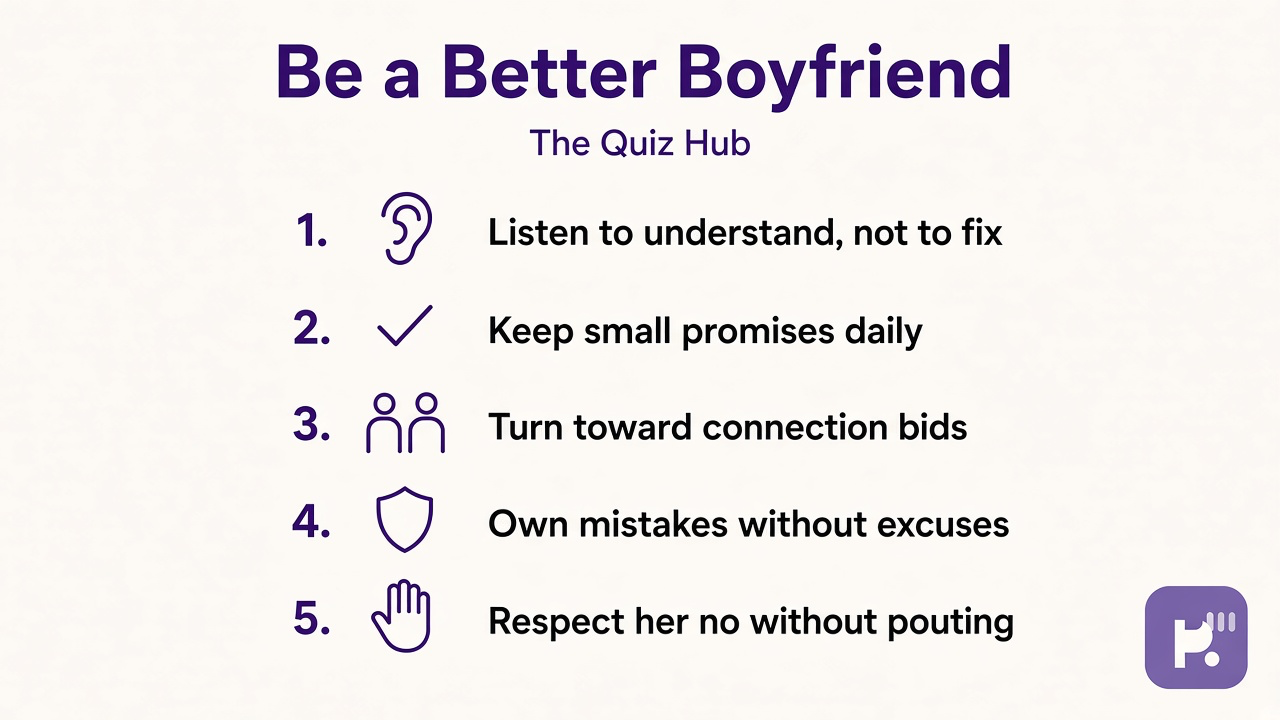
Key takeaways
- Trust grows from daily follow-through more than occasional grand gestures.
- Ask whether your partner wants empathy or solutions before you advise.
- Turn toward small bids for attention; ignoring them erodes closeness over time.
- Repair with specific accountability, not global "I am a terrible person" speeches.
- Attachment and communication quizzes support reflection; they do not grade your worth.
- Contempt, control, or fear mean safety planning, not more charm.
Core boyfriend skills table
Use this table as a practice menu, not a guilt machine. Pick one row for two weeks before you add another.
| Skill | What it looks like | Practice this week |
|---|---|---|
| Active listening | Phone down, reflect her words, ask one curious question | After she shares stress, say "I hear that you feel..." before any advice |
| Reliable follow-through | Texts when late, completes tasks you agreed to own | Pick one recurring promise (pickup, bill, chore) and track it on a calendar |
| Bid responsiveness | You notice small reach-outs: a meme, a sigh, a touch | Respond warmly to three small bids per day before scrolling |
| Repair after conflict | You return within 24 hours with ownership, not defensiveness | Script: impact + change + check-in ("Did that land okay?") |
| Respectful boundaries | You accept no without punishment or silent treatment | When she declines sex or plans, thank her for clarity and suggest another time |
| Shared planning | You initiate dates, chores, or hard talks instead of waiting to be managed | Own one invisible task she usually tracks (appointment, gift, family text) |
| Emotional honesty | You name your limits before you snap or vanish | Say "I need twenty minutes to cool down, then I want to talk" instead of ghosting |
Listen first, fix second
Many boyfriends were praised for being "the logical one" in childhood. That praise becomes a trap when your partner wants companionship, not a project manager. Before you offer steps, ask: "Do you want help solving this or do you want me to listen?" If you skip that question, she may hear criticism even when you mean care.
Reflect content and feeling: "You are exhausted from the commute and your boss ignored your idea." That single sentence often lowers tension more than five fixes. When you do give advice, tie it to her goal, not your preference. Read our gender differences in communication piece for research on why context and power shape talk more than stereotypes do.
Take the free communication styles in relationships quiz to notice whether you default to advising, avoiding, or escalating. Scores are conversation starters for couples, not proof that one style is superior.
Consistency beats surprise romance
Surprise dinners feel great when the baseline is kind. They feel hollow when you disappear between holidays. Consistency includes mundane reliability: you show up on time, you remember allergies, you do not joke about her body in front of friends. Those acts signal safety, which is the soil where desire and playfulness grow.
If you struggle with follow-through, shrink commitments. Promise less and deliver more. A weekly walk you never cancel beats a monthly expensive gift you resent buying. Pair reliability with curiosity about how she experiences you: "What is one small thing I could do this week that would feel caring?" Then do that thing without asking for applause.
Our emotional connection in relationships guide explains how shared rituals and responsive listening build closeness over months, not in one weekend getaway.
Turn toward bids for connection
A bid is any attempt to connect: she shows you a video, sighs after a hard day, or asks "Did you see that text from my sister?" Turning toward means you engage with warmth. Turning away means you grunt and keep scrolling. Turning against means you mock the bid. Gottman's team links habitual turning away with later dissatisfaction because partners learn that reaching out is not worth the risk.
You do not need perfect enthusiasm. You need minimum viable warmth: eye contact, a question, or "I am busy for ten minutes, then I want to hear this." That honesty beats fake attention. Practice with low-stakes bids before you tackle big conflicts.
Screen your bid habits with the four horsemen relationship quiz, which frames criticism, contempt, defensiveness, and stonewalling as patterns you can reduce with practice.
Repair without ego games
You will mess up. Better boyfriends return to the conversation with specifics: what you did, how it likely felt, what you will do differently, and how she can tell you early if it happens again. Avoid bargaining ("Well you also...") in the first repair pass. You can discuss mutual patterns later on a calmer day.
If fights repeat on the same theme, read compromise in relationships for trade structures that prevent secret resentment ledgers. When mockery enters the room, see contempt in relationships for warning signs that skill tips alone cannot fix.
Stonewalling and long silent treatments are not masculine mystery; they are shutdown. Our emotional withdrawal article lists causes and reconnection steps when you freeze under stress.
Attachment awareness without labels as weapons
Anxious patterns may show up as reassurance seeking or fast texting when she is quiet. Avoidant patterns may show up as joking away serious talks or needing long alone time after intimacy. Fearful-avoidant patterns can swing between chase and retreat. None of these labels excuse yelling, monitoring her location, or punishing boundaries.
The attachment style test on The Quiz Hub summarizes self-reported closeness and distance habits inspired by experiential research. Bring results to therapy or a honest couple talk; do not use a score to say "you are too needy" or "I cannot change."
Browse the Relationships and Dating test hub for additional screeners on intimacy fears and communication when you want more than one lens.
Respect autonomy and enthusiastic consent
Being a better boyfriend includes celebrating her friendships, career, and solo time without passive jealousy. Ask about physical intimacy with open questions and accept no without sulking. Coercion dressed as persistence is not romance. If you feel entitled to her body or schedule, individual therapy can unpack that entitlement before you damage trust further.
Fair partnerships also split mental load. If she plans every social event and you "just show up," gratitude is not enough. Own whole domains for a month, including the planning brain time, not only the fun parts.
Related reflection tools
- Attachment style test: closeness, distance, and reassurance habits for reflection.
- Communication styles in relationships quiz: advising, avoiding, and validating tendencies.
- Four horsemen relationship quiz: criticism, contempt, defensiveness, and stonewalling patterns.
- Relationships and Dating hub for boundary and intimacy screeners.
- Editorial policy: how we review relationship content.
When professional help makes sense
Consider couples therapy when the same fight loops for months, when criticism turns to contempt, or when trust events (lies, hidden spending, broken agreements about substances) need structured repair. Individual therapy helps when shame, trauma, or anger outbursts block the skills you read about here.
Call or text 988 (U.S.) if you are in crisis. Contact the National Domestic Violence Hotline at 1-800-799-7233 or thehotline.org when fear or control dominates.
Frequently asked questions
What makes a good boyfriend in everyday life?
A good boyfriend is reliable in small moments: he remembers what he promised, listens without turning every talk into a debate, and repairs after he hurts someone. Grand gestures matter less than patterns. Partners in longitudinal research (Gottman Institute, 2023) report that trust grows when bids for connection get a warm response most of the time, not when romance spikes once a year.
How can I be more emotionally present without fixing everything?
Ask what she wants first: "Do you want advice or just company?" Mirror back what you heard before you suggest solutions. Fixing is useful only when invited. If you default to lectures when she shares stress, she may stop opening up. Our communication styles in relationships quiz highlights habits like advising versus validating so you can practice one skill at a time.
How do I apologize well as a boyfriend?
Name the impact, not your intent: "I made you wait an hour without texting and that felt disrespectful." Offer a specific change and follow through. Avoid "I am sorry you feel that way" or immediate excuses. If the same injury repeats, a conversation about boundaries or couples therapy is healthier than another bouquet.
Does being a better boyfriend mean changing my personality?
Skills are not personality erasure. Introverted boyfriends can be excellent partners with planned quality time and clear words of care. Anxious boyfriends can learn to self-soothe before they flood a text thread. Attachment style patterns (Mikulincer and Shaver, 2016) explain why you chase or pull away; they do not excuse disrespect or control.
How much romance is enough?
Enough romance is the amount you both agree on after an honest talk, not what influencers perform online. Some couples value weekly dates; others prefer daily check-ins and shared projects. Mismatch is normal. Negotiate like adults: trade frequency, budget, and public versus private affection instead of keeping score in silence.
When is trying harder not the answer?
Stop over-functioning when a partner mocks your efforts, refuses all repair, or uses guilt to control you. Abuse, chronic contempt, or addiction that blocks safety need professional and sometimes legal help, not more date nights. Call or text 988 (U.S.) if you are in crisis. Contact the National Domestic Violence Hotline at 1-800-799-7233 when fear or control dominates.
Sources
- Gottman Institute. (2023). Turn toward instead of away.
- Mikulincer, M., and Shaver, P. R. (2016). Attachment in Adulthood: Structure, Dynamics, and Change. Guilford Press.
- American Psychological Association. (2020). Marriage and relationships.
- Reis, H. T., and Shaver, P. (1988). Intimacy as an interpersonal process. In S. Duck (Ed.), Handbook of personal relationships.