Autism Signs in Adults: Support Without the Functioning Label
Last updated:
Educational only: This article discusses autism spectrum traits and support options. It is not medical advice, a diagnostic tool, or emergency care. If you or your child talk about suicide, are injured, or are in immediate danger, call or text 988 (U.S.), contact Samaritans at 116 123 (UK), or use local emergency services.
"High-functioning autism" is outdated, nonclinical language that often praises outward achievement while ignoring sensory pain, social effort, and mental health needs. Autism spectrum disorder (ASD) in DSM-5-TR describes persistent differences in social communication and restricted, repetitive patterns that begin early and shape daily life. Support needs vary by person and season of life, not by a single functioning rank. If you search this phrase, you are usually looking for signs that fit you or your child and for practical next steps toward assessment, accommodations, and skilled support.
Tips at a glance
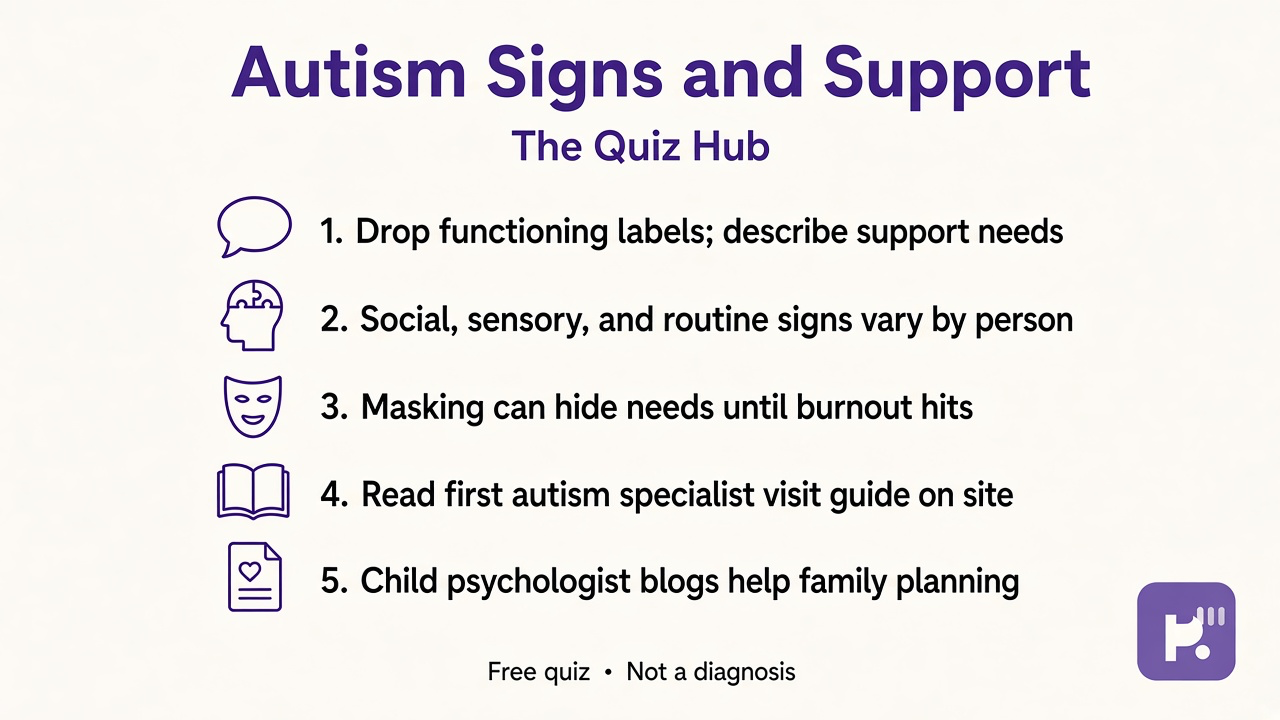
Key takeaways
- Functioning labels often erase invisible support needs and delay services.
- Core sign clusters include social communication, sensory processing, routines, and focused interests.
- Masking can look like success at school or work while burnout builds privately.
- Formal diagnosis requires licensed evaluation; online screeners only start conversations.
- Adults and children benefit from tailored accommodations, therapy, and coordinated care.
- Child and adult specialists describe support levels without shaming families.
Why "high-functioning" misleads
The term "high-functioning autism" grew from early research samples and casual shorthand. It suggests that speech, grades, or employment prove someone needs little help. In clinic, that story breaks quickly. An adult who leads meetings may still need scripts for small talk, noise-canceling gear, and days alone to recover. A child who reads early may melt down when socks feel wrong or when playground rules shift without warning.
Autistic self-advocates and clinicians increasingly prefer language about support needs, access barriers, and strengths. DSM-5-TR allows specifiers about required support in social communication and restricted behaviors when clinically useful. The goal is planning, not ranking people as more or less "autistic enough." When media glorifies functioning labels, it can delay therapy, benefits, or school services because families hear, "They are fine."
Sign clusters to discuss with a clinician
No single sign proves autism. Clinicians look for a pattern across settings, with onset in early development, though signs may become obvious only when demands rise. Use the table below as a conversation map, not a self-diagnosis checklist. Many traits overlap with ADHD, anxiety, language disorders, or trauma responses.
| Domain | Examples in daily life | Why it matters for support |
|---|---|---|
| Social communication | Missing conversational turn-taking, blunt honesty read as rude, difficulty reading indirect hints, preferring parallel play or structured topics | Explains friendship strain; guides social skills coaching without forcing fake personas |
| Nonverbal communication | Inconsistent eye contact, muted facial expression, unusual gesture timing, discomfort with posed photos | Teachers and employers can adjust expectations and feedback style |
| Relationships | Few close peers, interest in friendship but confusion about maintenance, attraction to clear rules in games | Supports social groups matched by interest, not only age |
| Restricted interests | Deep, enduring topics with extensive fact memory; distress when interest is mocked or interrupted | Can channel strengths into careers; needs respectful boundaries at home |
| Routines and change | Strong need for sameness, detailed scripts for transitions, meltdowns after schedule shifts | Visual schedules, advance warnings, and gradual exposure reduce crisis cycles |
| Sensory processing | Covering ears, avoiding certain foods or fabrics, seeking pressure or motion, overload in supermarkets | Occupational therapy, quiet spaces, and clothing choices become medical necessities, not quirks |
| Motor and coordination | Clumsiness, unusual gait, handwriting fatigue, difficulty with fine motor crafts | Physical therapy and keyboard accommodations prevent shame in classroom tasks |
| Emotional regulation | Long recovery after overload, shutdown (going quiet) or meltdown (visible distress) when capacity is spent | Family needs crisis plans that respect nervous system limits, not only behavior charts |
Girls and women are diagnosed later more often because interests may match peer hobbies and because social mimicry hides differences until adolescence or burnout. Nonbinary and transgender people also report higher autism identification rates; gender-affirming care and autism supports should work together, not compete.
Masking, burnout, and late recognition
Masking means consciously or unconsciously copying neurotypical social rules: rehearsing jokes, forcing eye contact, hiding stims, or staying silent to avoid ridicule. Masking can earn praise at work while depleting energy. Autistic burnout looks like lost skills, increased sensory sensitivity, depression, or inability to handle formerly manageable tasks. It often follows years of unsupported masking or major life changes such as college, parenthood, or bereavement.
Late-diagnosed adults describe relief mixed with grief for years without accommodations. A formal label is optional for some self-advocates yet essential for disability accommodations, certain therapies, or legal protections in some regions. Whether or not you pursue diagnosis, naming burnout as real helps families stop blaming willpower.
Children: when signs prompt evaluation
Pediatricians often screen toddlers with tools such as the M-CHAT-R. Red flags for referral include delayed back-and-forth babbling, limited gesture use, repetitive lining up of toys, intense distress at small changes, and regression of language or social skills. School staff may notice pragmatic language gaps, isolation at recess, or need for constant adult mediation.
A child psychologist visit can clarify whether autism, ADHD, anxiety, or learning differences best explain the pattern. Our child psychologist role guide describes how testing, play therapy, and parent coaching differ. For the evaluation day itself, read first visit with an autism specialist for documents to bring, timeline questions, and realistic pacing across multiple appointments.
Support that matches needs, not labels
Support plans should list what helps, not what impresses strangers. Common elements include sensory accommodations (lighting, noise, clothing), communication supports (extra processing time, written instructions, AAC devices), predictable schedules, and breaks after social demand. Cognitive behavioral therapy adapted for autism, occupational therapy for sensory and daily living skills, and speech-language therapy for social communication and language goals are frequent referrals.
Schools in the U.S. may offer IEP or 504 plans; other countries use different frameworks. Workplace accommodations can include remote days, agenda previews, and quiet rooms. Adults benefit from autistic-led communities where stimming and direct speech are normal. Partners and parents learn most when they ask, "What would make this easier?" instead of, "Why can't you just cope?"
Co-occurring conditions
Autism often travels with ADHD, anxiety, depression, epilepsy, or gastrointestinal issues. Treating only one condition can leave the person stuck. Clinicians screen broadly while respecting autistic communication styles. Medication decisions weigh sensory side effects and monitoring needs. Therapy should not aim to eliminate autistic traits; ethical goals target distress, safety, and skill building the person chooses.
When professional help makes sense
Seek evaluation when traits limit education, employment, self-care, or relationships and have persisted despite general support. Crisis care comes first if there is self-harm, elopement risk, or severe aggression. For children, early intensive behavioral and developmental services (often called ABA or naturalistic developmental models depending on region) remain debated; families should ask about goals, assent, and data before enrolling. Any approach that punishes stimming or forces eye contact deserves scrutiny.
Adults can request neuropsychological or psychological testing through primary care referrals or self-pay clinics. Waiting lists are long in many areas; document accommodations requests with employer or disability offices even while you wait if laws in your region allow interim supports.
Related quizzes on The Quiz Hub
Clinical screeners on our site estimate symptom themes for self-reflection. They do not diagnose autism spectrum disorder or predict service eligibility.
- Autism test: non-diagnostic reflection on social, sensory, and routine patterns common in screening conversations. Use results to prepare questions for intake, not as a final answer.
- Autism Spectrum Quotient (AQ-10): abbreviated research-inspired items often discussed in primary care. Elevated scores warrant clinical follow-up, not self-labeling from a web form.
- Browse the mental health and clinical test hub for additional screeners with stated limits, including mood and attention tools when overlap is a concern.
Frequently asked questions
Is "high-functioning autism" still an official diagnosis?
No. DSM-5-TR uses autism spectrum disorder with specifiers about support needs, not "high" or "low" functioning labels. "High-functioning autism" survives in casual speech but often hides real struggles with sensory overload, burnout, and mental health. Clinicians focus on strengths, barriers, and services rather than ranking a person.
What are common autism signs in adults?
Adults may report lifelong social timing gaps, intense special interests, sensory sensitivities, need for predictable routines, and exhaustion after masking at work or school. Some were missed as children, especially girls and gender-diverse people whose interests looked "typical." Signs overlap with ADHD, anxiety, and trauma; only evaluation can sort patterns.
Can someone be autistic and still hold a job or degree?
Yes. Achievement does not cancel autism. Many autistic adults excel in structured roles yet crash at home, avoid friendships, or need long recovery after social days. Support needs can be invisible until stress, illness, or life transitions remove coping strategies. Labels should describe access needs, not worth.
How is autism different from social anxiety?
Social anxiety centers on fear of judgment and often improves when safety rises. Autism involves developmental differences in communication, sensory processing, and interest patterns that persist across contexts. People can have both. Clinicians use history from childhood, observation, and standardized tools rather than a single checklist score.
Should I use an online autism quiz before seeing a specialist?
Screeners such as the AQ-10 can highlight traits to discuss with a clinician. They cannot observe you in daily life, interview family, or apply full diagnostic criteria. Use results to prepare questions, not to accept or reject a label. Our autism test on the clinical hub states the same limits.
When should a child see a psychologist about possible autism?
Consider evaluation when social communication gaps, repetitive play, intense interests, or sensory meltdowns affect learning, friendships, or family life for months. Early support helps even when diagnosis takes time. A child psychologist can coordinate with pediatricians and schools; see our child psychologist articles for timing and what therapy can address.
Sources
- American Psychiatric Association. (2022). Diagnostic and statistical manual of mental disorders (5th ed., text rev.). Autism spectrum disorder criteria and specifiers.
- Centers for Disease Control and Prevention. (2024). Data and research on autism spectrum disorder.
- Baron-Cohen, S., et al. (2001). The Autism-Spectrum Quotient (AQ): Evidence from Asperger syndrome/high-functioning autism, males and females, scientists and mathematicians. Journal of Autism and Developmental Disorders, 31(1), 5-17.
- Hull, L., et al. (2017). Putting on my best normal: Social camouflaging in adults with autism spectrum conditions. Journal of Autism and Developmental Disorders, 47(8), 2519-2534.
- Autistic Self Advocacy Network. (2023). Autistic-led advocacy resources.