First Visit to an Autism Specialist: What Parents Should Expect
Last updated:
Educational only: This article describes what many families experience at an initial autism evaluation. It is not medical advice, a diagnostic tool, or emergency care. If your child talks about suicide, is injured, or is in immediate danger, call or text 988 (U.S.), contact Samaritans at 116 123 (UK), or use local emergency services.
At a first visit with an autism specialist, expect a structured review of development, daily functioning, and family history, not a single blood test or five-minute checklist. The clinician will ask when skills appeared, how your child communicates and plays, what overwhelms them, and how school or daycare sees their behavior. You may leave with a plan for more testing, referrals, or follow-up visits rather than a final label the same day. Bringing organized notes and questions turns anxiety into partnership.
Tips at a glance
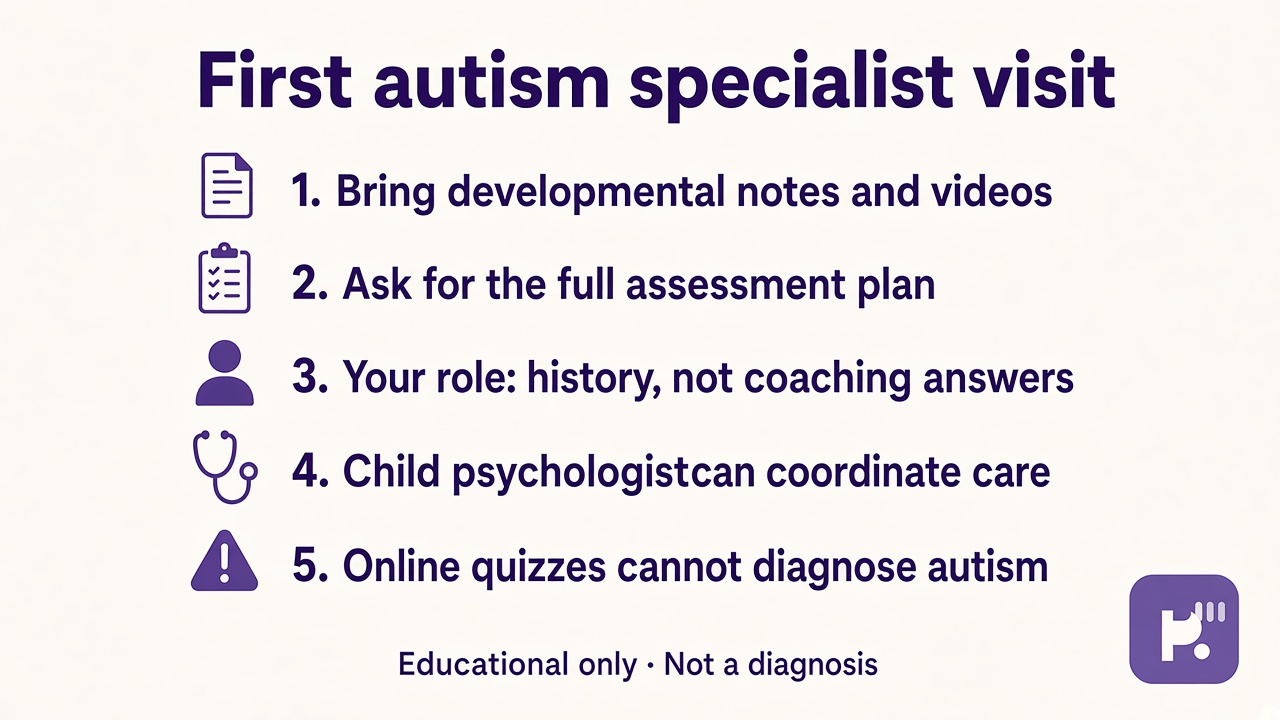
Key takeaways
- Diagnosis is a clinical process that combines history, observation, and often standardized tools.
- Prep a timeline, school feedback, and short home videos before intake.
- Specialists assess communication, social reciprocity, restricted interests, and sensory patterns in context.
- Online quizzes can flag topics for discussion; they cannot replace a licensed evaluation.
- Pediatricians, child psychologists, and school teams often share records to avoid duplicate testing.
- Ask for a written summary of next steps, including who contacts whom.
Why families book an autism specialist
Parents usually call after a pattern stacks up: late talking, limited eye contact, repetitive play, intense interests, trouble reading peers, or meltdowns when routines change. Teachers may flag pragmatic language gaps or difficulty joining group work. Sometimes a pediatrician screens with the M-CHAT-R or similar tool and recommends a full evaluation. Sometimes families pursue assessment after ADHD or anxiety treatment helps only part of the picture.
Autism spectrum disorder (ASD) in DSM-5-TR describes persistent differences in social communication and restricted, repetitive patterns that show up early and affect daily life. Severity varies widely. Two children with the same diagnosis may need different supports. The first visit clarifies whether ASD best explains the pattern or whether another condition (language disorder, intellectual disability, selective mutism, trauma response) fits better.
If you are unsure whether emotions or behavior need any specialist at all, read when to seek a child psychologist for duration and red-flag guidance that applies before or alongside autism assessment.
Parent prep checklist before the first visit
Clinics lose time when records are scattered. A one-page prep sheet helps you stay calm and gives the specialist a map. Use the table below as a packing list; adapt rows for teens or adults seeking late diagnosis.
| Item | Why it matters | Practical tip |
|---|---|---|
| Development timeline | Clinicians compare early milestones to current skills | Note ages for first words, phrases, pointing, pretend play, toilet training, and loss of skills if any |
| School or daycare notes | Behavior in groups differs from behavior at home | Forward recent report cards, IEP drafts, and teacher emails with dates |
| Prior evaluations | Avoid repeating the same tests without reason | Bring speech, OT, hearing, EEG, or genetics reports even if old |
| Short home videos | Observation windows are limited | 30 to 60 seconds of play, mealtime, or transition; label date and setting |
| Medical list | Sleep, seizures, and medications affect behavior | Include supplements, allergies, and sleep hours on school nights |
| Your top three questions | Prevents leaving with vague reassurance | Example: "What supports at school are reasonable while we wait for testing?" |
| Insurance and consent forms | Reduces checkout delays | Confirm whether both parents must sign for split custody |
| Comfort kit for the child | Sensory overload skews observation | Headphones, snack, fidget, or tablet with calm app if allowed |
Write honestly about strengths too: memory for facts, kindness to pets, visual art, or loyalty to friends. Specialists need a full portrait, not only struggle lists. If your child is a teen who refuses the word "autism," you can still describe behaviors without debating labels in the waiting room. For conflict-heavy households, our guide on dealing with a difficult teenager offers scripts that keep safety and respect central while you pursue evaluation.
What the autism specialist assesses
Training backgrounds vary. You may see a developmental pediatrician, child psychologist, neuropsychologist, or a team with speech-language pathology. Despite different titles, core domains overlap with diagnostic criteria and functional impact.
Social communication and interaction
Clinicians listen for how your child initiates conversation, shares enjoyment, and repairs misunderstandings. They note gesture use, facial expression, and whether speech is scripted or flexible. For minimally speaking children, they ask how your child requests help, protests, and joins play. Augmentative communication devices are strengths, not deficits.
Restricted and repetitive patterns
Specialists explore routines, sensory seeking or avoidance, intense interests, and repetitive motor habits. The goal is to see whether patterns limit learning, sleep, or family life. A child who memorizes dinosaur facts may be typical; a child who cannot shift topics during class may need accommodation even with strong grades.
Cognitive and adaptive functioning
Some evaluations include IQ or adaptive behavior scales to plan school placement and therapy hours. Scores describe support needs; they do not define worth. Co-occurring ADHD, anxiety, or learning disorders are common. A child psychologist may run emotion and behavior screens in the same clinic or refer you for therapy after results. Our overview of what a child psychologist does and how they help explains how therapy differs from a one-time diagnostic battery.
Medical and contextual factors
Hearing loss, sleep apnea, iron deficiency, and seizure disorders can mimic or worsen social difficulties. Expect questions about pregnancy, birth, early intervention, and family history. Pediatricians often complete medical clearance before or during the psychology leg.
Standardized tools you may hear named
Common instruments include the Autism Diagnostic Observation Schedule, Second Edition (ADOS-2), and parent interviews such as the Autism Diagnostic Interview-Revised (ADI-R). Not every clinic uses both. School teams may use different educational eligibility tools; clinical diagnosis and school classification are related but not identical. Ask how findings will be shared with your district if you consent.
What the first appointment may look like
A typical flow starts with registration and questionnaires, then a parent interview while a clinician observes the child with toys or tasks. Older children may complete puzzles, conversation samples, or self-report forms. Breaks matter. Fatigue and hunger look like "noncompliance."
You should receive clarity on timelines: when scores are scored, who writes the report, and whether a feedback meeting is separate. If the clinic recommends additional sessions, ask what happens if insurance authorizes only one visit. Document names and dates for your own file.
School psychologists sometimes contribute classroom observations or rating scales. District practices vary widely; tools are evolving. For context on how schools use data responsibly, see AI for school psychologists, which discusses documentation, privacy, and human judgment alongside new software. AI does not replace your child's evaluator, but it explains why schools may ask for digital forms or trend graphs.
Limits of online autism quizzes
Parent checklists and trait quizzes on the internet can help you phrase concerns for intake. They cannot watch your child at recess, interview a teacher, or distinguish autism from language delay, intellectual disability, or chronic stress. Algorithms miss context: a child who avoids eye contact in fluorescent lights may track faces at home. A teen who masks at school may collapse afterward; questionnaires filled out only by parents can undercount that cost.
Treat elevated scores as a reason to book evaluation, not as proof of autism. Treat low scores as inconclusive if real-life impairment remains. No online result should delay safety planning when self-harm, aggression, or elopement is present. In those cases, call 988 for crisis counseling in the U.S. and seek urgent local care when risk is immediate.
Ethical clinicians welcome notes from screeners you tried at home. They will explain which parts overlap with their tools and which require in-person observation. That transparency is part of informed consent.
After the visit: coordination and advocacy
Request a written summary you can share with pediatricians, therapists, and school teams. Ask which CPT or billing codes were used if prior authorization blocked services. If therapy is recommended, clarify frequency, parent coaching components, and measurable goals. Early intervention systems (for young children) and special education (for school-age children) have separate timelines; missing a deadline can delay services by months.
Disagreement between providers happens. Second opinions are appropriate when reports conflict or when interventions fail despite good-faith effort. Bring new data rather than only frustration. Updated teacher forms and therapy notes strengthen the next review.
Siblings and parents need support too. Respite, parent training groups, and individual therapy for caregivers reduce burnout. Autism is a family systems issue even when only one child carries the diagnosis on paper.
When to seek urgent help
Evaluation waitlists are not excuses to ignore safety. Contact crisis services if your child talks about not wanting to live, has a suicide plan, runs into traffic, or cannot be soothed during self-injury. The 988 Suicide and Crisis Lifeline (U.S.) connects you to counselors who can help with mobile crisis teams in many counties. Medical emergencies belong in emergency departments.
Aggression that injures others, especially with access to weapons, needs a safety plan the same week. Autism does not remove accountability, but it does require accommodations and skilled intervention. Psychology and psychiatry can partner when mood or impulse control crises overlap with developmental differences.
Related quizzes on The Quiz Hub
Screeners organize questions before clinical intake. They do not diagnose autism or set medical urgency.
- Child development quiz: compares skills and behaviors to broad age expectations. Useful when you wonder whether delay explains social friction. Not a substitute for ADOS-2 or a licensed developmental evaluation.
- Browse Mental Health & Clinical for additional screeners with stated limits, including mood and anxiety tools that often co-occur with autism referrals.
Frequently asked questions
What should I bring to a first autism specialist visit?
Bring a short timeline of milestones (first words, walking, toilet training), current concerns with dates, report cards or teacher emails, prior evaluations, medication list, and short phone videos of typical behavior at home (not only meltdowns). Write three questions you want answered before you leave. If your child uses AAC or has sensory triggers, note what helps and what backfires.
How long does an autism evaluation take?
Many clinics schedule one to three visits over several weeks. A single intake cannot always finish standardized testing, parent interviews, and school records review. Some centers add speech-language or occupational therapy screens. Ask at booking how many hours your child will spend in the room and whether breaks are built in for fatigue or sensory overload.
Can my pediatrician diagnose autism instead of a specialist?
Some pediatricians diagnose autism in young children when presentation is clear and they use validated tools. Complex cases, teens, girls with subtle social patterns, or co-occurring conditions often need a developmental pediatrician, psychologist, or multidisciplinary team. Your pediatrician can still coordinate referrals, rule out hearing or sleep problems, and order labs when medical causes are suspected.
Should my child attend the whole appointment?
Clinics differ. Expect a parent-only segment for sensitive history and a child segment for observation and play-based tasks. Older teens may meet alone for part of the session. Tell the office if separation is hard; gradual entry beats forcing eye contact in the waiting room. Siblings are usually better left with another caregiver so you can focus.
Will the specialist tell us autism is "mild" or "severe" on day one?
Ethical clinicians describe support needs, strengths, and recommended services rather than ranking your child for shock value. DSM-5-TR uses specifiers such as level of support when appropriate, but labels should serve planning, not shame. If language feels vague, ask what accommodations at school or home would help next month, not only long-term prognosis.
Can an online quiz diagnose autism?
No. Screeners and parent checklists can highlight traits worth discussing with a clinician. They cannot observe your child in context, interview teachers, or apply full diagnostic criteria. Use quiz results to prepare questions for intake, not to accept or reject a label without a licensed evaluation.
Sources
- American Psychiatric Association. (2022). Diagnostic and Statistical Manual of Mental Disorders (5th ed., text rev.). Autism spectrum disorder criteria.
- Centers for Disease Control and Prevention. (2024). Autism spectrum disorder: data and resources.
- Lord, C., et al. (2012). Autism Diagnostic Observation Schedule, Second Edition (ADOS-2) manual. Western Psychological Services.
- American Academy of Pediatrics. (2020). Autism patient care guidance for pediatricians.
- Substance Abuse and Mental Health Services Administration. (2022). 988 Suicide & Crisis Lifeline.
- National Institute of Mental Health. (2023). Autism spectrum disorder overview.