Gestalt Therapy: What a Gestalt Psychologist Does
Last updated:
Educational only: This article explains gestalt therapy and what gestalt-oriented psychologists do in session. It is not medical advice, a diagnosis, or a substitute for care from a licensed mental health professional. If you are in crisis, call or text 988 (U.S.) or contact your local emergency services.
A gestalt psychologist (or gestalt-trained therapist) practices gestalt therapy, a humanistic and experiential form of psychotherapy that emphasizes awareness, contact, and personal responsibility in the present moment. Instead of treating you as a set of symptoms to fix from a distance, the clinician helps you notice how you think, feel, and relate right now, including patterns you may avoid or interrupt. Gestalt work can support grief, identity questions, relationship conflict, and shame, though severe OCD, active addiction, or untreated psychosis often need additional structured or medical care first.
Key takeaways
- Gestalt therapy focuses on here-and-now awareness, contact with others, and experiments that reveal stuck patterns.
- Common methods include the empty chair, somatic tracking, and naming how you withdraw or merge in relationships.
- It differs from manualized CBT, which often fits acute anxiety or OCD when exposure-based protocols are required.
- Family or couples gestalt is a related but distinct format when multiple people attend sessions together.
- Online quizzes about attachment or intimacy can support reflection; they cannot show whether gestalt is safe or sufficient for you.
- Licensed clinicians should screen for violence, suicidality, and dissociation before intensive experiential work.
Core ideas gestalt psychologists use
Gestalt therapy grew from the work of Fritz Perls, Laura Perls, and Paul Goodman, among others, and later integrated with relational and field theories. The word gestalt refers to a whole pattern you perceive at once, not isolated fragments. In session, that translates into paying attention to how your story, body, and relationship to the therapist fit together in the moment.
The Association for the Advancement of Gestalt Therapy (AAGT, 2024) describes gestalt as phenomenological and dialogical: you and the therapist co-create meaning from direct experience rather than debating who is theoretically correct. That stance can feel refreshing if intellectualizing has become a defense, but it can also feel intense if you prefer clear worksheets and numbered steps.
Awareness and the here-and-now
Gestalt psychologists repeatedly invite you to notice what is happening now: breath, muscle tension, eye contact, or the urge to joke when sadness appears. The goal is not perpetual mindfulness for its own sake; it is to catch how you dodge contact with feelings or with other people. Awareness creates choice. Once you sense the pattern, you can experiment with a different response.
Contact and withdrawal
Contact means healthy connection with yourself, others, or the environment without losing your sense of self. Withdrawal or confluence describes merging, shutting down, or going numb. Relationship pain often involves both partners misreading withdrawal as rejection. Our article on emotional withdrawal causes and how to reconnect explains distance patterns in ongoing bonds; gestalt therapists study similar cycles as they unfold live in session, including how you might withdraw from the therapist when topics get vulnerable.
Unfinished business
Unresolved grief, anger, or loyalty conflicts can linger as bodily tension or repetitive relationship roles. Gestalt work may use dialogue techniques to express what was left unsaid, always with attention to safety and pacing. This is not the same as reliving trauma without containment; ethical clinicians slow down or shift to stabilization when dysregulation rises.
Techniques you might see in gestalt therapy
Gestalt is not a single script. Still, several methods appear often enough that knowing the vocabulary helps you interview providers.
| Technique | What happens in session | Possible benefit | Cautions |
|---|---|---|---|
| Empty chair work | You speak to an imagined person or part of yourself in another chair | Clarifies ambivalence, grief, or internal conflict | Can flood emotion; needs skilled pacing after abuse or trauma |
| Exaggeration experiment | You repeat a gesture or phrase to amplify awareness | Surfaces hidden shame or anger tied to body habits | Not appropriate if you feel coerced to perform |
| Staying with sensation | Therapist asks you to track throat, chest, or hands as feelings rise | Builds tolerance without immediately fixing or fleeing | May need grounding skills first if dissociation is common |
| Relational focus | Naming what you feel toward the therapist in real time | Reveals transference patterns that repeat outside therapy | Requires clear boundaries and consent about intensity |
| Field awareness | Exploring how culture, family roles, and context shape choices | Reduces harsh self-blame for systemic stressors | Still needs concrete safety plans when violence is present |
Gestalt compared with CBT and depth therapies
Choosing a modality is not about which name sounds wisest. It is about fit for your goals, symptom severity, and learning style. The table below summarizes common differences; individual therapists often blend tools.
| Dimension | Gestalt therapy | CBT (see our CBT therapist guide) | Jungian / depth (see Jungian therapy) |
|---|---|---|---|
| Primary focus | Present awareness, contact, experiments | Thought-behavior loops, skills, exposure when indicated | Symbols, dreams, archetypes, long-term individuation |
| Session structure | Flexible, experiential, relational | Often agenda-based with homework | Open-ended, symbolic exploration |
| Strong evidence pockets | Integrative and humanistic outcomes research | Large trial base for depression, anxiety, insomnia, OCD with ERP | Qualitative and historical tradition; less manualized trial data |
| May fit if you... | Want body-aware, dialogical work on relationship patterns | Need measurable symptom reduction on a timeline | Want mythic or dream-based meaning-making |
| May want alternatives if you... | Need strict ERP for OCD without avoidance of rituals | Feel reduced to homework scores without relational depth | Prefer highly structured behavioral coaching only |
Individual gestalt versus family gestalt formats
A gestalt psychologist working one-to-one helps you map your contact styles, boundaries, and unfinished business. When siblings, parents, or partners join, the therapist tracks how the system organizes roles in the room: who speaks, who goes silent, who carries the blame. That is the territory of gestalt family therapy, which shares gestalt philosophy but adds rules for fairness, turn-taking, and child safety. Family violence, active addiction, or severe parental psychosis may require crisis or substance specialists before experiential family sessions.
If your main pain is romantic distance rather than family-of-origin roles, attachment language may help you prepare for therapy. Take the free attachment style test to notice closeness and distance habits, and the fear of intimacy quiz if new relationships stall when vulnerability rises. Results are screeners for reflection, not labels that dictate which therapy you must choose.
Who gestalt therapy may fit, and honest limits
Gestalt can support people who feel numb, merged, or chronically reactive in relationships, and those processing loss or role changes. It may be a weaker first choice when you need intensive exposure for OCD, detox for active substance use, or acute mania stabilization. In those cases, coordinate with psychiatrists and consider a CBT-oriented therapist or specialist program while gestalt explores meaning and identity later.
Depth-oriented therapies, including gestalt and Jungian therapy, ask you to tolerate ambiguity while insight develops. That pace can clash with job deadlines or parenting crises that need quick behavioral tools. A skilled clinician will tell you when to add skills training or medical evaluation instead of pushing insight alone.
What to ask in a first gestalt session
First meetings usually cover confidentiality, fees, cancellation rules, and crisis plans between sessions. Ask how the therapist trained in gestalt (workshops, institute programs, supervision hours), how they handle intense emotion, and when they refer to psychiatry or higher levels of care. If you have trauma history, ask about pacing and grounding before chair experiments.
Notice whether you feel respected when you decline an exercise. Ethical gestalt practice treats experiments as invitations, not performances for the therapist's approval. If you leave sessions shamed or physically exhausted without support, that is feedback worth discussing or a sign to switch providers.
When professional help makes sense
Seek urgent care if you have thoughts of suicide, plan to harm yourself or others, or cannot stay safe. In the U.S., call or text 988. In the UK, Samaritans are available at 116 123.
Schedule an evaluation if low mood, panic, trauma flashbacks, or substance use disrupts sleep, work, or parenting for more than a few weeks. Gestalt can be part of a care plan after stabilization. Browse the Mental Health & Clinical test hub for mood and stress screeners with plain-language limits.
Related quizzes on The Quiz Hub
- Attachment style test: maps closeness and distance habits that gestalt therapists often explore in contact work. Not a therapy prescription.
- Fear of intimacy quiz: screens avoidance of vulnerability that can show up as withdrawal experiments in session. Cannot predict therapy outcomes.
- Mental Health & Clinical category: additional screeners when symptoms feel severe or unsafe.
Tips at a glance
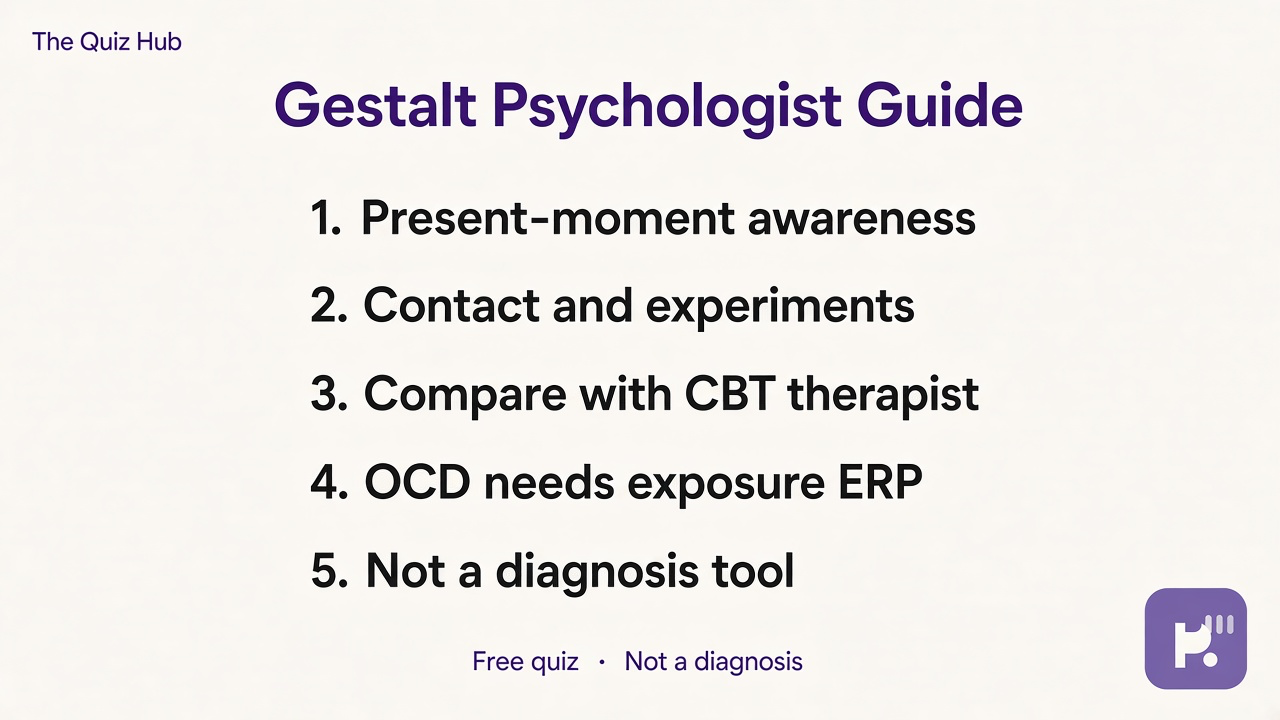
The hero graphic restates the same ideas: track here-and-now awareness, use contact experiments thoughtfully, compare fit with CBT for ritualized anxiety, treat family gestalt as its own format, and let licensed clinicians screen safety first.
Frequently asked questions
What does a gestalt psychologist do in therapy?
A gestalt-trained psychologist helps you notice thoughts, sensations, and relationship patterns in the present moment rather than only analyzing the past from a distance. Sessions may include experiments such as speaking to an empty chair, tracking body tension, or naming how you interrupt contact with others. The therapist stays curious about awareness, responsibility, and choice instead of handing you a fixed homework packet every week.
How is gestalt therapy different from CBT?
Cognitive behavioral therapy targets specific thought-behavior loops with structured exercises and measurable symptom goals, which many people prefer for panic, insomnia, or OCD when paired with exposure and response prevention. Gestalt work emphasizes here-and-now experience, unfinished business, and relational contact. Some clinicians blend both; others stay within one school. Neither replaces a full assessment for safety or medical needs.
Is gestalt therapy evidence-based?
Gestalt therapy has a long clinical history and appears in integrative training programs, but it is less standardized in large randomized trials than manualized CBT for discrete disorders. The American Psychological Association (2023) notes that many therapy relationships help through common factors such as alliance and empathy, while specific techniques matter more for some conditions. Ask your clinician how they measure progress and when they would add behavioral or medical treatments.
Can a gestalt psychologist work with couples or families?
Yes. Individual gestalt focuses on one person's awareness and contact styles. When relatives attend together, therapists often shift to gestalt family or couples formats that track interaction cycles in the room. That work is different from solo gestalt; read our gestalt family therapy overview for boundaries, safety, and when child therapists should join.
How long does gestalt therapy usually last?
Many gestalt therapists offer open-ended weekly sessions that continue for months or years, depending on goals and complexity. Some people use a shorter phase to process grief, role transitions, or relationship endings. Length should be discussed early and revisited if symptoms worsen or if you need a more structured protocol for severe OCD rituals or active substance use.
Does gestalt therapy work online?
Many gestalt clinicians offer secure video sessions when you have privacy and a stable connection. Experiments can be adapted: chair work on camera, somatic check-ins, or naming micro-withdrawals during conflict stories. Telehealth may be less ideal when domestic violence, severe dissociation, or psychosis needs in-person crisis support. Your therapist should screen for those conditions before deep experiential work.
Sources
- American Psychological Association. (2023). Understanding psychotherapy and how it works.
- Association for the Advancement of Gestalt Therapy. (2024). Gestalt therapy principles and training.
- National Institute of Mental Health. (2022). Psychotherapies overview.
- Perls, F., Hefferline, R., & Goodman, P. (1951). Gestalt Therapy: Excitement and Growth in the Human Personality. Julian Press. (Historical foundation text.)
- Yontef, G., & Jacobs, L. (2014). Gestalt therapy. In D. Wedding & R. J. Corsini (Eds.), Current Psychotherapies (10th ed.). Cengage. (Overview of methods and relational stance.)