Gestalt Family Therapy: Here-and-Now Work With Relatives
Last updated:
Educational only: This article explains gestalt family therapy and safety limits. It is not therapy, medical advice, or a crisis service. If you are in danger from a partner or relative, call or text 988 (U.S.), contact local domestic violence advocacy, or use emergency services. Conjoint sessions are unsafe when violence or coercion is active. See our disclaimer.
Gestalt family therapy brings relatives into the same room to study how they connect and pull away in the present moment. Therapists trained in gestalt theory watch contact, interruption, and unfinished emotional business as they unfold live, then design small experiments so members try new ways of speaking and listening. It differs from lecture-style family education and from purely structural mapping on a whiteboard. For one-to-one gestalt work, see our gestalt psychologist guide. Family gestalt adds system awareness: each person affects the whole field in the session.
Tips at a glance
Key takeaways
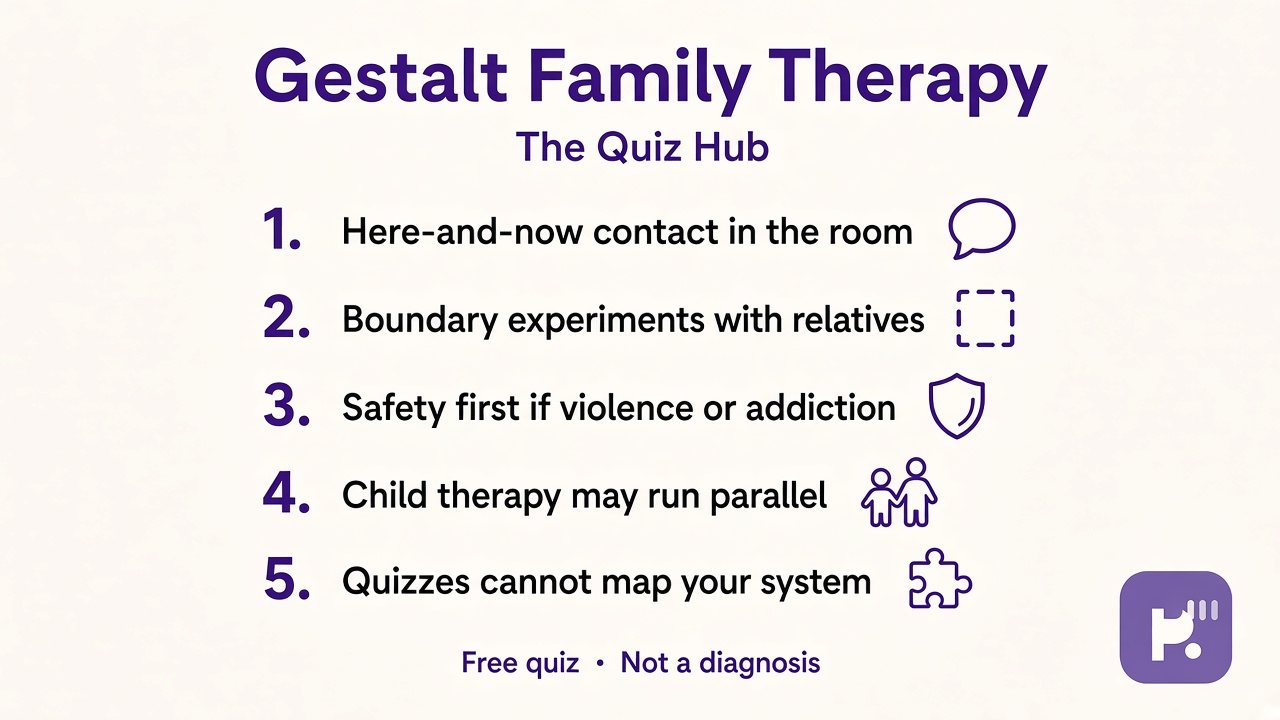
- Gestalt family therapy emphasizes present contact, awareness, and experiments, not only history retelling.
- Roles and boundaries show up in how members interrupt, merge, or distance in the room.
- Safety screening comes first when violence, addiction, or coercive control is possible.
- Children may need parallel child therapy while adults do conjoint work.
- Enmeshment patterns may improve when differentiation is practiced with therapist support.
- Online quizzes cannot assess whether your family is ready for conjoint gestalt.
Roots in gestalt theory
Classic gestalt therapy (Perls, Hefferline, and Goodman, 1951; later relational gestalt writers) treats awareness and contact as healing forces. "Figure and ground" language describes what grabs attention in the moment versus what fades into background. In families, a teenager's silence may become figure while parents debate logistics; the therapist slows the scene so everyone notices breath, posture, and unspoken alliances.
Unfinished business refers to emotions or needs that were cut off earlier and now leak into arguments about chores or money. Family gestalt does not require every member to excavate childhood in detail. It asks what is happening now between you and what small shift feels possible before the session ends.
Gestalt family therapy compared with related formats
Families encounter many labels: structural, strategic, Bowenian, emotion-focused, and more. Gestalt family work is not interchangeable with them, though skilled clinicians blend ideas. The table highlights contrasts useful when you interview providers.
| Approach | Primary focus | Typical session moves | Fit notes |
|---|---|---|---|
| Individual gestalt | One person's awareness and therapist contact | Experiments, chair work, somatic tracking | Good start when others refuse to attend; see gestalt psychologist guide |
| Gestalt family therapy | Live interaction between relatives in the room | Role reversals, here-and-now boundary trials, interrupting enmeshment | Needs basic safety; all key members ideally commit to attendance rules |
| Structural family therapy | Hierarchy, boundaries, subsystems | Joining, restructuring seating or parental authority | More directive about family organization; less emphasis on moment-to-moment phenomenology |
| Bowenian family therapy | Multigenerational patterns, differentiation of self | Genograms, coaching one member to stay calm in triangles | Long-term insight; less experiential staging in the room |
| Emotionally focused family work | Attachment cues and repair between caregivers and children | Tracking cycle of pursue-withdraw, reframing needs | Strong evidence base for some parent-child dyads; different language than classic gestalt |
Ask potential therapists how they handle safety, confidentiality between adolescents and parents, and cultural norms about respect and hierarchy. Gestalt's directness can feel refreshing or confrontational depending on your background.
What a session might look like
After ground rules (one speaker, no physical intimidation, bathroom breaks allowed), the therapist invites each person to share what they notice in their body today. A parent might report tight shoulders while a child picks at a sleeve. Rather than jumping to homework charts, the clinician asks who else feels tension when money is mentioned. Someone may try speaking from the "worry chair" while others listen without fixing.
Experiments stay short: "Can you tell your sister one feeling without explaining it for three minutes?" or "Stand behind your parent while they describe you and notice what changes." If laughter masks hurt, the therapist names the shift. If a member floods with tears, pacing slows before continuing. The goal is contact with authentic experience, not performance.
Enmeshment, boundaries, and emotional fusion
Families with blurred boundaries may finish one another's sentences, treat a child's mood as the parent's report card, or punish differentiation. Gestalt experiments make fusion visible: who leans forward when the other pulls back? Reading about patterns helps; practicing new sentences in session builds skill. For signs of enmeshment tied to trauma, see our enmeshment, trauma, and emotional boundaries article. Therapy is where you test whether "I disagree" can coexist with love.
Differentiation is not cold detachment. It means owning your feelings, tolerating another person's different choice, and returning to repair after rupture. When guilt follows every boundary, the therapist tracks that cycle in real time instead of assigning generic communication homework alone.
Children and adolescents in the room
Developmental stage shapes participation. Young children may draw family maps or use puppets while gestalt therapists watch contact with caregivers. Teens may need confidentiality agreements before sensitive topics surface in front of parents. Sometimes conjoint gestalt alternates with individual child therapy so kids have a private space to process what family sessions stir up.
Coercing a reluctant teen into experiential work usually backfires. Clinicians may meet adults first to stabilize parenting approaches, then invite the child when trust exists. School stress, neurodiversity, and peer relationships can enter family gestalt when they affect home contact.
Safety caveats before conjoint gestalt
Experiential family therapy increases emotional intensity. That is helpful when members can pause, respect limits, and leave the room safely. It is harmful when power imbalances mean honesty triggers punishment at home. Screen carefully for these red flags before booking conjoint gestalt:
- Recent or ongoing physical violence, threats, or destruction of property
- Active stalking, coercive control, or monitoring of a partner's communications
- Severe untreated substance use that leads to unpredictable aggression or blackouts
- A child or adult who says they are afraid to speak truthfully with the other person present
- Psychosis or mania that distorts reality testing without medical stabilization
In those cases, clinicians may recommend separate therapy, domestic violence advocacy, medical detox, or psychiatric care first. Empty-chair work that encourages confrontation can escalate danger if someone returns home with an abuser. Telehealth conjoint sessions are not automatically safer; they require confidentiality planning if others might overhear.
Mandated reporting still applies when abuse of a minor or vulnerable adult is disclosed. Therapists explain limits of confidentiality at intake. Your safety plan matters more than finishing a gestalt experiment.
How gestalt family therapy differs from CBT family programs
CBT-oriented family work often teaches skills worksheets, thought records, and behavioral contracts with clear homework. Gestalt family therapy spends more time on immediate experience and relationship contact. Some families benefit from CBT structure first, then gestalt depth when arguments are less explosive. Others prefer gestalt from the start when words feel stale but body cues tell the story. Matching modality to goals beats debating which label is "best."
Anxiety-driven families sometimes need individual CBT or exposure work for one member while gestalt addresses how worry spreads through the household. Coordinating two clinicians requires consent and clear communication boundaries.
Choosing a clinician and preparing for intake
Look for licensed marriage and family therapists, psychologists, or social workers with post-graduate gestalt or experiential family training, not only a weekend workshop. Ask how they screen for violence, whether they meet members separately first, and how they involve children. Discuss fees, insurance, and cancellation rules up front so money does not become the unspoken figure in the room.
Before session one, agree as a family on a shared goal: fewer shouting matches, clearer co-parenting, supporting a grieving teen, or repairing after an affair disclosure. Vague goals produce vague sessions. Bring curiosity rather than a verdict about who is "the problem."
Related quizzes on The Quiz Hub
Quizzes on this site support self-reflection about mood and stress. They do not evaluate family dynamics, power, or safety in your home.
- Anxiety test: if family tension fuels chronic worry in one member; discuss scores with a personal clinician, not as family evidence in arguments.
- Anxiety and depression screening (PHQ-4): brief check when caregiving burnout blends with low mood. Not a couple or family assessment.
- Browse the Mental Health & Clinical category for additional screeners with honest limits.
Frequently asked questions
What is gestalt family therapy?
Gestalt family therapy applies gestalt principles to relatives meeting together: present-moment awareness, contact between members, and experiments that reveal how the family system organizes closeness and distance. Therapists highlight "here and now" patterns in the room rather than only retelling old stories. It is experiential and relational, not a manualized symptom protocol like some CBT packages.
How is gestalt family therapy different from individual gestalt?
Individual gestalt focuses on one person's awareness, body sensations, and contact with the therapist. Family gestalt tracks interactions: who speaks for whom, which topics freeze the room, and how roles (caretaker, rebel, peacekeeper) shift under stress. Our gestalt psychologist guide covers one-to-one work; this article centers on multi-person sessions.
What techniques appear in gestalt family sessions?
Common moves include empty-chair work with a family member present, role reversals, noticing interrupting or merging, and experiments with new boundaries ("I will speak for myself for five minutes"). Therapists slow the action so members feel bodily cues before default reactions. Techniques adapt to children's developmental level; younger kids may use drawing or play within the gestalt frame.
When is gestalt family therapy not appropriate?
Active domestic violence, credible threats, untreated severe substance dependence, or ongoing coercive control usually require safety planning, separate sessions, or specialized programs before conjoint experiential work. Forcing "honesty" exercises when someone fears retaliation can harm. Clinicians screen for these risks in intake and may refer to advocacy or medical detox first.
Can gestalt family therapy help with enmeshment?
Gestalt work can clarify blurred boundaries when members speak over each other or cannot tolerate separate choices. It pairs well with psychoeducation about enmeshment and trauma when emotional fusion followed chronic stress. Our enmeshment and emotional boundaries article explains signs; therapy turns insight into practiced differentiation with support.
Do quizzes map my family system?
No. Online quizzes cannot observe live contact, power dynamics, or safety risk in your household. They may prompt reflection about communication habits but cannot recommend whether conjoint gestalt is safe or suitable. Licensed family therapists assess fit after confidential interviews.
Sources
- Perls, F., Hefferline, R. F., & Goodman, P. (1951). Gestalt therapy: Excitement and growth in the human personality. Julian Press.
- Yontef, G., & Jacobs, L. (2014). Gestalt therapy. In M. J. Lambert (Ed.), Bergin and Garfield's handbook of psychotherapy and behavior change (6th ed.). Wiley.
- Goldenberg, I., & Goldenberg, H. (2013). Family therapy: An overview (8th ed.). Brooks/Cole.
- American Association for Marriage and Family Therapy. (2015). About marriage and family therapists.
- National Domestic Violence Hotline. (2024). Safety planning resources.