Financial Psychologist: How They Help With Money Stress and Behavior
Last updated:
Educational only: This article explains financial psychology and how licensed psychologists may help with money-related stress. It is not tax advice, investment advice, or medical advice. If money stress comes with thoughts of self-harm, call or text 988 (U.S.) or contact local emergency services. See our editorial policy for how we review psychology career and therapy content.
A financial psychologist is a licensed psychologist who studies and treats the emotions, beliefs, and habits behind financial decisions. They help when spreadsheets are accurate but you still overspend, hide purchases, fight with a partner about debt, or feel paralyzed opening mail. They are not substitutes for a CPA who files taxes or a registered investment adviser who manages securities under fiduciary rules. The right professional depends on whether your main gap is compliance math, accountability coaching, or psychological blocks that keep repeating.
Key takeaways
- Financial psychology targets money scripts, shame, avoidance, and couple conflict, not tax code alone.
- Verify state psychology licensure; "financial therapist" marketing does not guarantee clinical training.
- CPAs handle taxes and audits; coaches often handle budgets; psychologists handle clinical distress tied to money.
- Insurance may cover psychotherapy with a diagnosis; pure financial coaching is usually self-pay.
- Ethical psychologists follow APA-style boundaries; see our ethics overview before you share sensitive history.
- Online quizzes can flag stress topics; they cannot diagnose disorders or replace licensed care.
How financial psychologists help with money stress
Money stress is not only a numbers problem. Research on financial psychology and behavioral economics shows that scarcity, childhood modeling, and identity threats can push smart people toward avoidance or impulsive relief spending. A financial psychologist starts with assessment: what happened in your family around money, which emotions show up when you check balances, and whether secrecy or control appears in relationships.
Treatment plans often blend cognitive-behavioral techniques, motivational interviewing, and couples work when partners disagree about risk. Some practitioners coordinate with CPAs or certified financial planners so behavioral goals align with realistic cash-flow data. That coordination should be documented with your consent; therapists should not casually email your tax return to third parties without a release.
Work overlap with career stress is common. If income uncertainty drives panic, a career counselor can help with direction and labor market planning while a psychologist addresses the anxiety that spikes during job search. Organizational leaders may instead consult an industrial-organizational psychologist when team incentives and culture distort financial decisions at work.
CPA vs financial coach vs financial psychologist
Search results often blur these titles. Use the table below to match the problem to the regulated role. When two rows apply, sequential care is normal: stabilize mood, then execute the budget, then file taxes.
| Role | Primary focus | Typical credential | What they usually do not do |
|---|---|---|---|
| CPA | Tax compliance, audits, business accounting, documented deductions | State CPA license, continuing education in accounting ethics | Long-term psychotherapy for trauma, couples therapy for contempt, or crisis stabilization |
| Financial coach | Budget systems, debt payoff plans, accountability, habit tracking | Variable; certificates from private programs; not a uniform clinical license | Diagnose depression, gambling disorder, or PTSD; prescribe medication; file tax returns |
| Financial psychologist | Emotions and beliefs driving money behavior; couples conflict; avoidance and shame | Doctoral psychology degree plus state psychology license for psychotherapy | Guarantee investment returns; prepare Form 1040 unless separately licensed as a CPA |
Consulting psychologists who advise firms on incentives and decision bias follow a different contract than personal therapy. Our consultant psychologist guide explains scope, billing, and when organizational work stays separate from clinical treatment.
Credentials, ethics, and training paths
In the United States, psychotherapy with a psychologist requires a doctoral degree (PhD or PsyD), supervised hours, a licensing exam such as the Examination for Professional Practice in Psychology (EPPP), and active state authorization. Specialization in financial psychology may come from postdoctoral fellowships, continuing education through the Financial Therapy Association, or research on money scripts (Klontz et al., 2015; updated practice summaries, FTA, 2024).
Licensed psychologists must follow enforceable ethics codes. Review our ethical principles of a psychologist article for informed consent, confidentiality limits, dual relationships, and fees. If you are comparing graduate routes, see how to become a psychologist in the USA for licensure steps versus coaching or planning careers.
Dual credentials (psychologist plus CFP or CPA) can help integrated planning but increase conflict-of-interest risk. Ethical practice requires clear agreements about which hat is worn in each hour and how records are stored. Be cautious with anyone who pressures you to move investments during therapy sessions without independent fiduciary review.
What sessions may include
Early sessions cover consent, fees, confidentiality, and crisis planning. The psychologist asks about income sources at a high level, debt feelings (not always exact balances on day one), family messages about worth, and any coercion or financial abuse in relationships. Later work may map triggers: payday spending, refund splurges, or panic when a partner requests transparency.
Homework might include tracking emotions before purchases, practicing disclosure scripts with a partner, or scheduling a CPA appointment you have avoided. Couples sessions need ground rules so therapy does not become a courtroom. Individual therapy may be recommended first when safety or substance use blocks honest accounting.
Who financial psychology fits, and who may want a different path
Fit depends on goals, safety, and whether clinical symptoms are active. Use this checklist to start conversations with providers, not as rigid rules.
| May be a good fit if you... | Consider alternatives if you... |
|---|---|
| Understand the math but repeat self-sabotaging money habits | Only need annual tax filing with straightforward W-2 income (CPA may suffice) |
| Fight with a partner about spending, secrecy, or risk tolerance | Are in active financial abuse or coercion (safety planning and legal aid may come first) |
| Feel shame or panic that blocks opening bills or credit reports | Want a simple budget template and weekly accountability without clinical care (coach) |
| Want licensed psychotherapy with money as the central theme | Need portfolio management or securities advice (fiduciary adviser with disclosed fees) |
| Can attend sessions and try agreed experiments between visits | Have untreated mania, psychosis, or active gambling disorder requiring specialized psychiatric care first |
| Are willing to verify psychology licensure on your state board site | Expect someone to log into your accounts or promise instant wealth outcomes |
When professional help makes sense
Seek urgent care if financial stress comes with thoughts of suicide, self-harm, or inability to stay safe. In the U.S., call or text 988 for the Suicide & Crisis Lifeline.
Schedule clinical evaluation if low mood, panic attacks, compulsive gambling, or substance use persist for weeks and block daily function, not only bill paying. Financial psychology works best when you can attend sessions, try homework, and tell your provider when conflict at home escalates.
Related quizzes on The Quiz Hub
Quizzes support reflection before or between professional visits. They do not replace CPAs, fiduciaries, or licensed therapists.
- Financial planning quiz: surfaces planning and habit patterns worth discussing with a coach or counselor. Not investment or tax advice.
- Browse Mental Health & Clinical screeners when money stress rides alongside mood, anxiety, or sleep disruption. Screeners flag topics; they do not diagnose.
- Career values quiz: helps separate income goals from identity and values when job choices drive financial fear.
Tips at a glance
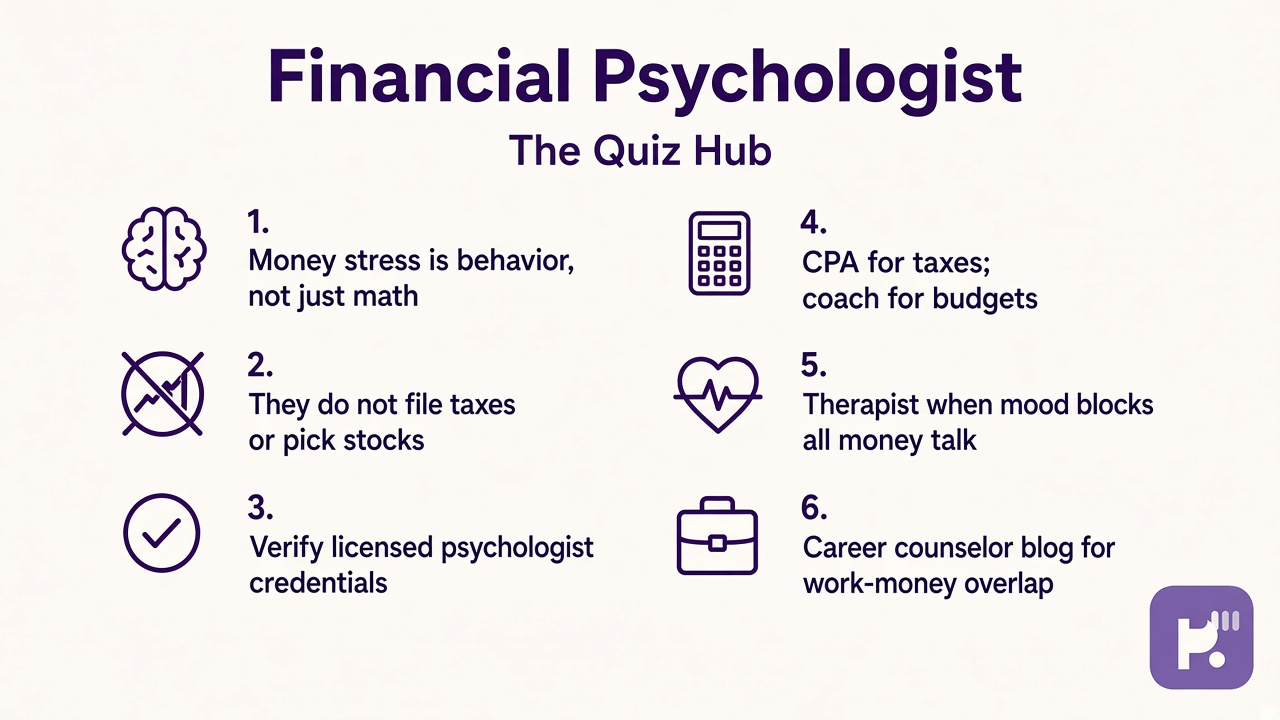
The hero graphic summarizes the same ideas: money stress blends behavior and emotion; psychologists are not CPAs; verify licenses; match CPA, coach, or therapist to the bottleneck; use career resources when work and money collide; call crisis lines when hopelessness is unsafe.
Frequently asked questions
What does a financial psychologist do?
A financial psychologist helps you understand emotions, beliefs, and relationship patterns that drive spending, saving, avoidance, or conflict about money. Work may include money scripts from family, shame after debt, couples disagreements about risk, or anxiety that blocks opening bills. They use psychotherapy skills and financial psychology research. They do not replace a CPA for tax filing or a fiduciary investment adviser for portfolio management unless they hold separate licenses and disclose dual roles.
Is a financial psychologist the same as a financial therapist?
The terms overlap in popular media. "Financial therapist" often describes any professional blending money and mental health, including some coaches. "Financial psychologist" should mean a doctoral-level psychologist licensed to practice psychotherapy who specializes in money behavior. Always verify state psychology board licensure rather than assuming a certificate title. The Financial Therapy Association (FTA, 2024) lists members with varied credentials; ask which license governs your clinical relationship.
When should I hire a CPA instead?
Hire a Certified Public Accountant when you need tax preparation, audit support, entity structure, payroll compliance, or documented deductions. CPAs follow accounting ethics and continuing education rules. They may discuss cash flow at a high level but are not trained to treat clinical anxiety, trauma, or marital contempt about money. Many clients use both: a CPA for returns and a psychologist for behavior change that makes it easier to follow the plan.
Can a financial coach replace therapy for money stress?
A coach can help with budgeting templates, debt snowball accountability, and weekly check-ins when you already feel emotionally stable enough to act. Coaches are not uniformly licensed for mental health treatment. Choose therapy or a licensed financial psychologist when panic, depression, compulsive spending, gambling disorder symptoms, or domestic conflict about money dominates the conversation. Coaches should refer out when safety or clinical symptoms appear.
Does insurance cover financial psychology sessions?
Insurance may cover psychotherapy with a licensed psychologist when a treatable mental health diagnosis is documented and care is medically necessary under your plan rules. Pure financial planning or coaching is usually out of pocket. Some employee assistance programs offer short-term counseling that can include stress about finances. Ask the provider for a benefits verification letter and whether sessions are billed as psychotherapy versus financial counseling codes.
How do I verify credentials before sharing account details?
Confirm an active psychology license on your state board website. Ask whether they hold CFP, CPA, or investment adviser registrations separately and how those roles interact with therapy notes. Review informed consent about confidentiality, couples sessions when one partner controls accounts, and mandatory reporting if abuse or exploitation is disclosed. Never share online banking passwords; legitimate clinicians do not need login access to help you change habits.
Sources
- Financial Therapy Association. (2024). FTA: About financial therapy.
- Klontz, B., Britt, S. L., & Archuleta, K. L. (2015). Financial therapy: Theory, research, and practice. Springer. (Money scripts and clinical integration framework.)
- American Psychological Association. (2024). Ethical Principles of Psychologists and Code of Conduct.
- American Institute of CPAs. (2024). AICPA: CPA licensure and ethics resources.
- Consumer Financial Protection Bureau. (2024). CFPB: Consumer tools on fraud and financial abuse.
- U.S. Bureau of Labor Statistics. (2024). Occupational Outlook Handbook: Psychologists.
Reviewed by