What this sexuality spectrum test measures
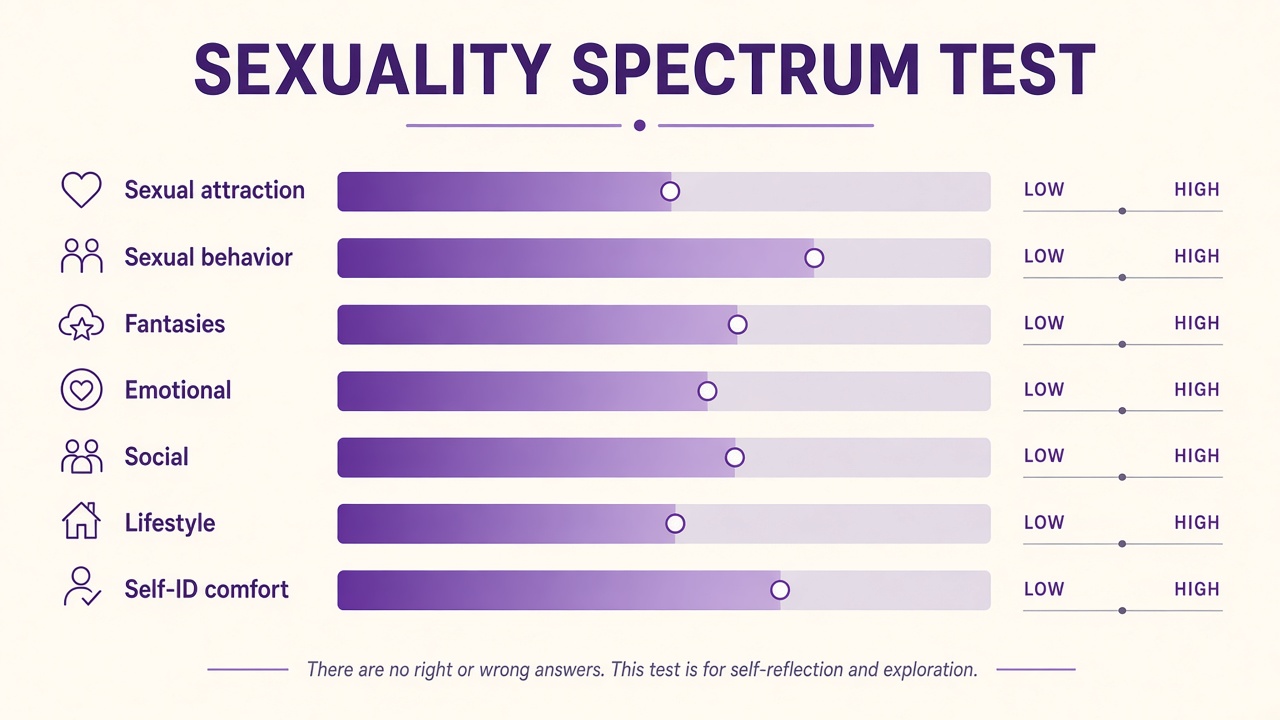
This sexuality spectrum test estimates patterns across seven Klein-inspired reflection axes. Twenty-eight original Likert items group into sexual attraction, sexual behavior, sexual fantasies, emotional preference, social preference, lifestyle preference, and self-identification comfort. Results show a spectrum index, seven axis bar scores, a leading axis, and pattern bands. No quiz can name your orientation for you.
Sexual attraction
Reported physical or sexual pull across genders as you experience it today.
Sexual behavior
Past or imagined intimate experiences and openness to partners across gender lines.
Sexual fantasies
Imagined scenarios that may differ from public behavior or current labels.
Emotional preference
Emotional closeness and partnership pull across gender presentations.
Social preference
Social bonding, flirting comfort, and dating interest across gender lines.
Lifestyle preference
Long-term routines, home life, and future partnership vision.
Self-identification comfort
Ease with questioning, evolving labels, and resisting rigid identity boxes.
How it works
Three steps from first question to your sexuality spectrum report. Click Start Quiz to open the interactive modal.
Rate 28 reflection statements
Answer from Strongly disagree to Strongly agree. There is no timer and no auto-advance between items.
Items map to seven axes
Your answers accumulate percentages for each Klein-inspired dimension separately.
View index, bars, and pattern band
Results show a spectrum index, ranked axis bars, a leading axis, and a pattern band with affirming next steps. No orientation label is assigned.
Take the sexuality spectrum test
Rate 28 Klein-inspired reflection statements on a five-point agreement scale. Your answers produce a spectrum index, seven axis scores, a leading axis, and a reflective pattern band with plain-language next steps. Affirming language only.
Opens in a focused modal. No account required. Results stay on screen.
What your result means
Your spectrum index is the normalized average across all 28 items on a 0 through 100 scale. Axis bars show each Klein-inspired dimension separately so fantasy can run ahead of behavior or identity comfort can lag behind attraction. Your leading axis names the top bar. Pattern bands combine the index with spread across axes: Diffuse Axis Mix when peaks are low or flat, Overlapping Spectrum when multiple axes pull similarly, Clearer Axis Lead when one axis leads with a wider gap.
| Pattern band | Typical pattern | Plain-language read |
|---|---|---|
| Diffuse Axis Mix | Lower index or even moderate axis bars | Still mapping how attraction, behavior, fantasy, and identity comfort align |
| Overlapping Spectrum | Two or more axis bars score similarly | Meaningful pull across dimensions with no single clear lead |
| Clearer Axis Lead | Higher index with one leading axis | Clearer lead today, still your choice whether to name it publicly |
What your sexuality spectrum report looks like
After all 28 items, your report opens with a spectrum index and pattern band badge, a plain-language headline, and a short takeaway about your multi-axis pattern. Below that you see up to two insight bullets, then seven ranked bar scores for sexual attraction, behavior, fantasies, emotional preference, social preference, lifestyle preference, and self-identification comfort. The leading axis is highlighted. Copy, retake, and close actions sit at the bottom of the scrollable results panel.
What this quiz can and cannot tell you
Can tell you
- How your self-reported patterns distribute across seven Klein-inspired axes on this screener
- Which axis leads today as your leading dimension
- Whether fantasy, behavior, and attraction items suggest alignment or divergence for you
- A starting pattern band and axis bars before you choose language, timing, or disclosure
Cannot tell you
- Whether you are definitively gay, bi, straight, pan, ace, or any other orientation label
- Whether you must come out, use a label, or stay private
- Whether one relationship or fantasy defines your whole spectrum map
- Whether you need therapy, medical care, or community support (only you and professionals decide that)
Fritz Klein, the Klein Grid, and why axes matter
Psychiatrist Fritz Klein introduced the Klein Sexual Orientation Grid in 1978 because single-scale models could not capture how attraction, behavior, fantasies, emotional preference, social preference, lifestyle, and self-identification diverge in real lives. The American Institute of Bisexuality later promoted Klein Grid education to show that bisexual and fluid experiences often look different on each axis. The Quiz Hub built this sexuality spectrum test with abbreviated original items inspired by those themes, not a verbatim copy of the published Klein Grid.
Twenty-eight items ask about sexual spark, intimate history, fantasy content, emotional partnership pull, social bonding, lifestyle vision, and label comfort. That structure helps when the broader sexuality test answers a different question across five domains like romantic interest and fluidity openness. Pair with our am I bisexual quiz when multi-gender attraction feels most relevant, or the sexual orientation grid test for a 12-item four-axis grid snapshot. For split attraction types rather than Klein axes, try our attraction test.
| The Quiz Hub test | What it adds |
|---|---|
| Sexuality test | Five-domain orientation reflection: emotional, physical, romantic, identity comfort, fluidity openness |
| Am I bisexual quiz | Multi-gender attraction, bi-erasure distress, and bi label comfort with narrower focus |
| Sexual orientation grid test | 12-item four-axis grid snapshot with no forced identity label |
| Sexual orientation test | Gendered attraction patterns plus romantic vs sexual distinction |
| This sexuality spectrum test | 28 items with spectrum index, seven axis bars, leading axis, and three pattern bands |
Sample item: agreeing that you imagine sexual scenarios with people of more than one gender raises your sexual fantasies bar. Agreeing that you keep sexual experiences within one gender category lowers your sexual behavior bar through a reverse-scored item. Mismatched bars are common and do not mean you are confused in a negative sense. Read how we review quizzes in our editorial policy or browse more tests on our sexuality and LGBTQ+ hub.
Sexuality spectrum test FAQ
What does this sexuality spectrum test measure?
This sexuality spectrum test measures how much you agree with 28 reflection items across seven Klein-inspired axes: sexual attraction, sexual behavior, sexual fantasies, emotional preference, social preference, lifestyle preference, and self-identification comfort. Results show a spectrum index, seven axis bar scores, a leading axis, and a pattern band such as Diffuse Axis Mix, Overlapping Spectrum, or Clearer Axis Lead. It is not a diagnostic tool and does not assign orientation labels.
What is the Klein Sexual Orientation Grid?
Psychiatrist Fritz Klein developed the Klein Sexual Orientation Grid in 1978 to show that orientation has multiple dimensions beyond a single gay or straight score. The original Klein Grid tracks attraction, behavior, fantasies, emotional preference, social preference, lifestyle, and self-identification across time. This quiz uses abbreviated original items inspired by those themes, not a verbatim copy of the published grid.
How is this different from the sexuality test?
The sexuality test on The Quiz Hub uses five broader domains: emotional attraction, physical attraction, romantic interest, identity comfort, and fluidity openness. This sexuality spectrum test follows seven Klein-inspired axes so you can compare fantasy, behavior, attraction, and identity comfort separately. Pair both when you want a wide lens plus multidimensional axis detail.
Can this quiz tell me if I am bisexual or gay?
No quiz can certify your orientation or assign a permanent label. This sexuality spectrum test maps self-reported patterns into axis bars and reflective bands. It names a leading axis and pattern summary, not a verdict like bisexual or gay. Pair with our am I bisexual quiz when multi-gender attraction feels most relevant.
What if my fantasy and behavior bars differ?
That mismatch is common in Klein Grid thinking. Fantasy, behavior, attraction, and identity comfort can diverge without one axis being wrong. Overlapping Spectrum and Diffuse Axis Mix bands often appear when axes tell different stories. Use the bars as a conversation starter with yourself, not proof that you are hiding something.
Who reviewed this content?
Dr. James Whitfield, PhD, reviewed the test framing and result explanations. See our editorial policy for review standards.
Reviewed by