What the Inferior Skull Quiz measures
This quiz does not read head CT scans, diagnose basilar skull fractures, or certify radiology skill from bar height. It measures how much you agree with introductory inferior skull anatomy grouped four ways: foramen magnum and occipital about brainstem passage and condyles; palatine and sphenoid base about midfloor landmarks; inferior view landmarks about base-not-face-only study; and quiz-not-clinical-diagnosis limits about diagram-first humility. You answer 22 statements from strongly disagree to strongly agree, with reverse-worded myths so agreeing with every shortcut cannot inflate every bar. Your answers also feed a second chart on closeness and trust habits.
Foramen magnum and occipital
Brainstem passage.
Palatine and sphenoid base
Midfloor landmarks.
Inferior view landmarks
Base not face only.
Quiz not clinical diagnosis
Class not CT read.
How it works
Answer 22 agreement items
Rate each statement from Strongly disagree to Strongly agree. Tap Next after each answer.
Answers sort into four domains
Each answer feeds one of four inferior skull anatomy groups, and every item also feeds a closeness and trust layer.
See your index and charts
You get a 0 to 100 index, a band, four domain bars, and a second chart for intimacy habits.
Take the Inferior Skull Quiz
Answer 22 short statements to see your inferior skull anatomy literacy index, four domain bars, and a closeness and trust chart.
What your result means
Your index is the average of all 22 answers, scaled from 0 to 100, with reverse-worded items flipped first. Read diagnosis limit bars together with foramen magnum literacy before you treat a high score as imaging authority. Clinicians and radiologists still own formal evaluation when trauma or neurologic symptoms are real.
| Band | Index range | Typical reading |
|---|---|---|
| Building inferior skull literacy | 0 to 35 | Fewer agreed facts on foramen magnum, palatine and sphenoid base, inferior landmarks, or quiz-not-diagnosis limits. |
| Mixed inferior skull literacy | 36 to 65 | Solid facts in some domains with myths about foramen-orbit sameness, sphenoid absence, or CT-replacing trivia. |
| Strong inferior skull literacy | 66 to 100 | Frequent agreement with landmarks and limits; still class study reflection only. |
Tips at a glance
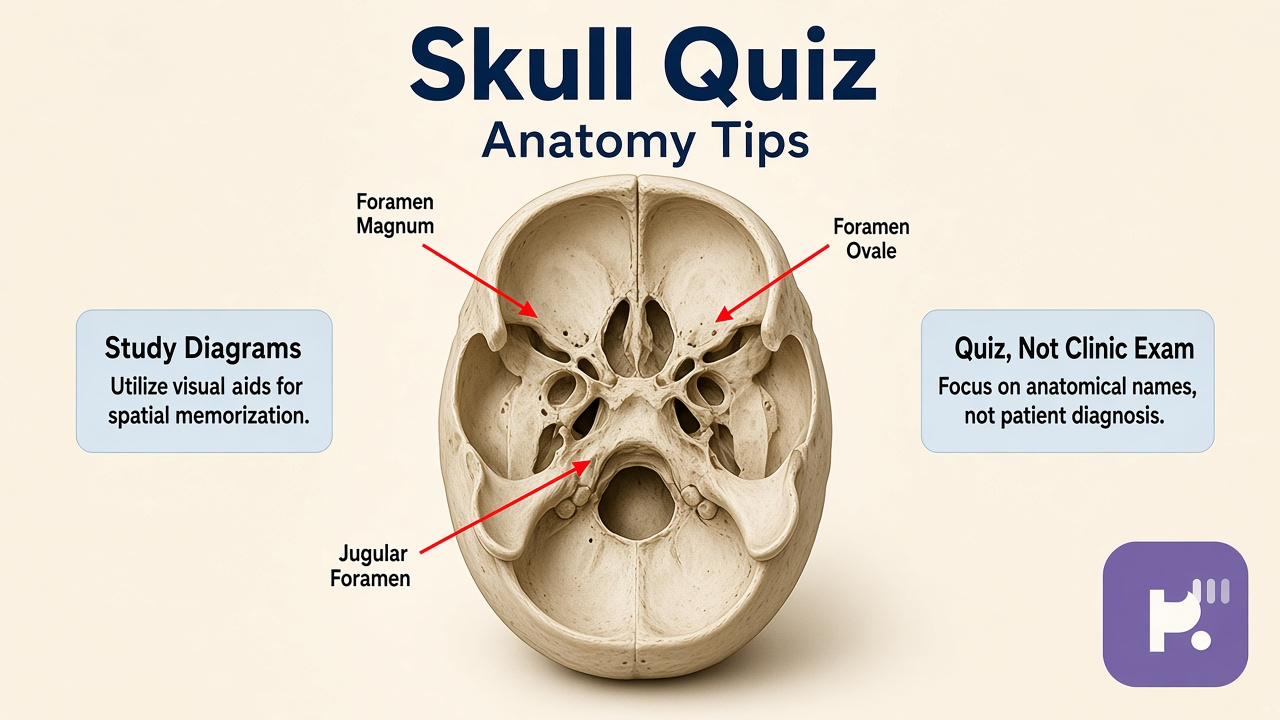
A quick takeaway graphic with topic tips (not your personal quiz scores). Start the quiz for your index, bands, and charts.
What this quiz can and cannot tell you
Can tell you
- Highlight foramen, palate, and inferior-view habits worth revisiting before lab practicals
- Separate study reflection from CT cosplay and fracture diagnosis threads
- Encourage instructor questions without radiology dunk spirals
- Spark better atlas goals without claiming clinical license
Cannot tell you
- Read CT scans or diagnose fractures from couch scores
- Replace anatomy lab, radiology training, or emergency care
- License online fracture verdict threads about friends photos
- Clear head-injury patients from agree totals alone
Why inferior skull study needs foramen literacy, base landmarks, view discipline, and diagnosis limits
Students search inferior skull quizzes when an anatomy unit flips the model to the cranial base and every foramen label blurs together on one photo. The foramen magnum sits centrally on inferior views as the large passage teachers name for brainstem continuity with the spinal canal. Occipital condyles sit beside that opening as neck articulation landmarks intro courses pair with the occipital bone. Calling the foramen magnum an eye socket is a trap quizzes flag on purpose because orbit vocabulary belongs to anterior face charts, not the base floor.
Hard palate regions and sphenoid-related inferior landmarks reward flipping models instead of memorizing only the smiling face poster. Palatine processes contribute to the palate students feel intraorally while inferior charts show midline floor geometry. Sphenoid elements appear on base views at syllabus depth even when anterior units emphasized the greater wings first. Agreeing that sphenoid never shows on inferior sheets should not inflate bars meant to track honest view-switching habits.
Inferior view discipline means consistent left-right language and separate mental foramen traps on the mandible chin region. Pair base study with our facial bones quiz when maxilla and mandible anterior labels must stay distinct from cranial floor holes. Use our anatomy quiz for general structure warm-ups rather than foramen-specific caps here. Our facial muscles quiz explores expression overlays rather than inferior foramen literacy on this page. Browse the IQ and cognitive hub for more study games. Retake after you can point to foramen magnum and occipital condyles on an unlabeled base photo; literacy grows when view orientation stays explicit, not when you hope face posters taught every hole.
| Test | Focus |
|---|---|
| Facial bones quiz | Anterior maxilla and mandible recall rather than inferior foramen magnum stems here |
| Anatomy quiz | General anatomy recall rather than cranial base inferior-view specificity on this page |
| Facial muscles quiz | Expression muscle overlays rather than inferior skull foramen literacy here |
Inferior Skull Quiz FAQ
What does the Inferior Skull Quiz measure?
It measures how much you agree with introductory inferior skull anatomy across foramen magnum and occipital landmarks, palatine and sphenoid base habits, inferior view study, and quiz-not-diagnosis limits. You get an index from 0 to 100 and four bars.
Can this quiz diagnose a skull fracture?
No. Limit items reject diagnosis cosplay. Seek emergency care when head injury symptoms worry you.
Does this replace anatomy lab or radiology training?
No. Bars describe study habits you endorsed here, not clinical skills exams or CT interpretation licenses.
Is the inferior view the same as the face chart?
No. Inferior view items track cranial base orientation separate from anterior face posters.
Who reviewed this quiz?
Dr. James Whitfield reviewed the framing, limit language, and result explanations. See our editorial policy for review standards.
Reviewed by