What the Facial Muscles Quiz measures
This quiz does not read strangers emotions, certify you for cosmetic surgery, or score your social intelligence. It measures how much you agree with introductory facial muscle anatomy grouped four ways: frontalis and brow about forehead placement, eyebrow elevation, and keeping brow lift separate from eye-ring muscles; orbicularis oculi about eyelid closure, squint habits, and crow-foot context on charts; mouth and smile muscles about orbicularis oris lip purse, zygomaticus major corner pull, and keeping lip ring distinct from cheek pull; and facial muscles quiz limits about diagram-first study, retakes, and leaving injections and nerve exams to licensed clinicians. You answer 22 statements from strongly disagree to strongly agree, with reverse-worded myths so agreeing with every shortcut cannot inflate every bar. Your answers also feed a second chart on closeness and trust habits, because health worry sometimes pushes people toward quick internet certainty. The total becomes an index from 0 to 100 where higher means more reported facial muscle literacy on this screener, not proof you should skip care when facial nerve symptoms scare you.
Frontalis and brow
Forehead muscle, eyebrow raise, and separation from eye-ring orbicularis.
Orbicularis oculi
Eye-ring closure, squint, and crow-foot context on expression charts.
Mouth and smile muscles
Orbicularis oris purse, zygomaticus smile pull, and corner habits.
Facial muscles quiz limits
Label diagrams first, retakes, and no DIY injections or nerve-exam pretense.
How it works
Answer 22 agreement items
Rate each statement from Strongly disagree to Strongly agree. Tap Next after each answer.
Answers sort into four domains
Each answer feeds one of four facial muscle groups, and every item also feeds a closeness and trust layer.
See your index and charts
You get a 0 to 100 index, a band, four domain bars, and a second chart for intimacy habits.
Take the Facial Muscles Quiz
Answer 22 short statements to see your facial muscles literacy index, four domain bars, and a closeness and trust chart.
What your result means
Your index is the average of all 22 answers, scaled from 0 to 100, with reverse-worded items flipped first. Higher means more reported facial muscle literacy on this screener. Read quiz limit bars together with orbicularis and mouth bars before you treat the total as surgical expertise.
| Band | Index range | Typical reading |
|---|---|---|
| Building facial muscles literacy | 0 to 35 | Fewer agreed facts on frontalis, orbicularis oculi, mouth smile muscles, or quiz-not-surgery limits on this screener. |
| Mixed facial muscles literacy | 36 to 65 | Solid facts in some domains with myths about frontalis-orbicularis sameness, lip-eye swaps, or surgery-replacing trivia. |
| Strong facial muscles literacy | 66 to 100 | Frequent agreement with accurate frontalis, orbicularis, and smile muscle trivia plus healthy study limits. |
Tips at a glance
A quick takeaway graphic with topic tips (not your personal quiz scores). Start the quiz for your index, bands, and charts.
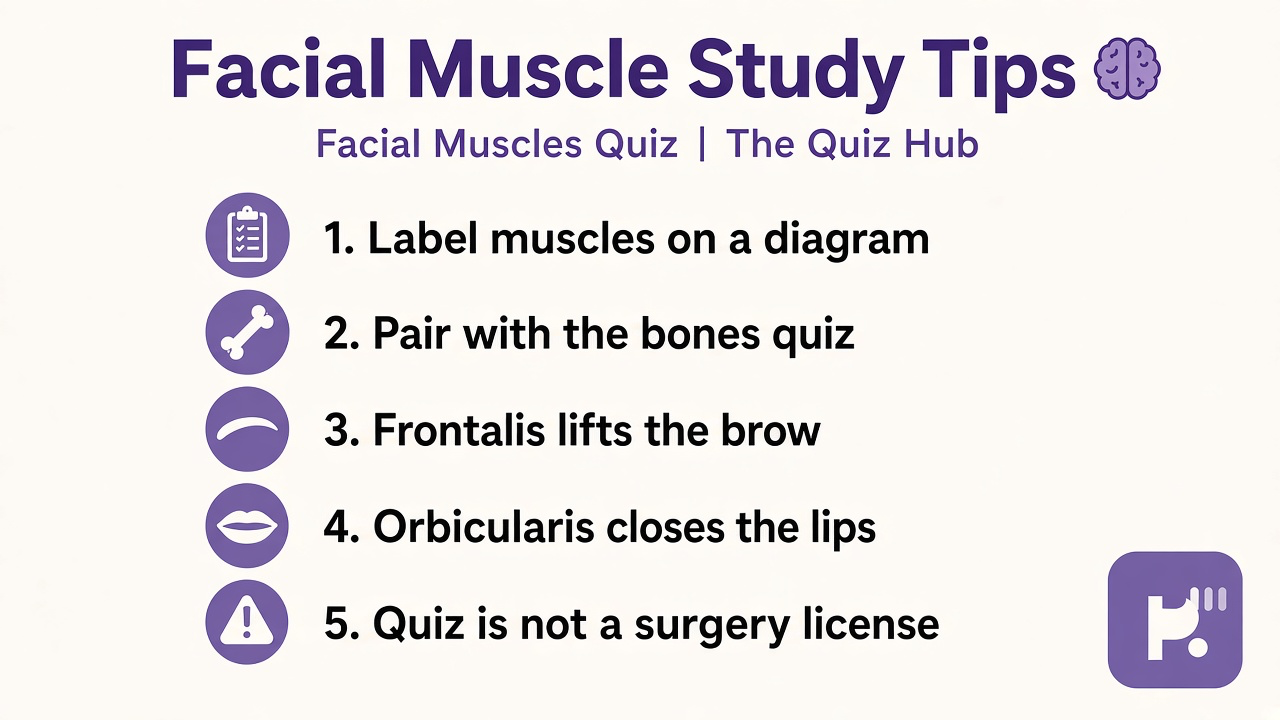
What this quiz can and cannot tell you
Can tell you
- Clarify frontalis, orbicularis oculi, orbicularis oris, and zygomaticus names in plain language
- Highlight common brow-eye-lip swap myths worth unlearning
- Encourage labeled diagram study and retake habits without shame
- Spark better questions during school expression anatomy units
Cannot tell you
- Diagnose Bell palsy, stroke, or cosmetic complications from trivia answers
- Replace nerve exams, injection training, or hands-on surgical licensing
- Certify you for botox planning, prescribing, or medical licensing
- Prove your face is nerve-healthy when droop, eye closure failure, or numbness appears
Facial muscle anatomy beyond one expression poster
Students search facial muscles when an anatomy unit overlays muscle names on a surprised or smiling face and every orbicularis label blurs together. Frontalis spans much of the forehead and is the muscle teachers name when eyebrows rise and horizontal brow wrinkles appear. It sits above the orbital region, separate from the ring of tissue that hugs the eyelids. Calling frontalis and orbicularis oculi the same muscle is a trap quizzes flag on purpose because expression charts want you to place forehead lift and eye closure on different lines, not memorize Latin without placement.
Orbicularis oculi wraps around the eye in a sphincter-like pattern intro courses use for blink, squint, and gentle eye closure demos. Crow-foot lines beside the eye often get discussed alongside this muscle in expression units, still as anatomy vocabulary rather than aging shame. Agreeing that orbicularis oculi lives only on the lower lip or that eyelids never use that name should not inflate literacy bars meant to track real structure habits. Pair eye-ring labeling with brow labeling on one diagram before you retake.
Mouth expression muscles split lip ring from cheek pull on most charts. Orbicularis oris encircles the mouth opening and helps purse or compress the lips, which is why whistle and kiss shapes show up in lab handouts. Zygomaticus major attaches toward the corner of the mouth and pulls upward and outward in the classic smile arrow students trace with a pen. Confusing orbicularis oris with zygomaticus major is another common swap when posters are small or unlabeled. Label purse separately from smile pull is the habit the third domain rewards.
Surgery and nerve-exam limits are the fourth domain because trivia scores tempt overconfidence. Retakes, flashcards, and labeled diagrams are normal class prep; they do not mean you finished plastic surgery residency or neurology clerkship. Agreeing that a perfect quiz replaces injection training or substitutes for urgent evaluation after sudden droop is another myth worth rejecting before you retake. Pair diagram study with humility when friends share procedure photos online.
This screener stays on muscle names and mechanical roles for expressions. Our facial expression quiz sibling stays on emotion cue literacy and context habits, not frontalis-orbicularis labeling depth on this page. Use this slug as a warm-up, not a verdict. Pair it with our facial bones quiz when you want maxilla and mandible landmarks before muscle overlays, the anatomy quiz when you want general structure recall, or the human body quiz when you want broader organ warm-ups. Browse the IQ and cognitive test hub for more low-stakes study games. Retake after you can point to frontalis, orbicularis oculi, orbicularis oris, and zygomaticus on an unlabeled chart; literacy grows when brow, eye, and mouth layers stay in order, not when you hope smile starts with z and skip the forehead chapter.
| Test | Focus |
|---|---|
| Facial expression quiz | Emotion cue and context literacy rather than frontalis-orbicularis-zygomaticus labeling depth |
| Facial bones quiz | Skull bone recall rather than expression muscle overlay and surgery-limit myths |
| Anatomy quiz | General anatomy recall rather than expression muscle specificity |
Facial Muscles Quiz FAQ
What does the Facial Muscles Quiz measure?
It measures how much you agree with introductory facial muscle anatomy across frontalis and brow, orbicularis oculi, mouth and smile muscles, and quiz-not-surgery limits. You get an index from 0 to 100 and four bars. It reflects self-reported knowledge on this screener, not a clinical skills exam or emotion-reading score.
Is this the same as the Facial Expression Quiz?
No. This page tests muscle names and mechanical roles on expression diagrams. The facial expression quiz sibling focuses on emotion cue habits and context literacy, not orbicularis labeling depth. Take both if you want anatomy plus social-cue reflection, but stems stay distinct.
Is this quiz enough to plan cosmetic injections?
No. It is study trivia and care literacy. Injection planning and nerve exams belong to licensed clinicians. Sudden facial weakness, eye closure failure, or trauma need professional evaluation, not a high score here.
Why are some statements worded as myths?
Reverse-worded myths catch overconfidence. Agreeing that frontalis and orbicularis oculi are one muscle, that orbicularis oculi sits only on the lip, that zygomaticus and orbicularis oris never differ, or that trivia replaces nerve exams should not inflate your literacy index.
Who reviewed this quiz?
Dr. James Whitfield, PhD reviewed the educational framing, anatomy literacy limits, and result explanations. See our editorial policy for review standards.
Reviewed by