What the Industrial Revolution Quiz measures
This quiz does not grade AP World or AP European History exams, proctor timed IB papers, or replace instructor document essays. It measures how much you agree with Industrial Revolution study statements grouped four ways: timeline and technology literacy about mechanization, steam spread, factory growth, reform phases, and syllabus name discipline; primary source habits about factory reports, citations, partial viewpoints, translation checks, and pairing visuals with text; labor context and multiple views about wages, crowding, child labor, union threads, bias language, separating class analysis from modern dunk hashtags, and content warnings; and quiz not AP substitute about unofficial warm-up framing, teachers and exam boards owning scored gates, refusing bar-height essay or exam clearance fantasies, and sharing results as study habits not finals proof. You rate 22 statements from strongly disagree to strongly agree, with reverse-worded traps so one lucky guess cannot inflate every bar. Your answers also feed a second chart on closeness and trust habits.
Timeline and technology literacy
Mechanization, steam, factories, reform phases.
Primary source habits
Reports, citations, partial viewpoints, translation checks.
Labor context and multiple views
Conditions, reforms, bias without modern dunks.
Quiz not AP substitute
Warm-up only; timed exams live with teachers and boards.
How it works
Answer 22 agreement items
Rate each statement from Strongly disagree to Strongly agree. Tap Next after each answer.
Answers sort into four domains
Each answer feeds one of four Industrial Revolution literacy groups, and every item also feeds a closeness and trust layer.
See your index and charts
You get a 0 to 100 index, a band, four domain bars, and a second chart for intimacy habits.
Take the Industrial Revolution Quiz
Answer 22 short statements to see your Industrial Revolution study literacy index, four domain bars, and a closeness and trust chart.
What your result means
Your index is the average of all 22 answers, scaled from 0 to 100, with reverse-worded items flipped first. Read quiz-not-AP bars together with primary source habits before you treat a high score as exam or essay proof. Instructors and official exam boards still own scored gates.
| Band | Index range | Typical reading |
|---|---|---|
| Building Industrial Revolution study habits | 0 to 35 | Fewer agreed habits on timeline literacy, primary sources, labor context views, or AP-limit items on this screener. |
| Mixed Industrial Revolution study habits | 36 to 65 | Solid timeline habits with source skips, modern dunk slips, meme-date myths, or essay waiver fantasies. |
| Strong Industrial Revolution study habits | 66 to 100 | Frequent agreement with timeline, sources, labor context views, and AP limits; still unofficial warm-up only. |
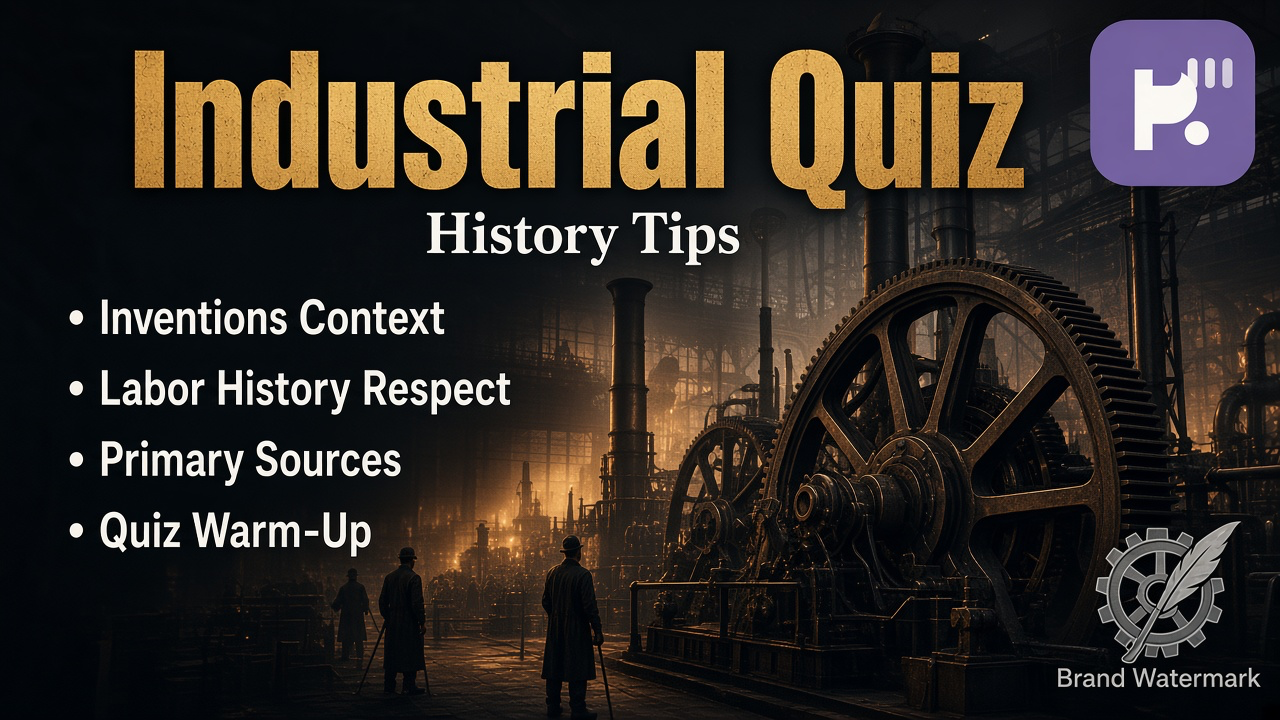
Tips at a glance
A quick takeaway graphic with topic tips (not your personal quiz scores). Start the quiz for your index, bands, and charts.
What this quiz can and cannot tell you
Can tell you
- Highlight timeline, source, and labor context habits worth revisiting before the next industrial discussion
- Separate unofficial history reflection from AP, IB, or instructor essay grading
- Encourage document citations and respectful unit chat without public shame spirals
- Spark better questions about factory-era sources without claiming exam authority
Cannot tell you
- Replace AP or IB history exams, proctored finals, or instructor rubrics on document essays
- Prove essay grades, university admission, or history course exemption from one couch screener
- Give permission to map steam-age debates onto modern election fights without syllabus sources
- Substitute for reading assigned primary sources when teachers require annotations or DBQ practice
Why Industrial Revolution quizzes need sources, labor context, and exam separation
Search traffic around Industrial Revolution quizzes usually wants a playful mirror after the factory assignment, not AP clearance or modern dunk ambushes. Those goals help when readers place mechanization, steam spread, and reform anchors on a timeline and cite assigned reports from syllabus packets. They hurt when one afternoon myths replace document reading, or when agree bars get treated as proof someone should skip the labor DBQ.
Dr. James Whitfield reviews iq-cognitive history screeners with a simple split: reward honest timeline curiosity and honest limits on exam substitution myths at the same time. Timeline and technology literacy tracks factory-era anchors tied to handouts. Primary source habits tracks reports, citations, and partial viewpoints. Labor context and multiple views tracks crowding, child labor, conflicting bias language, and refusing modern partisan dunk theater.
Real students mix bars. You might score high on timelines while keeping primary source bars moderate, which often describes careful classmates who still argue causes from podcasts alone. Reverse items catch one-afternoon history, optional primary sources, modern team-wins-Manchester claims, or essay waiver myths.
Pair results with siblings on this hub instead of forcing one genius industrial story. Our world history quiz stays on general study habits when research sources need blurbs beside national units. Our French revolution quiz explores 1789 source habits with separate stem banks. Our American revolution quiz widens Atlantic revolution parallels when syllabi assign them. Browse the IQ and cognitive test hub for more study screeners.
| Test | Focus |
|---|---|
| World history quiz | General world history study framing rather than industrial primary source habits here |
| French revolution quiz | 1789 timeline and source habits rather than factory-era industrial stems on this page |
| American revolution quiz | Atlantic revolution parallel themes rather than steam-age labor context focus here |
Industrial Revolution Quiz FAQ
What does the Industrial Revolution Quiz measure?
It measures how much you agree with statements about timeline literacy, primary source habits, labor context and multiple views, and quiz-not-AP limits. You get an index from 0 to 100 plus four bars. It reflects self-reported industrial history study habits on this screener, not AP exam scores.
Does this quiz cover every industrial nation and the entire nineteenth century?
Items stay focused on classroom anchors, factory growth, reform themes, and source habits your unit likely assigns first. Regional depth and later imperial threads belong in instructor packets when your syllabus moves on.
Why include primary source items on an industrial history quiz?
Document essays and DBQ-style tasks reward citation habits. Source items nudge learners back toward assigned factory reports and reform speeches instead of meme-only recaps.
Can this replace an AP or IB history exam?
No. Instructors and official exam boards own timed history gates. This page is unofficial warm-up reflection only and cannot substitute for scored finals or graded essays.
Who reviewed this quiz?
Dr. James Whitfield reviewed the educational framing, AP separation, source and labor context language, and result explanations. See our editorial policy for review standards.
Reviewed by