What the Humerus Labeling Quiz measures
This quiz does not certify orthopedic licensure, replace instructor practicals, or diagnose arm injuries from labeled photos. It measures how much you agree with unofficial humerus labeling reflection grouped four ways: proximal and distal landmarks about head, tubercle, neck, shaft, and condyle language; shoulder and elbow joint links about glenoid and trochlea connections at unit depth; humerus osteology humility about atlases versus web triage cosplay; and quiz-not-ortho-lab-exam limits about humble captions. You rate 22 statements from strongly disagree to strongly agree, with reverse-worded traps so one lucky poster cannot inflate every bar. Your answers also feed a second chart on closeness and trust habits.
Proximal and distal landmarks
Head, tubercle, condyles in order.
Shoulder and elbow joint links
Glenoid and trochlea connections.
Humerus osteology humility
Atlas practice without triage cosplay.
Quiz not ortho lab exam
Warm-up without licensure myths.
How it works
Answer 22 agreement items
Rate each statement from Strongly disagree to Strongly agree. Tap Next after each answer.
Answers sort into four domains
Each answer feeds one of four humerus labeling study groups, and every item also feeds a closeness and trust layer.
See your index and charts
You get a 0 to 100 index, a band, four domain bars, and a second chart for intimacy habits.
Take the Humerus Labeling Quiz
Answer 22 short statements to see your humerus labeling literacy index, four domain bars, and a closeness and trust chart.
What your result means
Your index is the average of all 22 answers, scaled from 0 to 100, with reverse-worded items flipped first. Read joint link bars with landmark bars together before you treat a high total as practical proof. Instructors still own graded depth.
| Band | Index range | Typical reading |
|---|---|---|
| Building humerus labeling literacy | 0 to 35 | Fewer agreed habits on proximal distal landmarks, shoulder elbow links, humility, or quiz-not-lab limits. |
| Mixed humerus labeling literacy | 36 to 65 | Solid bone recall with softer bars on landmarks, joint links, or humility items. |
| Strong humerus labeling literacy | 66 to 100 | Frequent agreement with habits and limits; still unofficial study reflection only. |
Tips at a glance
A quick takeaway graphic with topic tips (not your personal quiz scores). Start the quiz for your index, bands, and charts.
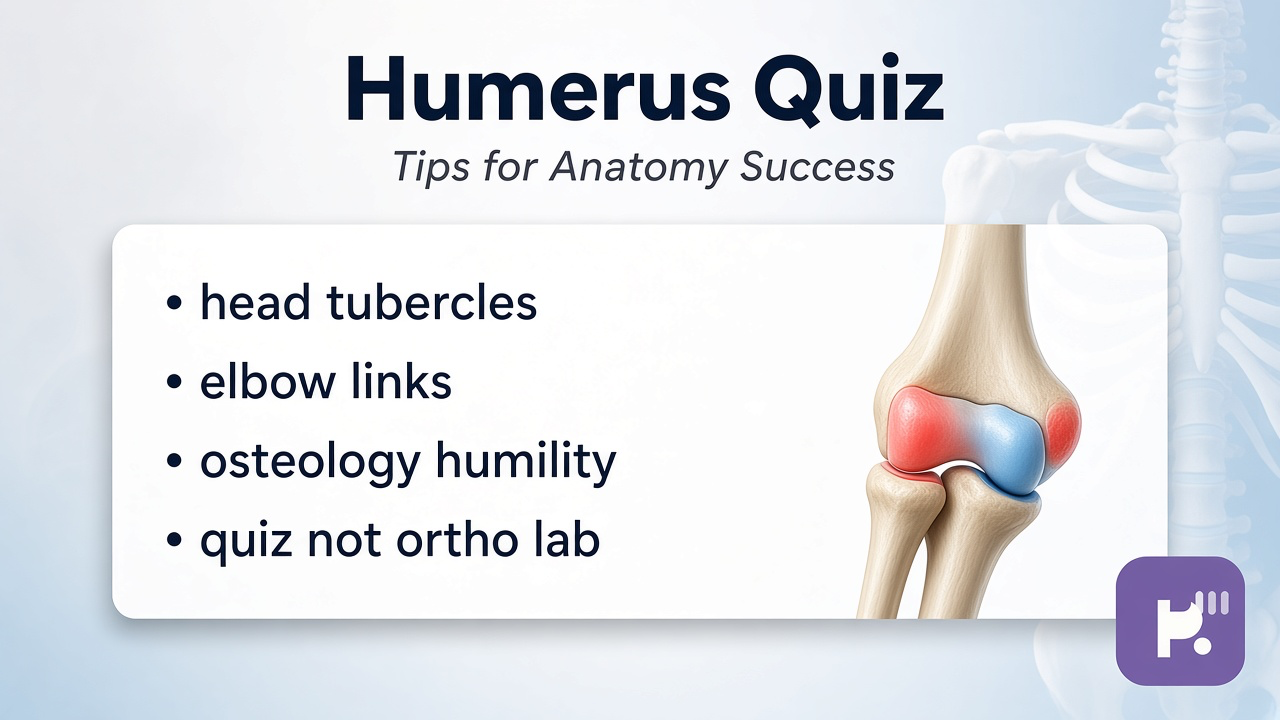
What this quiz can and cannot tell you
Can tell you
- Highlight landmark and joint topics worth revisiting before upper-limb practicals
- Separate respectful study reflection from fracture triage dunk threads
- Encourage atlas citations without shame spirals about first-block gaps
- Spark better study questions about humerus flow without claiming licensure
Cannot tell you
- Replace medical school, athletic training clinicals, or instructor practical exams
- Diagnose fractures, nerve injuries, or emergencies from quiz bars
- Prove you may skip supervision or mock classmates from literacy height
- Predict board scores or declare who counts as a real orthopedist from bars alone
Landmarks, joint links, and study literacy without orthopedic cosplay
Students search humerus labeling quizzes when tubercle names blur mid semester and sports clips mislabel epicondyles for jokes. Those goals help when readers treat bars as a study map and cite atlases. They hurt when couch scores become proof you may triage friends arm pain.
Proximal landmarks reward head, greater tubercle, and anatomical neck order before distal condyle language. Left-right practice keeps epicondyle labels from swapping when you flip the chart. Distal trochlea and capitulum links belong to elbow units your syllabus names.
Shoulder links connect humeral head to glenoid language without pretending couch quizzes read MRI films. Rotator cuff rehab debates belong in sibling screeners, not in every humerus stem on this page.
Pair results with siblings instead of forcing one limb story. Our appendicular skeleton quiz covers whole-limb bone order with separate stems. Our bone landmarks quiz widens landmark trivia when cuff weeks overlap. Our clavicle labeling quiz stays on shoulder girdle labels. Browse the IQ and cognitive test hub for more study screeners.
| Test | Focus |
|---|---|
| Appendicular skeleton quiz | Whole-limb bone order rather than humerus-only landmark depth on this page |
| Bone landmarks quiz | Mixed landmark trivia rather than four-domain humerus ethics depth here |
| Clavicle labeling quiz | Shoulder girdle labels rather than humerus proximal distal stems on this screener |
Humerus Labeling Quiz FAQ
What does the Humerus Labeling Quiz measure?
It measures how much you agree with statements about proximal and distal landmarks, shoulder and elbow joint links, osteology humility, and quiz-not-lab limits. You get an index from 0 to 100 plus four bars reflecting self-rated labeling habits on this screener.
Can I use results to judge arm fractures or sports injuries?
No. Limit items reject triage cosplay. Deformity, severe pain, or numbness after injury need emergency care and licensed clinicians.
Does a high score mean I passed an anatomy or orthopedic practical?
No. Instructors and proctored exams own graded outcomes. High bars describe habits you endorsed here, not licensure or lab clearance.
How is this different from the appendicular skeleton quiz?
This page emphasizes humerus landmark and joint-link depth. The appendicular sibling covers broader limb bone order with wholly separate stems.
Who reviewed this quiz?
Dr. James Whitfield reviewed the educational framing, study-limit language, and result explanations. See our editorial policy for review standards.
Reviewed by