What the How Do Men Perceive You Quiz measures
This quiz does not score how attractive men find you, predict dating success, or certify male gaze totals from bar height. It measures how much you agree with unofficial humility statements grouped four ways: self-worth beyond ratings about value apart from polls; consent and boundary habits about opt-in attention without surveillance; anti-objectification manners about refusing ranking games; and quiz-not-male-gaze-verdict limits about inspired framing and refusal to treat hobby bars like how hot men think I am proof. You rate 22 statements from strongly disagree to strongly agree, with reverse-worded traps so comparison spirals cannot inflate every bar. Your answers also feed a second chart on closeness and trust habits. The total becomes an index from 0 to 100 where higher means more reported humility habits on this screener, not proof of male attention.
Self-worth beyond ratings
You are not a poll.
Consent and boundary habits
Opt-in attention.
Anti-objectification manners
People not props.
Quiz not male gaze verdict
Mirror not scoreboard.
How it works
Answer 22 agreement items
Rate each statement from Strongly disagree to Strongly agree. Tap Next after each answer.
Answers sort into four domains
Each answer feeds one of four perception humility groups, and every item also feeds a closeness and trust layer.
See your index and charts
You get a 0 to 100 index, a band, four domain bars, and a second chart for intimacy habits.
Take the How Do Men Perceive You Quiz
Answer 22 short statements to see your perception humility index, four domain bars, and a closeness and trust chart.
What your result means
Your index is the average of all 22 answers, scaled from 0 to 100, with reverse-worded items flipped first. Read anti-objectification bars together with limit bars before you treat a high score as dating authority. Safety still beats scoreboards when someone ignores no.
| Band | Index range | Typical reading |
|---|---|---|
| Building perception humility reflection | 0 to 35 | Fewer agreed habits on self-worth beyond ratings, consent and boundary habits, anti-objectification manners, and quiz-not-male-gaze-verdict limits or unofficial limit items. |
| Mixed perception humility reflection | 36 to 65 | Solid habits in some domains with softer bars on limits or humility items. |
| Strong perception humility reflection | 66 to 100 | Frequent agreement with habits and limits; still unofficial reflection only. |
Tips at a glance
A quick takeaway graphic with topic tips (not your personal quiz scores). Start the quiz for your index, bands, and charts.
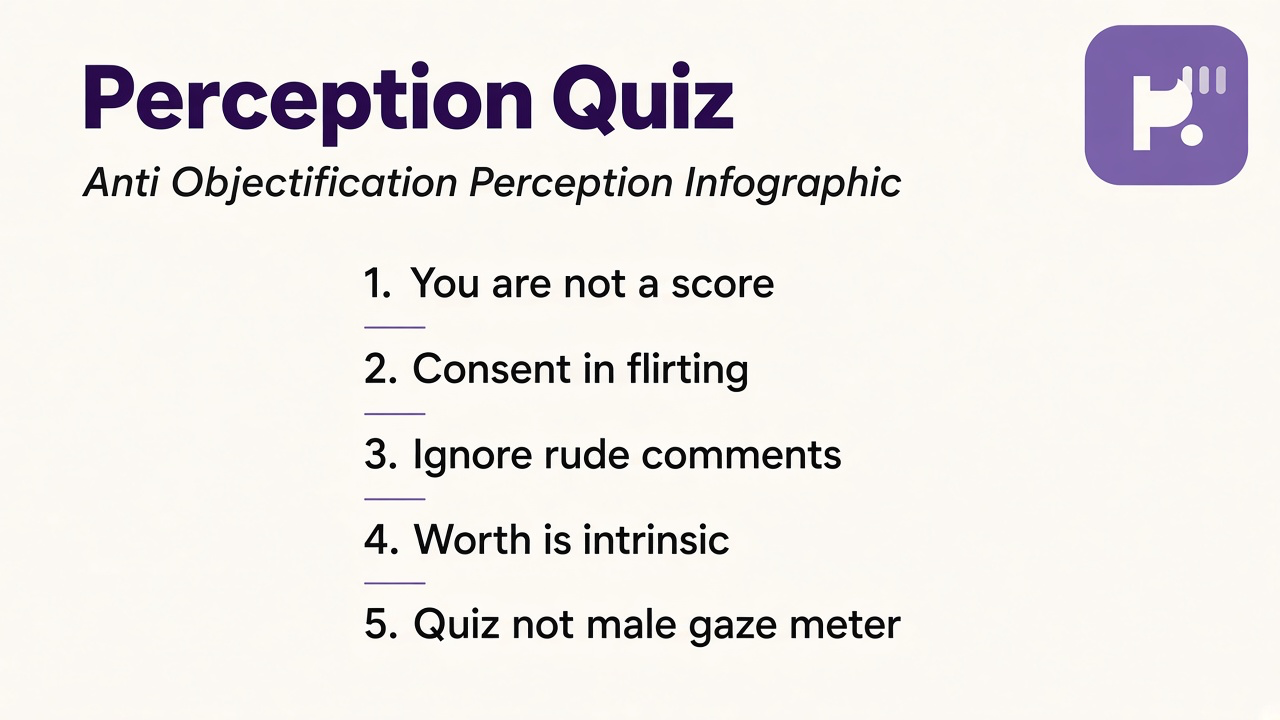
What this quiz can and cannot tell you
Can tell you
- Highlight self-worth, consent, and anti-objectification habits worth revisiting during dating seasons
- Separate playful reflection from male gaze scoreboards and hot-or-not cosplay
- Encourage opt-in flirtation without shaming chosen style
- Spark healthier boundary talks without claiming bars measure male attention
Cannot tell you
- Prove how men or anyone perceives your attractiveness from couch bars
- Predict dating success, marriage timing, or partner loyalty from one screener
- License stalking, revenge posts, or ranking strangers bodies online
- Replace therapists or advocates when fear, coercion, or violence appears
Why perception quizzes need self-worth, consent, anti-objectification, and male-gaze separation
Search traffic around how men perceive you mixes honest insecurity with feeds that treat male attention like a public leaderboard. Humility screeners help when readers anchor worth beyond polls, practice consent, and refuse gaze scoreboards. They hurt when agree bars become proof someone should stalk crushes or dunk people who dress boldly.
Dr. Priya Sharma reviews self-image screeners with a simple split: reward boundary habits and reward refusal of objectification cosplay at the same time. Self-worth items track value beyond likes. Consent items track surveillance myths. Anti-objectification items track ranking games. Limit items keep the page separate from male gaze verdict machines.
Reverse items catch stare-count obsession, ex surveillance, and rating every woman in a room. Those myths should not inflate bars meant to track respectful humility habits.
Pair with our body image questionnaire BIQ when appearance concern needs another lens. Our am I attractive quiz sibling uses separate stems with its own unofficial limits. Our red flag or green flag quiz explores concern patterns rather than gaze scoreboards here. Browse the self image and appearance hub for more reflection screeners.
| Test | Focus |
|---|---|
| Body image questionnaire BIQ | Body image concern patterns rather than male gaze humility lanes here |
| Am I attractive quiz | Distinct attractiveness reflection stems with separate unofficial limits |
| Red flag or green flag quiz | Concern pattern reflection rather than perception scoreboard manners on this page |
How Do Men Perceive You Quiz FAQ
What does the How Do Men Perceive You Quiz measure?
It measures how much you agree with statements about self-worth beyond ratings, consent and boundary habits, anti-objectification manners, and quiz-not-male-gaze-verdict limits. You get an index from 0 to 100 plus four bars reflecting self-rated habits on this screener.
Does this quiz tell me how men perceive me?
No. Limit items reject male gaze verdict cosplay. Bars describe humility and boundary habits you endorsed here, not measurements of stranger attention.
Can high bars prove I am attractive to men?
No. Reverse items reject hotness proof myths. Attractiveness is not a scoreboard this page can certify.
Is this therapy or abuse assessment?
No. Seek licensed clinicians or advocates when fear, control, or violence appears. This page stays unofficial reflection only.
Who reviewed this quiz?
Dr. Priya Sharma reviewed the self-image framing, boundary language, and result explanations. See our editorial policy for review standards.
Reviewed by