What the Heart Murmur Quiz measures
This quiz does not diagnose murmurs, read echocardiograms, or replace clinical skills exams. It measures how much you agree with heart murmur study literacy statements grouped four ways: innocent versus pathologic study about benign traits and red-flag patterns at syllabus depth; site and timing vocabulary about apex, base, systole, and diastole language; reporting and student scope about notifying instructors within training limits; and quiz-not-murmur-diagnosis limits about playful captions and refusing echo cosplay. You rate 22 statements from strongly disagree to strongly agree, with reverse-worded traps so one lucky audio meme cannot inflate every bar. Your answers also feed a second chart on closeness and trust habits. The total becomes an index from 0 to 100 where higher means more reported study literacy on this screener.
Innocent versus pathologic study
Benign traits versus red-flag patterns at intro depth.
Site and timing vocabulary
Apex, base, systole, and S1 S2 orientation.
Reporting and student scope
Notify instructors without hallway verdicts.
Quiz not murmur diagnosis
Study warm up without echo cosplay.
How it works
Answer 22 agreement items
Rate each statement from Strongly disagree to Strongly agree. Tap Next after each answer.
Answers sort into four domains
Each answer feeds one of four murmur study groups, and every item also feeds a closeness and trust layer.
See your index and charts
You get a 0 to 100 index, a band, four domain bars, and a second chart for intimacy habits.
Take the Heart Murmur Quiz
Answer 22 short statements to see your heart murmur study literacy index, four domain bars, and a closeness and trust chart.
What your result means
Your index is the average of all 22 answers, scaled from 0 to 100, with reverse-worded items flipped first. Read timing bars with reporting bars together before you treat a high total as echo proof. Instructors still own graded auscultation outcomes.
| Band | Index range | Typical reading |
|---|---|---|
| Building murmur study literacy | 0 to 35 | Fewer agreed habits on innocent versus pathologic study, site timing, reporting, or diagnosis-limit items. |
| Mixed murmur study literacy | 36 to 65 | Solid S1 S2 recall with site blur, reporting slips, or unofficial limit corners. |
| Strong murmur study literacy | 66 to 100 | Frequent agreement with study habits and limits; still unofficial practice only. |
Tips at a glance
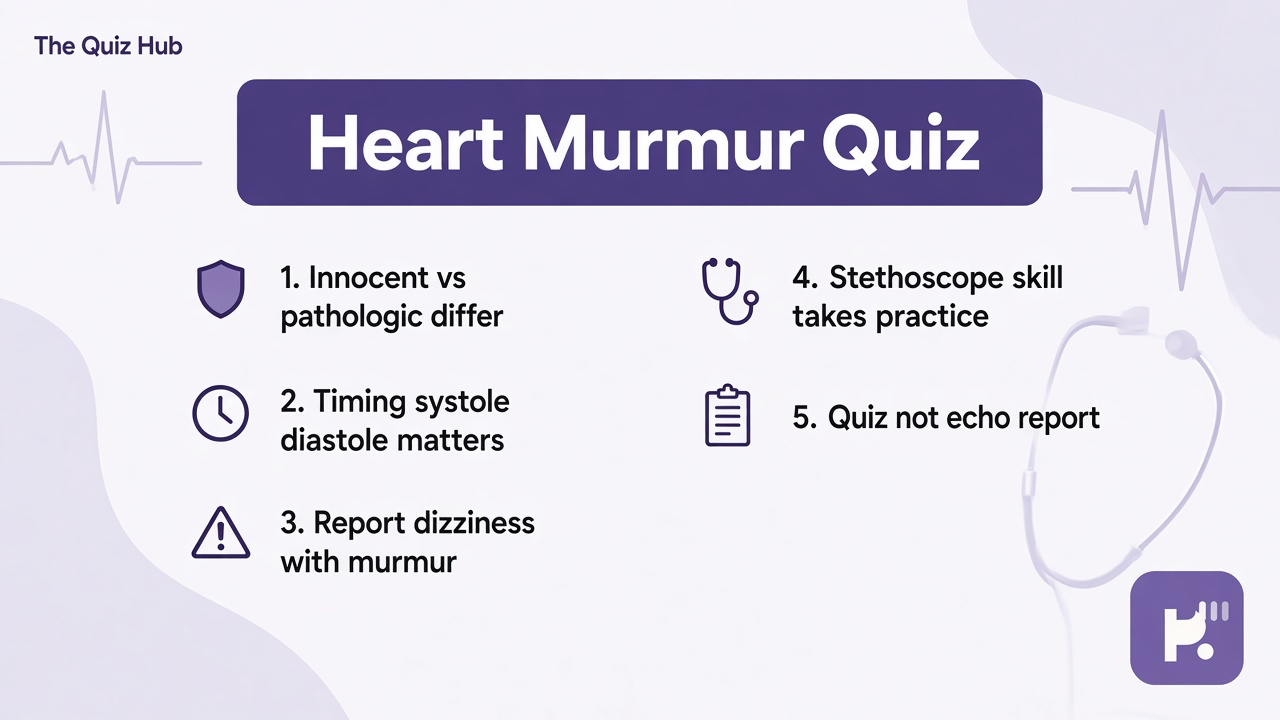
A quick takeaway graphic with topic tips (not your personal quiz scores). Start the quiz for your index, bands, and charts.
What this quiz can and cannot tell you
Can tell you
- Highlight innocent versus pathologic, timing, and reporting topics worth revisiting before skills labs
- Separate respectful study reflection from hallway diagnosis dunk threads
- Encourage instructor audio citations without shame spirals about first-lab gaps
- Spark better study questions about murmurs without claiming cardiology authority
Cannot tell you
- Replace clinical skills exams, echo training, or licensed murmur workups
- Diagnose innocent versus pathologic murmurs for real patients from quiz bars
- Prove you may skip preceptor listens or imaging orders from bar height
- Predict skills exam scores or declare cardiology readiness from bars alone
Innocent versus pathologic study, timing words, and limits without echo cosplay
Students search heart murmur quizzes when S1 S2 orientation blurs before skills lab and social audio clips skip timing vocabulary. Those goals help when readers treat bars as a study map and replay instructor files. They hurt when couch scores become proof you may label hallway listens as pathologic. Study reflection works best when limit items sit beside original stems.
Innocent murmur study tracks soft systolic examples and healthy youth cases from manuals without panic-every-sound myths. Pathologic red flags stay at syllabus depth until clinicians order exams students do not perform. Site and timing literacy practices apex versus base language with systolic and diastole terms on labeled recordings.
Reporting literacy rehearses notifying instructors or RNs within student scope and avoids patient clips without consent training. Reverse items catch hallway diagnosis cosplay and silent-report myths that should not inflate study bars.
Pair results with siblings instead of forcing one stethoscope genius story. Our heart anatomy quiz supports chamber recall when anatomy week overlaps. Our heart block quiz explores conduction study with separate stems. Our fundamentals of nursing quiz widens assessment manners. Browse the mental health and clinical hub for more YMYL screeners. Caption shares as study practice and skip murmur verdicts on real people.
| Test | Focus |
|---|---|
| Heart anatomy quiz | Chamber and valve structure recall rather than murmur timing depth here |
| Heart block quiz | AV conduction and strip study rather than auscultation site timing on this page |
| Fundamentals of nursing quiz | Broader nursing assessment habits rather than murmur-specific audio lanes here |
Heart Murmur Quiz FAQ
What does the Heart Murmur Quiz measure?
It measures how much you agree with statements about innocent versus pathologic study, site and timing vocabulary, reporting and student scope, and quiz-not-murmur-diagnosis limits. You get an index from 0 to 100 plus four bars reflecting self-rated study habits on this screener.
Can I use results to tell someone their murmur is harmless?
No. Limit items reject diagnosis cosplay. Murmur workups require licensed exams and imaging beyond couch bars.
Does a high score mean I passed auscultation skills?
No. Instructors and proctored skills exams own graded outcomes. High bars describe habits you endorsed here, not clinical clearance.
How is this different from the heart anatomy quiz?
This page emphasizes murmur types, timing, and reporting study. The anatomy sibling focuses chamber structure recall with separate stems.
Who reviewed this quiz?
Dr. Elena Vasquez reviewed the educational framing, YMYL study-limit language, and result explanations. See our editorial policy for review standards.
Reviewed by