What the GCS Quiz measures
This quiz does not triage patients, score head injuries from photos, or replace EMS or emergency departments. It measures how much you agree with Glasgow Coma Scale literacy statements grouped four ways: GCS vocabulary literacy about eye, verbal, and motor components summed under protocols without faking myths; eye verbal motor humility about moment snapshots, sedation context, and pediatric versus adult teaching without emergency delay cosplay; EMS and handoff literacy about unresponsive victims, worsening head injury, and structured handoff phrases without telling bystanders to stand down; and unofficial GCS limits about study mirrors without stranger scoring threads or screenshot clinic authority. You rate 22 statements from strongly disagree to strongly agree, with reverse-worded traps so one lucky guess cannot inflate every bar. Your answers also feed a second chart on closeness and trust habits, because trauma news sometimes collides with friendship stress when fear runs hot. The total becomes an index from 0 to 100 where higher means more reported GCS literacy habits on this screener, not proof you may perform bedside assessment.
GCS vocabulary literacy
Eye, verbal, motor parts and summed totals.
Eye verbal motor humility
Moment snapshots, sedation, context.
EMS and handoff literacy
Call emergency services; structured handoff.
Unofficial GCS limits
Quiz mirror only; clinicians score patients.
How it works
Answer 22 agreement items
Rate each statement from Strongly disagree to Strongly agree. Tap Next after each answer.
Answers sort into four domains
Each answer feeds one of four GCS literacy groups, and every item also feeds a closeness and trust layer.
See your index and charts
You get a 0 to 100 index, a band, four domain bars, and a second chart for intimacy habits.
Take the GCS Quiz
Answer 22 short statements to see your GCS literacy index, four domain bars, and a closeness and trust chart.
What your result means
Your index is the average of all 22 answers, scaled from 0 to 100, with reverse-worded items flipped first. Read unofficial GCS limit bars together with EMS literacy before you treat a high score as triage permission. Call emergency services when someone is unresponsive; cozy reflection supports study spaces, not delayed care.
| Band | Index range | Typical reading |
|---|---|---|
| Building GCS literacy | 0 to 35 | Fewer agreed habits on GCS vocabulary, component humility, EMS literacy, or unofficial limits on this screener. |
| Mixed GCS literacy | 36 to 65 | Solid literacy with faking myths, photo scoring, EMS delay slips, or ranking poll traps. |
| Strong GCS literacy | 66 to 100 | Frequent agreement with literacy, component humility, EMS habits, and unofficial limits; still not triage. |
Tips at a glance
A quick takeaway graphic with topic tips (not your personal quiz scores). Start the quiz for your index, bands, and charts.
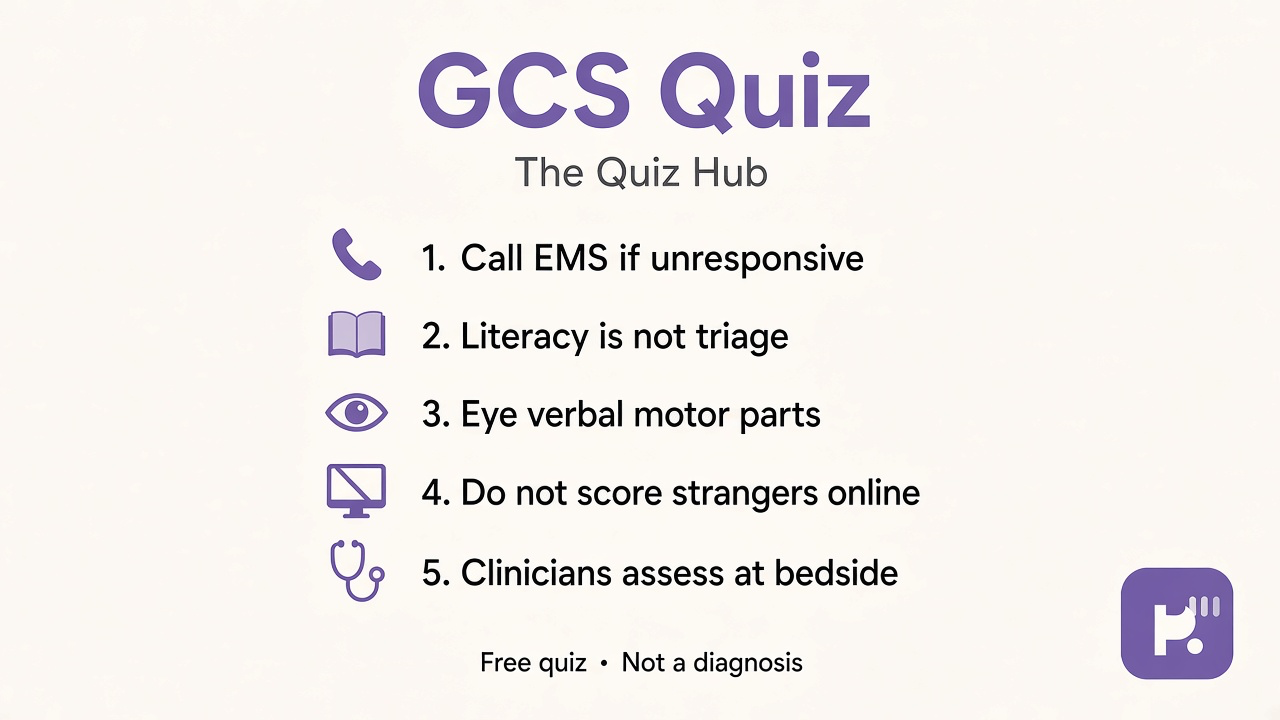
What this quiz can and cannot tell you
Can tell you
- Highlight GCS vocabulary and component habits worth revisiting before you comment on trauma posts
- Separate unofficial literacy from triage cosplay and stranger scoring threads
- Encourage EMS activation language without public shame spirals
- Spark better nursing study questions without claiming bedside authority
Cannot tell you
- Replace EMS, emergency departments, nursing assessment, or hands-on certification
- Prove triage clearance or score real patients from photos or agree totals
- Give permission to delay emergency calls when someone is unresponsive
- Rank accident victims in polls because literacy bars looked tall
Why GCS quizzes need component humility and not-triage limits
Search traffic around GCS quizzes usually wants a mirror after a nursing lecture, a first-aid unit, or a trauma headline, not a field triage badge or a stranger scoring thread. Those goals help when readers name eye, verbal, and motor parts, respect EMS activation, and keep literacy separate from bedside authority. They hurt when meme totals delay emergency calls, or when photo guesses replace hands-on assessment. GCS literacy works best when it pairs vocabulary with unofficial limits while staying distinct from general nursing trivia siblings.
Dr. Elena Vasquez reviews clinical literacy screeners with a split between accurate trauma vocabulary and accurate refusal to triage from couches. GCS vocabulary literacy tracks Glasgow Coma Scale summaries without faking myths. Eye verbal motor humility tracks moment snapshots and context without emergency delay cosplay. EMS and handoff literacy tracks activation and structured phrases without telling bystanders to stand down. Unofficial GCS limits keep screeners separate from stranger scoring polls and screenshot clinic authority.
Real students mix bars. You might score high on vocabulary while EMS phrases stay moderate, which often describes someone strong on charts but new to handoff practice. You might score high literacy with softer limit items, which can mean you avoid polls yet still treat totals like triage cosplay in private. Reverse items catch photo scoring, EMS delay myths, and ranking polls that should not inflate bars meant to track study manners.
Pair results with siblings instead of forcing one trauma story. Our fundamentals of nursing quiz sibling emphasizes broader nursing study habits with separate stems from GCS literacy here. Our mental health and clinical hub collects more YMYL screeners with unofficial banks. Browse carefully before you comment on real cases. Caption shares as study literacy, credit instructors, and never score injured people online.
News cycles and clinical rotations rotate faster than one screener snapshot. An EMS bar might rise after one simulation lab while vocabulary stayed steady all semester. When you share results, say unofficial GCS literacy habits. When real emergencies happen, call local emergency services first. Retake after one trauma unit and watch whether unofficial limit bars stay high even if vocabulary enthusiasm rises.
| Test | Focus |
|---|---|
| Fundamentals of nursing quiz | Broader nursing study habits rather than GCS component literacy here |
| Mental health and clinical hub | More YMYL screeners with separate unofficial question banks |
| Gaslighting victim questionnaire (VGQ) | Abuse reflection literacy rather than trauma consciousness scoring here |
GCS Quiz FAQ
What does the GCS Quiz measure?
It measures how much you agree with statements about Glasgow Coma Scale vocabulary, eye verbal motor humility, EMS handoff literacy, and unofficial limits. You get an index from 0 to 100 plus four bars. It reflects self-rated study habits on this screener, not official patient scores.
Can I use this to triage a head injury?
No. Call emergency services when someone is unresponsive or worsening. Literacy items reject triage cosplay and emergency delay myths.
Is this the official Glasgow Coma Scale form?
No. This page focuses on public education literacy. Bedside scoring belongs to trained clinicians and EMS protocols.
How is this different from the fundamentals of nursing quiz?
This quiz centers GCS components and not-triage limits. The fundamentals of nursing quiz sibling uses separate stems aimed at broader nursing habits rather than consciousness scale literacy here.
Who reviewed this quiz?
Dr. Elena Vasquez reviewed the YMYL literacy framing, EMS activation norms, and result explanations. See our editorial policy for review standards.
Reviewed by