What the From Author Avtor Ne Ustanovlen quiz measures
This quiz does not grade your course, certify academic integrity compliance, or tell instructors whether to accept your references. It measures how much you agree with unofficial citation-literacy statements grouped four ways: missing metadata literacy about author unknown, n.d., and translated Avtor ne ustanovlen lines as prompts to trace real sources without inventing theorists; honest citation habits about citing the document you read, paraphrase credit, working bibliographies, and refusing meme templates or quiz-as-reference-list myths; plagiarism refusal literacy about refusing purchased essays, pasted summaries, hidden copying games, and skipping common-knowledge questions with instructors; and unofficial academic limits about informal framing, refusal to treat hobby bars as honor code waivers, consented sharing, and zero permission to cheat because metadata was missing. You rate 22 statements from strongly disagree to strongly agree, with reverse-worded traps so agreeable mood cannot hide shortcut habits. Your answers also feed a second chart on closeness and trust habits, because shame about school struggles sometimes blocks asking for help. The total becomes an index from 0 to 100 where higher means more reported literacy habits on this screener, not proof your institution endorsed you.
Missing metadata literacy
Author unknown signals trace the source; do not invent names.
Honest citation habits
Cite what you read; paraphrase still needs credit.
Plagiarism refusal literacy
Reject paste shortcuts and essay mills with clear limits.
Unofficial academic limits
Reflection only; syllabi and librarians still own rules.
How it works
Answer 22 agreement items
Rate each statement from Strongly disagree to Strongly agree. Tap Next after each answer.
Answers sort into four domains
Each answer feeds one of four citation literacy groups, and every item also feeds a closeness and trust layer.
See your index and charts
You get a 0 to 100 index, a band, four domain bars, and a second chart for intimacy habits.
Take the From Author Avtor Ne Ustanovlen
Answer 22 short statements to see your citation literacy index, four domain bars, and a closeness and trust chart.
What your result means
Your index is the average of all 22 answers, scaled from 0 to 100, with reverse-worded items flipped first. Read metadata and plagiarism-refusal bars together with unofficial limit scores before you treat a high total as submission clearance. Educational reflection supports kinder library visits; instructors, librarians, and honor councils still own course-specific decisions.
| Band | Index range | Typical reading |
|---|---|---|
| Building citation literacy | 0 to 35 | Fewer agreed habits on missing metadata, honest citation, plagiarism refusal, or unofficial academic limits on this screener. |
| Mixed citation literacy | 36 to 65 | Solid awareness in some domains with fake-author slips, light paraphrase traps, summary-paste myths, or quiz-as-waiver corners. |
| Strong citation literacy | 66 to 100 | Frequent agreement with metadata tracing, honest citation, plagiarism refusal, and unofficial limits; still not a course grade. |
Tips at a glance
A quick takeaway graphic with topic tips (not your personal quiz scores). Start the quiz for your index, bands, and charts.
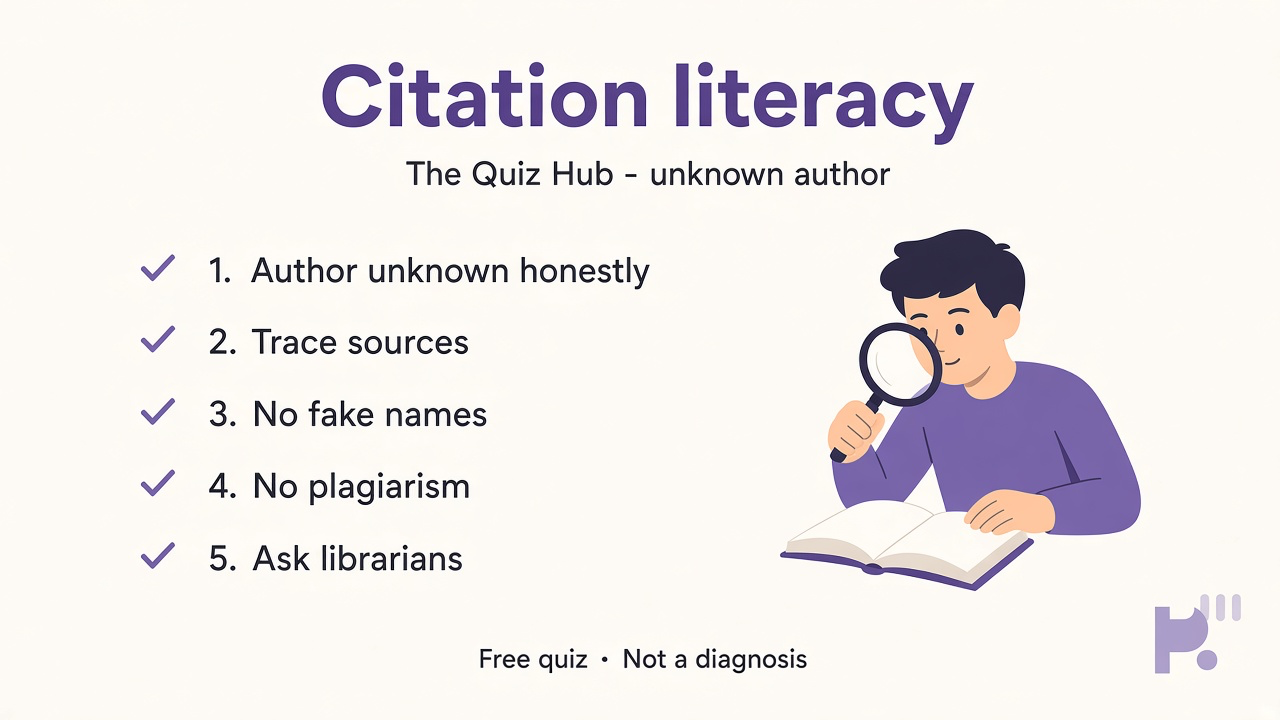
What this quiz can and cannot tell you
Can tell you
- Highlight unknown-author and citation vocabulary worth practicing before the next psych summary assignment
- Separate informal literacy from plagiarism encouragement or fabricated reference habits
- Encourage librarian and writing-center visits without shame spirals or shortcut theater
- Spark better questions about metadata without claiming grading authority
Cannot tell you
- Replace your syllabus, honor code, instructor feedback, or accredited librarian guidance
- Prove a paper is ethical or unethical from one agree screener
- Give permission to cheat, buy essays, or omit citations based on bar height
- Certify that you met APA, MLA, or Chicago rules for a specific institutional assignment
Why unknown-author psych summaries need citation literacy, not invented names
Search traffic around Avtor ne ustanovlen often follows international students translating psych handouts where author lines were lost, while English threads treat missing metadata as permission to paste or pick a famous theorist. Those goals help when readers trace originals, label author unknown honestly, and visit librarians before deadlines. They hurt when literacy bars become proof someone may sell uncited summaries, or when hobby totals replace honor code reading. Citation literacy works best when it pairs metadata humility with plagiarism refusal and stays distinct from grammar drill siblings on this hub.
Dr. Priya Sharma reviews educational screeners with a simple split: reward honest tracing habits and honest refusal of cheat shortcuts at the same time. Missing metadata literacy tracks author unknown and n.d. labels as search prompts without inventing scholars. Honest citation habits tracks what you actually read with paraphrase credit and working bibliographies. Plagiarism refusal literacy tracks quotes, group chat ethics, and essay-mill refusal without shame-as-virtue traps. Unofficial academic limits track informal framing, syllabus humility, and consented sharing.
Real students mix bars. You might score high on refusal language while keeping metadata tracing moderate, which often describes careful quote markers yet rushed PDF hoarding. You might score high literacy with softer limit items, which can mean you avoid bragging yet still treat quiz totals like waiver notes. Reverse items catch overconfidence: random theorist names, two-word paraphrase, public-domain fantasies, quiz-as-reference-list myths, or essay-mill licenses should not inflate scores meant to track layered habits.
Pair results with siblings on this hub instead of forcing one citation story. Our either-or neither-nor quiz explores grammar stems rather than unknown-author literacy framing on this page. Our femur labeling quiz includes atlas citation habits with separate anatomy stems from metadata tracing here. Our fetal pig anatomy quiz stays on lab literacy rather than psych summary citation on this screener. Browse the personality and psychology hub for more reflection screeners. Share scores as study conversation starters with consent, not as orders about who cheats.
Finals season moves faster than one calm bibliography field on a draft. A metadata bar might dip after one all-nighter while refusal recall stays high until you retake gently. When you share results, say unofficial literacy habits. When you borrow tips, credit librarians who taught you tracing steps and classmates who deserve privacy off-screen. Retake after one graded paper and watch whether unofficial limit bars stay high even if citation habits rise, which often means you separated curious study from shortcut pressure.
| Test | Focus |
|---|---|
| Either-or neither-nor quiz | Grammar and construction stems rather than unknown-author citation literacy on this page |
| Femur labeling quiz | Anatomy atlas citation habits rather than psych summary metadata tracing here |
| Fetal pig anatomy quiz | Lab manual literacy rather than Avtor ne ustanovlen citation framing on this screener |
From Author Avtor Ne Ustanovlen FAQ
What does the From Author Avtor Ne Ustanovlen quiz measure?
It measures how much you agree with statements about missing metadata literacy, honest citation habits, plagiarism refusal literacy, and unofficial academic limits. You get an index from 0 to 100 plus four bars. It reflects self-reported study habits on this screener, not your course grade.
Does this quiz encourage plagiarism when the author is unknown?
No. Items explicitly reject pasted summaries, essay mills, and invented author names. Literacy means tracing sources and citing honestly, not skipping attribution.
What does Avtor ne ustanovlen mean?
It is a Russian phrase meaning author not established or author unknown, often printed when metadata was lost in translated psych materials. This page uses it as a literacy theme, not as a real person.
Can a high score replace my reference list?
No. Strong bars describe habits you endorsed here, such as tracing PDFs and refusing shortcuts. Instructors still require syllabus-specific references and style rules.
Who reviewed this quiz?
Dr. Priya Sharma reviewed the unofficial framing, plagiarism refusal separation, academic limit tone, and result explanations. See our editorial policy for review standards.
Reviewed by