What the Femur Labeling Quiz measures
This quiz does not grade your cadaver lab, certify orthopedic surgery, or scan your femur on an X-ray. It measures how much you agree with introductory femur diagram literacy grouped four ways: proximal femur landmarks about head, neck, and trochanters; femoral shaft features about mid-shaft orientation and linea aspera; distal femur landmarks about condyles, notch, and patellar groove language; and labeling study limits about atlas citations, specimen respect, and leaving fracture care to trained teams. You answer 22 statements from strongly disagree to strongly agree, with reverse-worded myths so shortcut agreements cannot inflate every bar. Your answers also feed a second chart on closeness and trust habits, because competitive lab culture sometimes pushes bragging over learning. The total becomes an index from 0 to 100 where higher means more reported femur labeling literacy on this screener, not proof you should skip instructors when imaging or injuries look serious.
Proximal femur landmarks
Femoral head, neck, greater and lesser trochanters, and hip joint context on teaching diagrams.
Femoral shaft features
Shaft midportion, posterior linea aspera, and orientation cues before knee labels.
Distal femur landmarks
Medial and lateral condyles, intercondylar notch, and patellar groove at the knee end.
Labeling study limits
Atlas study, lab ethics, no OR credentialing, and trauma protocols over trivia pride.
How it works
Answer 22 agreement items
Rate each statement from Strongly disagree to Strongly agree. Tap Next after each answer.
Answers sort into four domains
Each answer feeds one of four femur labeling groups, and every item also feeds a closeness and trust layer.
See your index and charts
You get a 0 to 100 index, a band, four domain bars, and a second chart for intimacy habits.
Take the Femur Labeling Quiz
Answer 22 short statements to see your femur labeling literacy index, four domain bars, and a closeness and trust chart.
What your result means
Your index is the average of all 22 answers, scaled from 0 to 100, with reverse-worded items flipped first. Higher means more reported femur labeling literacy on this screener. Read study limit and distal landmark bars together before you treat the total as clinical authority.
| Band | Index range | Typical reading |
|---|---|---|
| Building femur labeling literacy | 0 to 35 | Fewer agreed labels on proximal landmarks, shaft features, distal condyles, or study limits on this screener. |
| Mixed femur labeling literacy | 36 to 65 | Solid labels in some regions with myths about head-patella sameness, shaft-condyle swaps, or quiz-based credentialing. |
| Strong femur labeling literacy | 66 to 100 | Frequent agreement with accurate femur region labels and healthy study limits. |
Tips at a glance
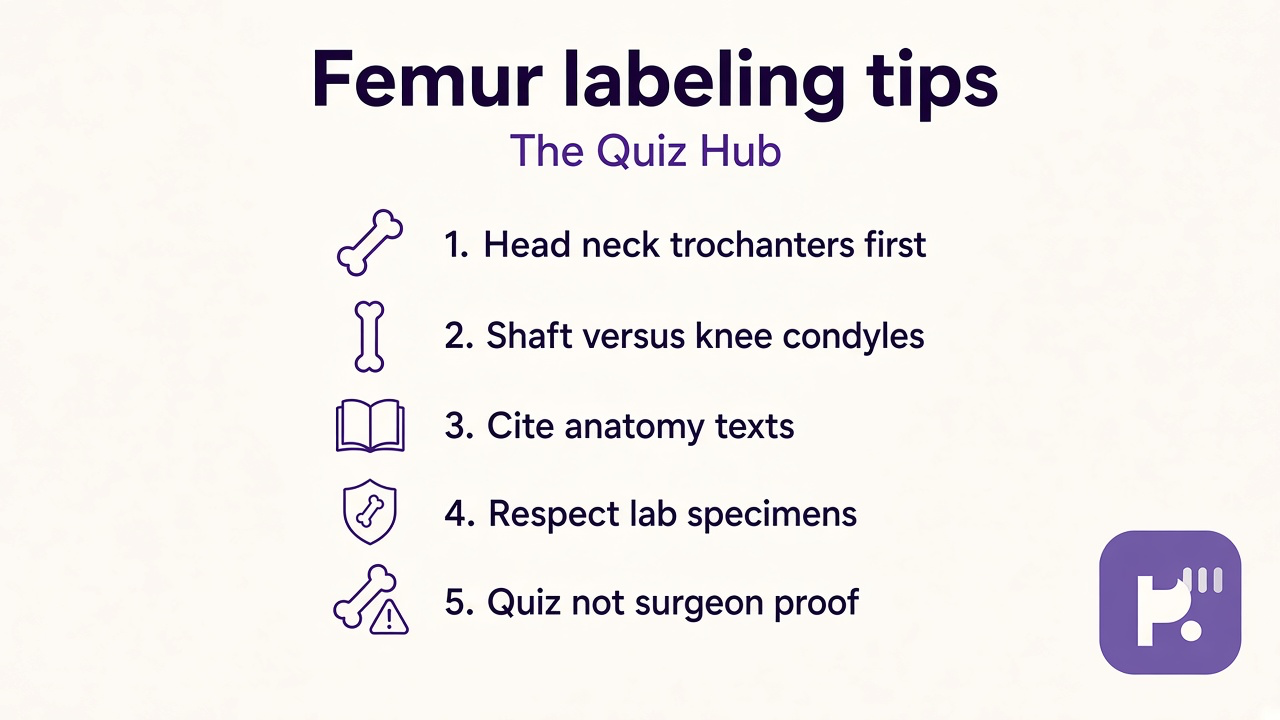
A quick takeaway graphic with topic tips (not your personal quiz scores). Start the quiz for your index, bands, and charts.
What this quiz can and cannot tell you
Can tell you
- Clarify head, neck, trochanter, shaft, and condyle names in plain language
- Highlight common head-patella and shaft-condyle swap myths worth unlearning
- Encourage atlas and model retakes without shame
- Spark better questions during A&P or radiology intro units
Cannot tell you
- Diagnose femur fractures, avascular necrosis, or hip dislocation from trivia answers
- Replace cadaver lab, imaging interpretation courses, or surgical credentialing
- Certify you for reduction, pinning, or prescribing without licensure
- Prove a limb is safe when open fracture, pulse loss, or severe deformity appears
Femur labels from hip head to knee condyles
Students search femur labeling when an A&P unit hands them an unmarked thigh bone and every bump looks equally important. The femur is the longest bone in the body, so instructors expect you to partition it: proximal hip end, long shaft, distal knee end. Mixing those regions on one vague label is the trap this screener flags on purpose.
Proximal landmarks anchor hip vocabulary. The femoral head sits in the acetabulum; the neck is the slender bridge students mark on AP hip teaching films; greater and lesser trochanters are distinct palpable and diagram bumps, not interchangeable slang. Calling the patella part of the femoral head or naming the whole thigh head because it is near the hip are myths worth rejecting before you retake.
Shaft literacy keeps mid-femur honest. The linea aspera is a posterior ridge tied to muscle attachment lists in atlases. Anterior versus posterior views matter because you cannot see every landmark on one flat drawing. Treating the shaft as identical to distal condyles breaks the story of how the knee end widens for joint surfaces.
Distal labels finish the bone at the knee. Medial and lateral condyles, the intercondylar notch between them, and the anterior patellar groove or trochlear region belong to intro knee chapters. Tibial plateau names belong on the tibia, not pasted onto femur charts because joints sit side by side, not fused into one sticker.
Study limits are the fourth domain because labeling scores tempt overconfidence. Retakes, atlases, and respectful lab rules are normal class prep; they do not mean you finished orthopedics residency. Agreeing that perfect trivia replaces imaging consults when staff worry about a hip film is another myth worth rejecting. Use this screener as a warm-up, not a verdict. Pair it with our anatomical landmarks quiz for surface point warm-up, the anatomy quiz for broader structure recall, or the fetal pig anatomy quiz when your course uses specimen labeling ethics in the same term. Browse the IQ and cognitive test hub for more low-stakes study games. Retake after you can trace one femur top to bottom without peeking; literacy grows when regions stay in order, not when you memorize that femur starts with f and hope condyles never appear on the final.
| Test | Focus |
|---|---|
| Anatomical landmarks quiz | Human surface palpation points, not full femur head-to-condyle diagram depth |
| Anatomy quiz | General structure recall rather than thigh-bone region labeling drill |
| Fetal pig anatomy quiz | Specimen dissection literacy and lab respect, not adult femur radiology labels |
Femur Labeling Quiz FAQ
What does the Femur Labeling Quiz measure?
It measures how much you agree with introductory femur diagram literacy across proximal landmarks, shaft features, distal knee-end labels, and study limits. You get an index from 0 to 100 and four bars. It reflects self-reported labeling habits on this screener, not a proctored lab practical or IQ score.
Is this quiz enough to manage femur fractures or hip injuries?
No. It is diagram trivia and study literacy. Open fractures, pulseless limbs, severe deformity, or staff concern on imaging need emergency and orthopedic protocols, not a high score here.
Why are some statements worded as myths?
Reverse-worded myths catch overconfidence. Agreeing that the femoral head equals the patella, that the shaft is the same as condyles, that linea aspera never appears on exams, or that trivia replaces imaging consults should not inflate your literacy index.
Does this cover every muscle attachment or radiology projection?
This screener stays at shared intro labeling: regions, major bumps, and study habits. Advanced muscle origin lists, full CT/MRI interpretation, and surgical fixation belong in dedicated courses and supervised practice.
Who reviewed this quiz?
Dr. James Whitfield, PhD reviewed the educational framing, femur labeling limits, and result explanations. See our editorial policy for review standards.
Reviewed by