What workplace flexibility measures
This quiz does not administer licensed Big Five, Hogan, or HR personality inventories, and it cannot predict job performance or hiring fit from one score. It measures how much you agree with unofficial workplace adaptability statements grouped four ways: role adaptability habits about curiosity toward new tools, workflows, and team norms without conspiracy or seniority myths; feedback pivot habits about hearing critique as data, asking examples, and trying one change without shame collapse or insult acceptance; flex team without boundary loss about covering teammates while naming capacity, scope, and off-hours limits instead of infinite flexibility performance; and quiz not HR personality limits about unofficial reflection, low bars as timing not trash labels, and refusing viral type dunking from bar height. You rate 22 statements from strongly disagree to strongly agree, with reverse-worded traps so one lucky guess cannot inflate every bar. Your answers also feed a second chart on closeness and trust habits, because fear of disappointing managers sometimes blocks honest capacity talks. The total becomes an index from 0 to 100 where higher means more reported workplace flexibility literacy on this screener, not proof you should accept every scope creep or rewrite coworkers roles.
Role adaptability habits
Curiosity toward new tools and norms without conspiracy panic.
Feedback pivot habits
Critique as data with examples, not global shame verdicts.
Flex team without boundary loss
Help teammates while naming capacity and off-hours limits.
Quiz not HR limits
Reflection only; hiring and type labels belong with proper process.
How it works
Answer 22 agreement items
Rate each statement from Strongly disagree to Strongly agree. Tap Next after each answer.
Answers sort into four domains
Each answer feeds one of four workplace flexibility groups, and every item also feeds a closeness and trust layer.
See your index and charts
You get a 0 to 100 index, a band, four domain bars, and a second chart for intimacy habits.
Take the Flexibility of Personality in the Workplace
Answer 22 short statements to see your workplace flexibility index, four domain bars, and a closeness and trust chart.
What your result means
Your index is the average of all 22 answers, scaled from 0 to 100, with reverse-worded items flipped first. Read quiz-not-HR bars together with boundary habits before you treat a high score as permission to overwork or relabel coworkers. Adaptability reflection supports kinder team talks; HR, unions, and clinicians still own formal personality assessment and harassment response when harm is present.
| Band | Index range | Typical reading |
|---|---|---|
| Building workplace flexibility literacy | 0 to 35 | Fewer agreed habits on role adaptability, feedback pivots, boundary-aware teamwork, or quiz-not-HR limits on this screener. |
| Mixed workplace flexibility literacy | 36 to 65 | Solid pivot skills in some domains with resistance myths, boundary erosion, or HR cosplay traps in others. |
| Strong workplace flexibility literacy | 66 to 100 | Frequent agreement with adaptability, feedback pivots, boundary-aware flex, and quiz-not-HR limits; still reflection only. |
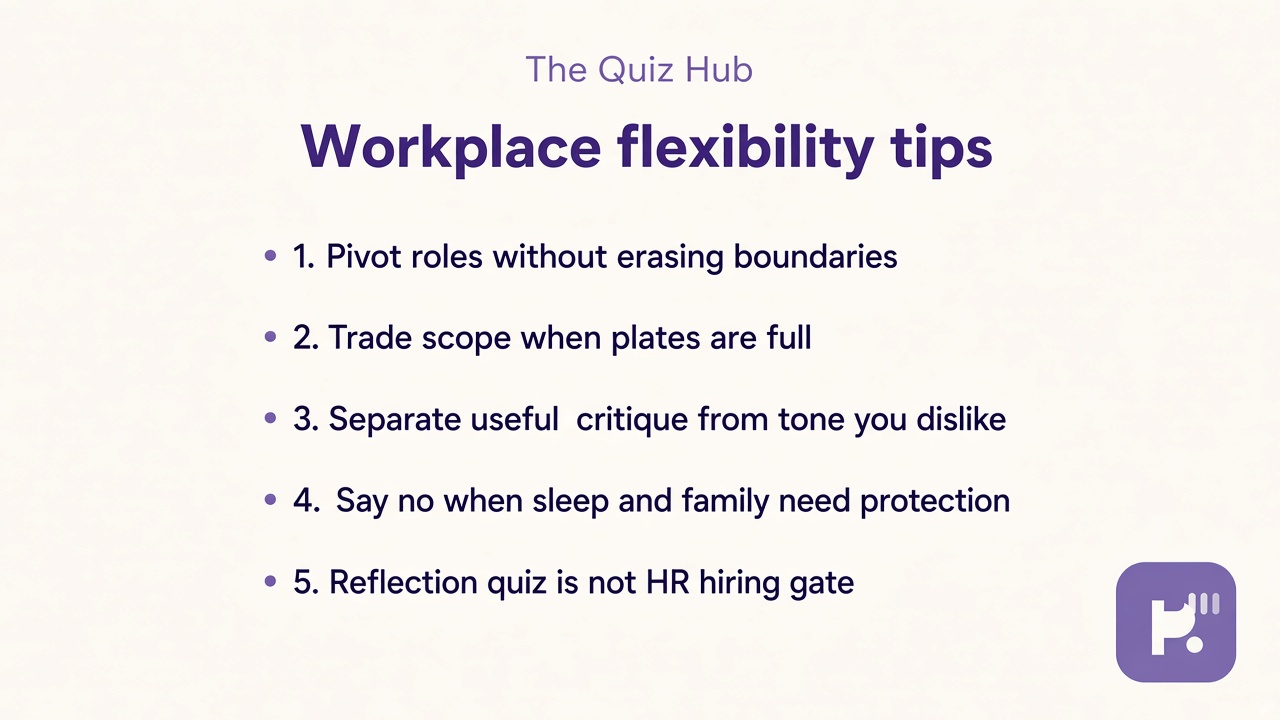
Tips at a glance
A quick takeaway graphic with topic tips (not your personal quiz scores). Start the quiz for your index, bands, and charts.
What this quiz can and cannot tell you
Can tell you
- Highlight adaptability, feedback pivot, and boundary habits worth revisiting before the next reorg
- Separate unofficial reflection from HR inventory cosplay or viral type rankings
- Encourage capacity conversations without shaming rigid stereotypes
- Spark better team language about change without claiming hiring authority
Cannot tell you
- Predict promotion, firing, or job fit from one agree screener
- Replace HR investigations, union processes, or licensed occupational testing
- Prove moral worth or leadership rank from bar height
- License scope creep or identity erasure because flexibility bars looked high
Workplace adaptability before type dunking and HR cosplay
Search traffic around workplace personality flexibility usually wants two things: language when change feels personal, and relief when feedback stings without meaning identity is fixed. Those goals help when teams name curiosity, pivot after critique, and protect capacity. They hurt when quiz bars become hiring proof, or when hustle culture treats boundaries as weakness. Adaptability literacy works best when it names feedback habits and unofficial limits together.
Dr. Priya Sharma reviews personality-psychology workplace screeners with a simple split: reward honest learning habits and honest limits on HR fantasy at the same time. Role adaptability tracks experiments and training asks without every change becoming a firing conspiracy. Feedback pivot tracks examples and one-behavior adjustments without insult acceptance myths. Flex team without boundary loss tracks helpful coverage with scope trade-offs instead of infinite yes performance. Quiz not HR keeps screeners separate from hiring inventories and viral type dunking.
Real professionals mix bars. You might score high on role adaptability while keeping feedback pivot moderate, which often describes fast learners who still need shame-aware coaching. You might score high pivot with softer boundary items, which can mean you adjust after notes yet still over-yes until burnout. Reverse items catch sloppy answers: resistance as always smart, insults as mandatory coaching, never saying no as team virtue, or high bars licensing job rewrites should not inflate charts meant to track layered adaptability knowledge.
Pair results with siblings on this hub instead of forcing one office story. Our feedback style quiz explores giving feedback habits with stems separate from receiving pivots here. Our find out what kind of leader you are sibling angles toward leadership reflection when you want a distinct bank. Our feedback sensitivity scale covers critique reactivity frequency rather than agree-item adaptability habits on this page. Browse the personality and psychology hub for more light screeners. Share scores as conversation starters with consent, not as HR files.
Reorg seasons refresh faster than meme type threads. When you share results, say unofficial adaptability mirror. When you borrow tips, credit managers who honored capacity and teammates who disagreed without rigid labels. Retake after one project cycle and watch whether quiz-not-HR bars stay high even if adaptability rises, which often means you separated learning habits from actual boundary habits.
| Test | Focus |
|---|---|
| Feedback style quiz | Giving feedback habits rather than receiving pivot and adaptability stems on this page |
| Find out what kind of leader you are | Leadership reflection lane rather than everyday workplace flexibility habits here |
| Feedback sensitivity scale | Critique reactivity frequency rather than agree-item adaptability literacy on this screener |
Flexibility of Personality in the Workplace FAQ
What does workplace personality flexibility measure?
It measures how much you agree with statements about role adaptability, feedback pivot habits, flexible teamwork with boundaries, and quiz-not-HR limits. You get an index from 0 to 100 plus four bars. It describes self-reported adaptability habits on this screener, not hiring fit or licensed personality typing.
Is this an HR personality test for hiring?
No. Quiz-not-HR items keep the page unofficial. Employers use validated inventories and structured processes; this screener is couch reflection and habit prompts only.
Does a high score mean I should say yes to every task?
No. Flex-with-boundary items reject infinite yes myths. High bars mean you related to habit statements here, not that you must erase capacity limits for managers.
Does low flexibility mean I am a bad employee?
Not automatically. Low bars can reflect burnout timing, new-role overwhelm, or rigid culture stress. Use domains as a map for one experiment or support conversation, not a moral sentence.
Who reviewed this quiz?
Dr. Priya Sharma reviewed the educational framing, boundary-aware adaptability tone, and unofficial HR limits. See our editorial policy for review standards.
Reviewed by