What this Fitzpatrick skin type quiz measures
This page does not administer a licensed dermatology Fitzpatrick examination, assign official phototype categories for treatment decisions, or diagnose skin cancer from one score. It measures how much you agree with habits educators and clinicians often discuss when sun exposure meets self-image and event photography, organized four ways: burn and tan awareness when you notice reaction patterns without treating one beach trip as lifelong proof; SPF and shade habits when broad-spectrum protection, reapplication, hats, and peak-UV breaks show up in real plans; photography and makeup context when flash, filters, and undertone matching stay separate from skin health moralizing; and Fitzpatrick quiz limits when unofficial screeners replace dermatology visits, rank strangers by tone, or treat meme charts as clinic substitutes. You rate 22 statements from strongly disagree to strongly agree, with reverse-worded tanning myths so one base-tan brag cannot inflate every bar. Your responses also feed a second chart on closeness and trust habits, because appearance shame sometimes blocks asking for shade or skin checks. The total becomes an index from 0 to 100 where higher means stronger reported sun-safety literacy on this screener. Your answers suggest habits to discuss with clinicians when spots or burns worry you; they do not prove you owe anyone a specific tan or tone.
Burn and tan awareness
How much you notice reaction patterns without one-day diagnosis myths.
SPF and shade habits
How much practical protection shows up before and during outdoor time.
Photography and makeup context
How much lighting and undertone stay separate from filter shame spirals.
Fitzpatrick quiz limits
How much quiz humility and clinician routing beat online typing myths.
How it works
Answer 22 agreement items
Rate each statement from strongly disagree to strongly agree. Tap Next after each answer.
Answers sort into four domains
Each answer feeds one of four sun-safety literacy groups, and every item also feeds a closeness and trust layer.
See your index and charts
You get a 0 to 100 index, a band, and two bar charts you can use for personal notes or clinician questions.
Take the Fitzpatrick Skin Type Quiz
Answer 22 short statements to see your Fitzpatrick sun-safety literacy index, four domain bars, and a closeness and trust chart.
What your result means
Your index is the average of all 22 answers, scaled from 0 to 100, with reverse-worded myths flipped first. Higher means stronger reported sun-safety literacy on this screener. Read Fitzpatrick quiz limits with SPF bars before you treat any total as clinical typing proof. Suspicious moles, severe burns, or unsafe despair deserve licensed care, not only retakes.
| Band | Index range | Typical reading |
|---|---|---|
| Growing sun-safety literacy | 0 to 35 | Less agreement with burn awareness, SPF habits, photo context, or unofficial limit items on this screener. |
| Mixed sun-safety literacy | 36 to 65 | Some strong burn awareness or SPF habits alongside softer photo context or limit myths on other items. |
| Stronger sun-safety literacy | 66 to 100 | Frequent agreement with burn awareness, SPF habits, and photo context; pair with Fitzpatrick limit bars. |
Tips at a glance
A quick takeaway graphic with topic tips (not your personal quiz scores). Start the quiz for your index, bands, and charts.
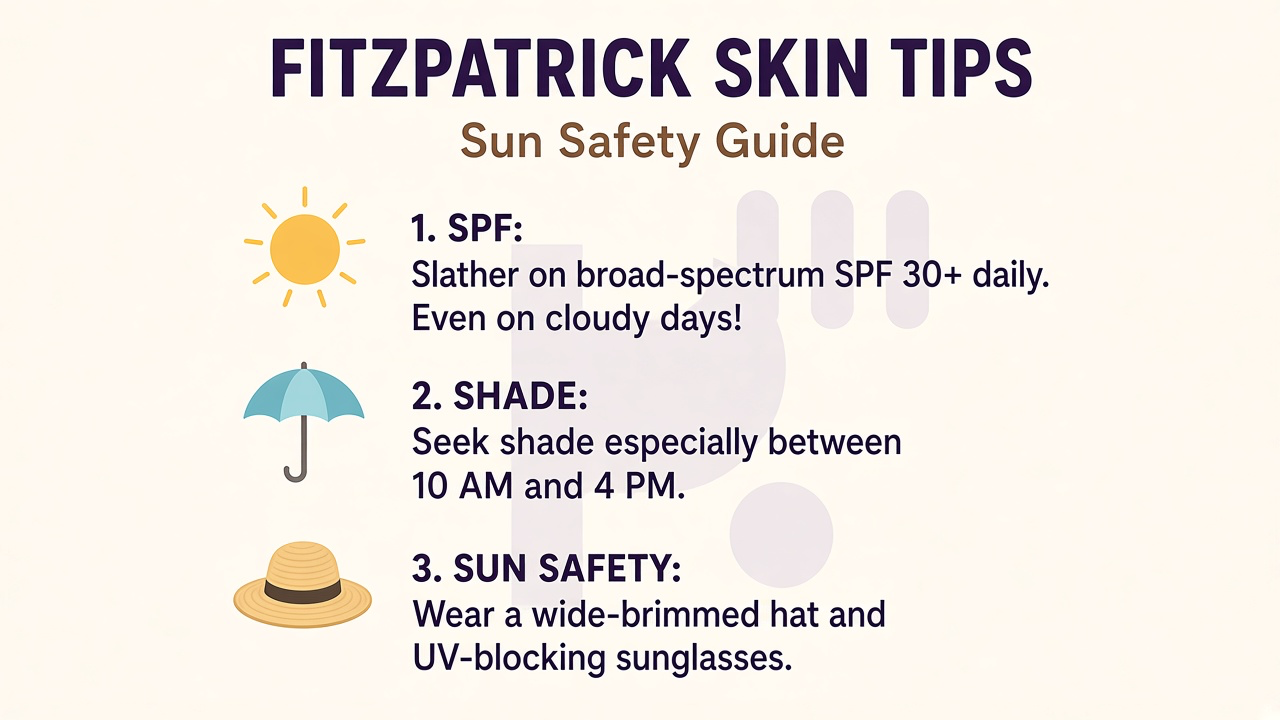
What this quiz can and cannot tell you
Can tell you
- Name burn awareness, SPF, and photo-context habits in plain language for dermatology questions
- Highlight when tanning myths, stranger ranking, or skipping skin checks show up in answers
- Support event planning conversations about shade and SPF without forcing one online label
- Offer a baseline if you retake after one honest sun-exposure log week
Cannot tell you
- Diagnose skin cancer, melanoma risk, or photodermatitis from one score
- Replace in-person Fitzpatrick assessment used in laser or treatment settings
- Prescribe SPF numbers or medical therapies from one bar chart
- Substitute for emergency care when burns blister widely or despair feels unsafe
Burn patterns, SPF habits, and quiz-not-diagnosis limits
Traffic to Fitzpatrick pages mixes legitimate sun-protection questions with appearance shame and filter comparison spirals. Dermatology educators discuss how burn-and-tan history, medications, and UV index interact, which is why in-person assessment matters for procedures and risk conversations. This online screener uses that literacy lens unofficially; it cannot replace skin exams or tell you which treatment fits without your history and clinician judgment.
Burn and tan awareness covers noticing whether you burn first, treating painful burns as signals to protect next time, and refusing base-tan myths that excuse skipped SPF. SPF and shade habits cover broad-spectrum use, reapplication after water or sweat, hats and sleeves at peak UV, and kind teaching without tone policing strangers.
Photography and makeup context covers flash and window light when matching foundation, separating filters from health, and enjoying group photos while still planning outdoor protection. Real people mix bars. You might score high SPF habits with softer photo-context items after one harsh wedding weekend. Reverse items catch tanning-bed myths, stranger ranking, and diagnosis cosplay.
Pair results with siblings on this hub instead of forcing one skin story. Our fear of negative evaluation of appearance FNAES sibling tracks mirror and judgment frequency with separate wording, not Fitzpatrick literacy here. Our concealer quiz focuses on undertone matching habits rather than burn-pattern awareness on this page. Our electromagnetic spectrum quiz covers UV physics literacy rather than event-photo context here. Browse the self image and appearance hub for more respectful appearance tools. Share scores as conversation starters, not orders to rank bodies in group chat.
Higher scores mean stronger self-reported sun-safety literacy on this tool, not permission to diagnose strangers. Bring domain bars to dermatology visits as habit examples, not as proof you skipped professional skin checks. If appearance despair spikes, prioritize clinicians or crisis support over retake loops. Retake after one week of honest SPF-and-shade notes when safe and compare bars, not only the total.
| Test | Focus |
|---|---|
| Fear of negative evaluation of appearance FNAES | Mirror and judgment fear frequency rather than Fitzpatrick sun-safety literacy on this quiz |
| Concealer quiz | Undertone and concealer matching habits rather than burn-pattern and SPF literacy here |
| Electromagnetic spectrum quiz | UV physics study habits rather than photography and makeup context on this page |
Fitzpatrick Skin Type Quiz FAQ
What does the Fitzpatrick skin type quiz measure?
It measures how much you agree with burn-and-tan awareness, SPF and shade habits, photography and makeup context, and Fitzpatrick limit statements. You get an index from 0 to 100 plus four domain bars. Your answers suggest self-reported sun-safety literacy for reflection, not a clinical phototype assignment.
Does this quiz officially type my Fitzpatrick skin category?
No. Licensed clinicians assess phototype in context for procedures and care plans. This page is an unofficial literacy screener with its own stems. It cannot replace skin exams or certify official Fitzpatrick categories from one online index.
How is this different from appearance fear screeners on this site?
Appearance fear screeners track mirror distress and judgment frequency. This Fitzpatrick quiz focuses on sun reaction awareness, SPF habits, and event-photo context with separate wording. Stems do not overlap; use each screener separately.
Can a high score tell me I am safe from skin cancer?
A higher score means you agreed with more sun-safety literacy statements here. It is not a cancer risk guarantee or reason to skip dermatology when moles change. Routine professional skin checks still matter when your clinician recommends them.
What should I do if I notice a new or changing spot?
Contact a licensed clinician or dermatology practice for an in-person evaluation rather than relying on quiz bars. Seek urgent care when burns are severe or despair about appearance feels unsafe.
Who reviewed this quiz?
Dr. Elena Vasquez, PhD reviewed the soft YMYL framing, unofficial instrument limits, sibling separation from FNAES and concealer wording, and result explanations. See our editorial policy for review standards.
Reviewed by