What the Financial Ratio Quiz measures
This quiz does not license CPAs, sign audits, or grade your course. It measures how much you agree with textbook financial ratio literacy grouped four ways: liquidity ratios about short-term payability, current ratio setup habits, and working capital companions without infinite-cash myths; leverage ratios about debt versus equity comparisons, risk magnification stories, and industry context without unlimited-debt traps; margin ratios about gross and net margin percents, numerator-denominator discipline, and markup distinction without formula confusion; and textbook not CPA about licensing exam depth, instructor authority on homework, and refusing to treat online bars like audit opinions. You rate 22 statements from strongly disagree to strongly agree, with reverse-worded traps so one lucky formula recall cannot inflate every bar. Your answers also feed a second chart on closeness and trust habits. The total becomes an index from 0 to 100 where higher means more reported ratio study literacy on this screener, not proof you may practice public accounting.
Liquidity ratios
Short-term payability, current ratio setup, and working capital companions.
Leverage ratios
Debt versus equity comparisons and cautious risk language from texts.
Margin ratios
Gross and net margin percents with labeled numerators and denominators.
Textbook not CPA
Licensing limits, instructor feedback, and quiz credential humility.
How it works
Answer 22 agreement items
Rate each statement from Strongly disagree to Strongly agree. Tap Next after each answer.
Answers sort into four domains
Each answer feeds one of four ratio literacy groups, and every item also feeds a closeness and trust layer.
See your index and charts
You get a 0 to 100 index, a band, four domain bars, and a second chart for intimacy habits.
Take the Financial Ratio Quiz
Answer 22 short statements to see your financial ratio literacy index, four domain bars, and a closeness and trust chart.
What your result means
Your index is the average of all 22 answers, scaled from 0 to 100, with reverse-worded items flipped first. Higher means more reported liquidity, leverage, margin, and textbook-limit agreement on this screener. Read textbook-not-CPA bars with margin setup before you treat a high liquidity bar as licensing permission.
| Band | Index range | Typical reading |
|---|---|---|
| Building ratio literacy | 0 to 35 | Fewer agreed liquidity, leverage, margin, or textbook-limit items on this screener. |
| Mixed ratio literacy | 36 to 65 | Solid margin recall mixed with liquidity myths, leverage traps, or CPA credential fantasies. |
| Strong ratio literacy | 66 to 100 | Frequent liquidity, leverage, margin, and textbook-limit agreement; still not credentialing. |
Tips at a glance
A quick takeaway graphic with topic tips (not your personal quiz scores). Start the quiz for your index, bands, and charts.
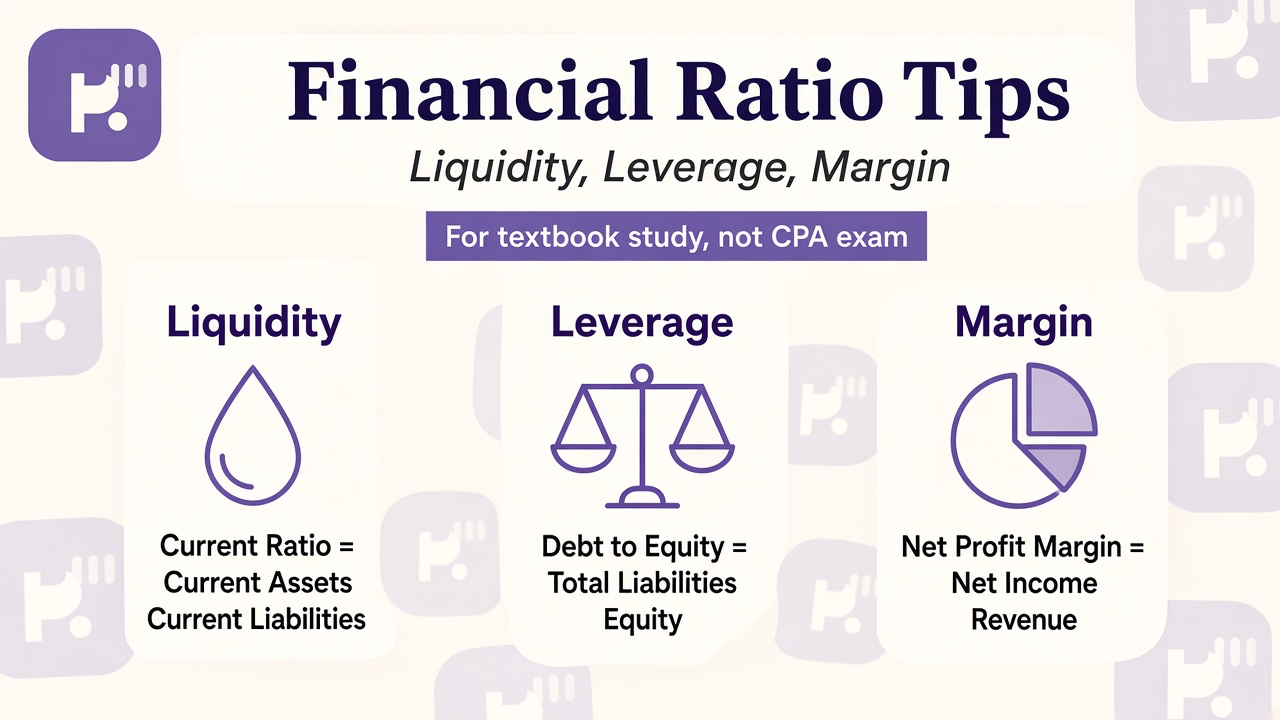
What this quiz can and cannot tell you
Can tell you
- Highlight liquidity, leverage, and margin habits worth revisiting before ratio exams
- Separate study curiosity from CPA fantasies without merging them into one trick lane
- Encourage instructor questions on denominators instead of calculator-only drops
- Give a playful baseline to retake after one textbook ratio chapter
Cannot tell you
- License CPAs, certify audits, or approve SEC filings from one online screener
- Replace graded homework, tutoring, or instructor partial credit on ratio setups
- Turn literacy scores into harassment of classmates over one homework decimal
- Guarantee job offers in accounting because bars look high today
Ratio literacy before CPA exam shortcuts
Search traffic around financial ratio quizzes usually wants two things: sound informed in intro finance without pretending to be a licensed CPA, and check whether liquidity, leverage, and margin vocabulary matches the textbook before midterms. Those goals help when readers treat bars as a study map. They hurt when people treat scores like audit badges, ignore denominators, or confuse margin with markup on every problem.
Dr. James Whitfield reviews iq cognitive study screeners with a simple split: reward honest agreement with widely taught ratio habits and honest limits on credential hype at the same time. Liquidity ratios tracks short-term payability stories, current ratio setup, and working capital companions without infinite-cash myths. Leverage ratios tracks debt versus equity comparisons and risk magnification without unlimited-debt health traps. Margin ratios tracks gross and net margin percents and setup discipline without markup equivalence myths. Textbook not CPA keeps licensing depth, instructor authority, and refusal to treat quiz bars like unqualified audit opinions visible beside bravado.
Real readers mix bars. You might score high on margin while keeping leverage moderate, which often describes income-statement comfort before balance sheet pairing clicks. You might score high on liquidity with softer textbook limits, which can mean strong formulas yet little exposure to what CPA pathways require. Reverse items catch sloppy answers: treasury solved forever, debt always healthy, margin equals markup always, or high indices like automatic audit licenses should not inflate bars meant to track layered study literacy.
Pair results with siblings on this hub instead of forcing one finance story. Our financial statement quiz leans balance sheet, income statement, and cash flow line labels when you want statement vocabulary separate from ratio relationships. The financial literacy quiz for high school students stays on teen money ethics when you want habits separate from college ratio units. Browse the IQ and cognitive test hub for more low stakes screeners. Caption shares as study practice and skip CPA dunking on friends still in chapter one.
Courses stack faster than one trivia night. Textbook editions, instructor rounding rules, and industry benchmarks shift what homework expects each term. When you share results, say instructors beat scoreboards for partial credit stories. When you borrow ratio tips, credit professors who teach setup before calculator speed. Retake after one ratio exam and watch whether textbook-not-CPA bars rise even if margin spikes, which often means you separated performative scoring from actual humility about licensing.
| Test | Focus |
|---|---|
| Financial statement quiz | Statement line labels and cash flow sections rather than ratio numerators |
| Financial literacy quiz for high school students | Teen budgeting ethics rather than college leverage ratios |
Financial Ratio Quiz FAQ
What does the Financial Ratio Quiz measure?
It measures how much you agree with statements about liquidity ratios, leverage ratios, margin ratios, and textbook-not-CPA limits. You get an index from 0 to 100 plus four bars. It describes self-rated study literacy on this screener, not CPA licenses, audit opinions, or course grades.
Is this a CPA exam or audit certification test?
No. This page builds introductory ratio literacy for class review. CPA exams, state boards, and audit firms issue credentials this screener cannot replace.
Does a high score mean my ratio homework is always correct?
No. High bars mean you related to literacy statements here. Graded work depends on setup, dates, rounding, and instructor rubrics, not online agree quizzes.
Why separate liquidity, leverage, and margin bars?
Intro finance search intent blends payability, debt, and profitability percents. Split bars keep formula wins separate from interpretation myths and licensing humility so results stay honest about which lanes you endorse.
Who reviewed this quiz?
Dr. James Whitfield, PhD reviewed the educational framing, textbook-not-CPA limits, and result explanations. See our editorial policy for review standards.
Reviewed by