What the Financial Management Quiz measures
This quiz does not certify CPA credentials, run payroll for employers, or score whether you should become a bookkeeper. It measures how much you agree with unofficial financial management literacy grouped four ways: budgeting basics about income maps, category splits, plan adjustments, and living documents versus shame ledgers; cash flow tracking about inflow-outflow timing, reconciliations, payday alignment, subscription drift, and learning-not-dunking; bill calendar habits about due-date visibility, autopay alignment, clustered due dates, weekly money dates, and shared household visibility; and study not accountant about self-study framing, kind tips, licensed professionals owning filings, and refusing bar-height CPA fantasies. You rate 22 statements from strongly disagree to strongly agree, with reverse-worded items so memory-only heroics cannot inflate every line. Your answers also feed a second chart on closeness and trust habits, because household money talk sometimes chases audit rights instead of support. The total becomes an index from 0 to 100 where higher means more reported financial management literacy and humble limits on this screener, not proof a state board mailed you licensure.
Budgeting basics
Income maps, categories, plan adjustments, and budgets as steering wheels not shame ledgers.
Cash flow tracking
Timing, reconciliations, payday alignment, subscription drift, and pattern learning.
Bill calendar
Due dates, autopay checks, money dates, and shared household visibility.
Study not accountant
Self-study reflection, kind shares, and no CPA license from online indexes.
How it works
Answer 22 agreement items
Rate each statement from Strongly disagree to Strongly agree. Tap Next after each answer.
Answers sort into four domains
Each answer feeds one of four financial management groups, and every item also feeds a closeness and trust layer.
See your index and charts
You get a 0 to 100 index, a band, four domain bars, and a second chart for intimacy habits.
Take the Financial Management Quiz
Answer 22 short statements to see your financial management literacy index, four domain bars, and a closeness and trust chart.
What your result means
Your index is the average of all 22 answers, scaled from 0 to 100, with reverse-worded items flipped first. Higher means more reported financial management literacy and kind study limits on this screener. Read cash flow tracking and bill calendar bars together before you treat the total as CPA certification.
| Band | Index range | Typical reading |
|---|---|---|
| Building cash flow systems | 0 to 35 | Fewer agreed budgeting, tracking, bill calendar, or study-not-accountant items on this screener. |
| Mixed management literacy | 36 to 65 | Some budget and calendar facts mixed with tracking gaps or credential slips. |
| Source-aware household systems | 66 to 100 | Frequent budget, tracking, calendar, and study-not-accountant agreement with kind sharing habits. |
Tips at a glance
A quick takeaway graphic with topic tips (not your personal quiz scores). Start the quiz for your index, bands, and charts.
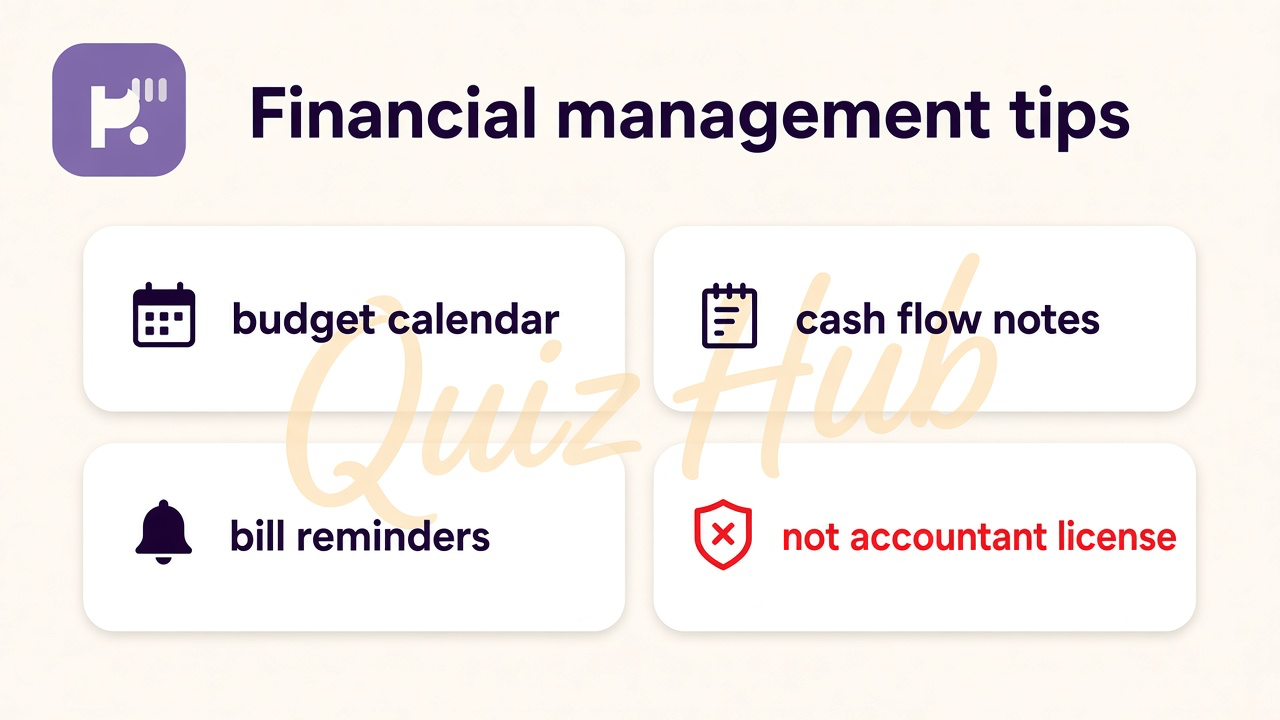
What this quiz can and cannot tell you
Can tell you
- Spot whether you rely on memory-only due dates or skip reconciliations
- Encourage weekly money dates and shared calendars without public shaming
- Separate self-study reflection from licensed accounting and payroll work
- Give a playful baseline to retake after one month of visible bill tracking
Cannot tell you
- Prove CPA, EA, or bookkeeping licenses or employer payroll certifications
- Replace tax filings, GAAP books, or business compliance review
- Certify affiliation with any accounting board or software vendor
- Tell someone which budget template they must use for their household or LLC
Financial management literacy without CPA cosplay
People land on financial management quizzes because color-coded spreadsheets go viral while due dates still cluster before payday. Budgets map income and categories so you steer before overdraft texts, not only after regret. Adjusting limits when income drops beats pretending last month’s grid still fits. Calling tracking useless because budgeting sounds boring is a myth this screener flags so readers try one month-end review.
Cash flow is timing, not one balance snapshot. Money leaving before deposits arrive breaks plans that look fine on paper. Occasional reconciliations catch duplicate charges and subscription drift. Memory-only renewal tracking fails; humility items sit beside tracking stems so you do not audit partners in group chat.
Bill calendars turn due dates into visibility. Autopay helps when dates align with paychecks and paying accounts hold cushion. Hope is not a late-fee strategy. Weekly money dates beat midnight panic. Shared households need calendars both partners see when money is joint.
Study limits keep the page honest. This screener is self-study reflection, not CPA exam prep. Kind calendar tips beat dunking on one missed utility during crunch weeks. CPAs, enrolled agents, and payroll teams own formal filings; online bars do not replace them or justify self-issued licensure.
Use your index as a nudge toward one system tweak, not a credential. Pair this with our financial health quiz when you want separate stems on emergency funds and debt awareness rather than household calendars here, the financial planning quiz for long-range goal and retirement study habits with its own bank, or the IQ and cognitive test hub for more low-stakes screeners. Retake after two money dates without mixing in CPA license claims; systems grow when calendars stay visible, not when you win the spreadsheet aesthetic.
| Test | Focus |
|---|---|
| Financial health quiz | Emergency fund and debt awareness stems, not monthly budget category maps here |
| Financial planning quiz | Retirement study and estate humility, not bill due-date calendar items here |
Financial Management Quiz FAQ
What does the Financial Management Quiz measure?
It measures how much you agree with financial management literacy across budgeting basics, cash flow tracking, bill calendar habits, and study-not-accountant limits. You get an index from 0 to 100 and four bars. It reflects self-reported household habits on this screener, not accounting exam scores.
Can I use this quiz instead of hiring a CPA or bookkeeper?
No. Licensed CPAs, enrolled agents, and qualified bookkeepers own formal books and tax filings. This screener is habit reflection only and cannot replace licensure, audits, or payroll compliance.
How is this different from the Financial Health Quiz?
Management focuses budgets, inflow-outflow tracking, and bill calendars. Health uses a separate stem bank on cushions, debt awareness, and insurance humility so sentences do not duplicate across quizzes.
Why are some items worded negatively?
Reverse-worded statements balance optimism. Agreeing that tracking is useless because budgets bore you, that memory replaces renewal dates, that hope prevents late fees, or that perfect scores grant CPA licensure should not inflate literacy.
Who reviewed this quiz?
Dr. James Whitfield reviewed the educational framing, study-not-accountant limits, and result explanations. See our editorial policy for review standards.
Reviewed by