What the Fetal Heart Rate Monitoring Practice Quiz measures
This quiz does not connect to your hospital monitor, certify L&D competency, or interpret a live tracing for a patient in your unit. It measures how much you agree with introductory fetal heart rate monitoring practice literacy grouped four ways: baseline and variability about rate ranges, moderate wiggle, and minimal or absent variability red flags in teaching materials; accelerations and decelerations about accel definitions, early, late, and variable decel language, and calm timing habits; monitoring method basics about external Doppler, internal scalp electrodes when appropriate in sim stories, tocodynamometer contraction context, and belt troubleshooting; and practice not credential about simulation prep, Category III escalation language in curricula, and obstetric team calls instead of trivia scores. You answer 22 statements from strongly disagree to strongly agree, with reverse-worded myths so panic shortcuts cannot inflate every bar. Your answers also feed a second chart on closeness and trust habits, because high-stakes clinical worry sometimes pushes quick certainty. The total becomes an index from 0 to 100 where higher means more reported FHR practice literacy on this screener, not proof you should skip preceptors when tracings or fetal movement worry you.
Baseline and variability
Term baseline teaching ranges, moderate variability, and minimal or absent variability flags in study strips.
Accelerations and decelerations
Accel definitions plus early, late, and variable decel vocabulary tied to contraction timing in intro courses.
Monitoring method basics
External versus internal monitoring stories, contraction tracing context, and basic belt troubleshooting language.
Practice not credential
Simulation prep, Category III escalation teaching, obstetric team calls, no DIY licensure from bar height.
How it works
Answer 22 agreement items
Rate each statement from Strongly disagree to Strongly agree. Tap Next after each answer.
Answers sort into four domains
Each answer feeds one of four FHR practice groups, and every item also feeds a closeness and trust layer.
See your index and charts
You get a 0 to 100 index, a band, four domain bars, and a second chart for intimacy habits.
Take the Fetal Heart Rate Monitoring Practice Quiz
Answer 22 short statements to see your FHR monitoring practice literacy index, four domain bars, and a closeness and trust chart.
What your result means
Your index is the average of all 22 answers, scaled from 0 to 100, with reverse-worded items flipped first. Higher means more reported FHR monitoring practice literacy on this screener. Read practice-not-credential and accel-decel bars together before you treat the total as clinical clearance.
| Band | Index range | Typical reading |
|---|---|---|
| Building FHR practice literacy | 0 to 35 | Fewer agreed facts on baseline, variability, accel-decel language, monitoring methods, or escalation limits on this screener. |
| Mixed FHR practice literacy | 36 to 65 | Solid baseline or accel facts mixed with decel panic myths or quiz-based credentialing slips. |
| Strong FHR practice literacy | 66 to 100 | Frequent agreement with accurate FHR vocabulary and healthy escalation humility. |
Tips at a glance
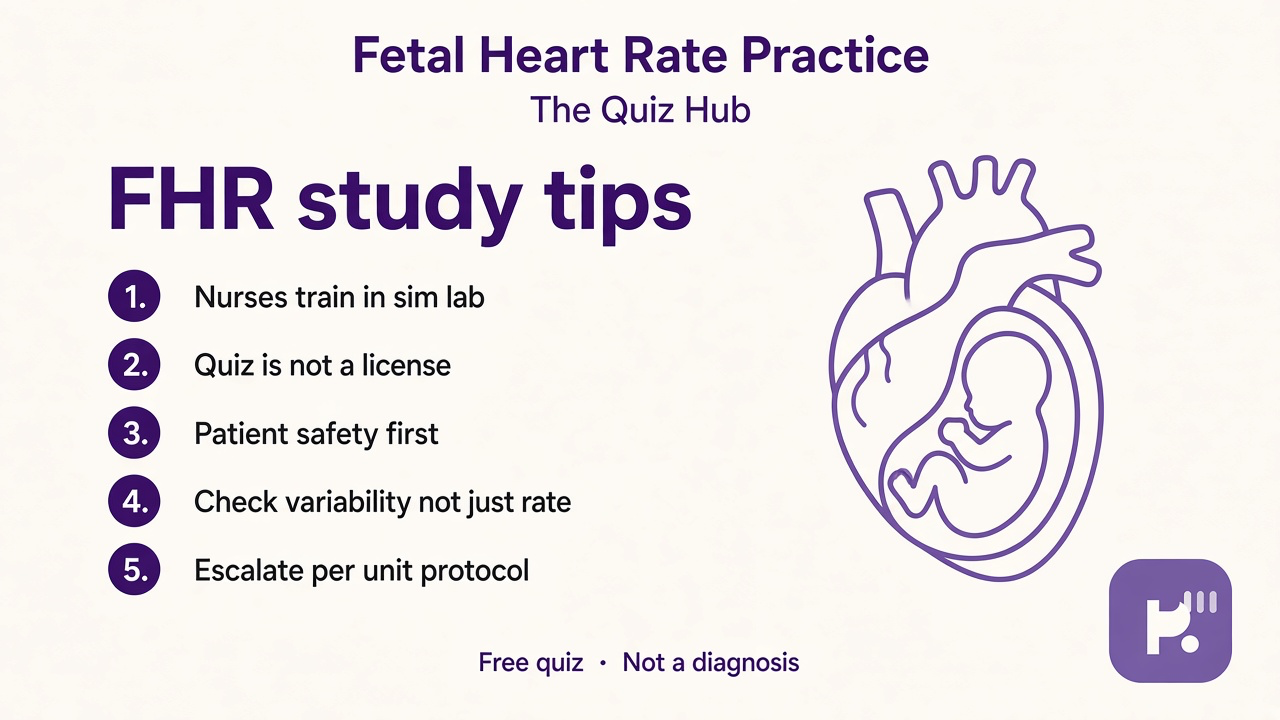
A quick takeaway graphic with topic tips (not your personal quiz scores). Start the quiz for your index, bands, and charts.
What this quiz can and cannot tell you
Can tell you
- Clarify baseline, variability, and basic accel-decel vocabulary in plain language
- Highlight common variability-ignore and decel-panic myths worth unlearning before sim
- Encourage labeled strip retakes without shame between lecture and clinical
- Spark better questions during nursing fetal monitoring units
Cannot tell you
- Interpret live hospital tracings or replace NICU or L&D credentialing
- Diagnose uteroplacental insufficiency, cord prolapse, or fetal acidosis from trivia alone
- Tell pregnant patients to ignore decreased fetal movement based on a high score here
- Certify independent monitoring without preceptor oversight or unit protocols
FHR practice literacy before the sim lab strip
Nursing students search fetal heart rate monitoring practice when lecture slides show squiggles and every decel feels like an emergency headline. Introductory curricula teach baseline as the average rate between peaks and valleys, often citing roughly 110 to 160 beats per minute at term in teaching examples. Variability is the beat-to-beat wiggle instructors want you to notice before you name decel shapes. Skipping variability to chase drama is a trap this screener flags on purpose.
Accelerations are usually taught as abrupt rises above baseline lasting on the order of fifteen seconds in many texts—a reassuring pattern in many practice strips. Decelerations come in families: early dips mirroring contractions in head compression discussions, late dips whose nadir follows contraction peaks in uteroplacental insufficiency review, and variable V-shaped dips with cord compression language in skills lectures. Calling every blip late before you mark contraction timing is another myth worth rejecting.
Monitoring tools belong in the same story as the strip. External Doppler picks up rate through the abdomen; internal scalp electrodes appear in teaching scenarios after membranes rupture and dilation allows closer signal when instructors compare clarity tradeoffs. Tocodynamometers add contraction frequency and duration so you read fetal rate in context. Believing internal monitoring replaces every external check or ignoring uterine activity while labeling decels breaks sim debrief habits.
Escalation literacy is the fourth domain because trivia tempts false confidence. Category III language in many programs combines absent variability with recurrent late decels or bradycardia patterns students practice recognizing for immediate obstetric response in simulation—not solo student cesarean calls on real units. Perfect quiz scores do not replace preceptor sign-off, hospital monitoring certification, or calling the team when real patients look non-reassuring.
Use this screener as warm-up before labeled strip sets, not as a verdict on your clinical worth. Pair it with our ECG anatomy and physiology quiz when you want adjacent monitor literacy, the fetal pig anatomy quiz for specimen ethics in the same study week, or the IQ and cognitive test hub for more low-stakes study games. Retake after you can narrate baseline, variability, and one decel type on an instructor strip without peeking; practice literacy grows when timing stays tied to contractions, not when you memorize that late starts with l and hope variability never appears on the exam.
| Test | Focus |
|---|---|
| ECG anatomy and physiology quiz | Adult cardiac strip and lead literacy, not intrapartum fetal monitoring patterns |
| Fetal pig anatomy quiz | Specimen dissection labeling and lab respect, not L&D tracing escalation protocols |
Fetal Heart Rate Monitoring Practice Quiz FAQ
What does this FHR monitoring practice quiz measure?
It measures how much you agree with introductory fetal heart rate monitoring practice literacy across baseline and variability, accelerations and decelerations, monitoring methods, and practice-not-credential limits. You get an index from 0 to 100 and four bars. It reflects self-reported study habits on this screener, not a clinical skills exam or IQ score.
Can this quiz credential me for labor and delivery monitoring?
No. Hospital fetal monitoring competency, preceptor sign-off, and unit protocols require supervised clinical training. This page is trivia and vocabulary prep only.
I am pregnant and worried about my baby movement. Should I use this quiz?
Contact your obstetric clinician or go to labor and delivery for decreased fetal movement, bleeding, severe pain, or other urgent symptoms. This quiz cannot assess your baby and is not emergency care.
Why are some statements worded as myths?
Reverse-worded myths catch overconfidence. Agreeing that variability never matters, that every dip is an emergency late decel, that internal monitors belong in every office visit, or that trivia replaces preceptor sign-off should not inflate your literacy index.
Who reviewed this quiz?
Dr. James Whitfield, PhD reviewed the educational framing, FHR practice limits, and result explanations. See our editorial policy for review standards.
Reviewed by