What the ECG Anatomy and Physiology Quiz measures
This quiz does not attach electrodes to your chest, certify you for telemetry, or score your intelligence. It measures how much you agree with introductory ECG anatomy and physiology literacy grouped four ways: ECG recording basics about grid speed, calibration, electrodes, and conduction paths; lead placement literacy about limb and precordial landmarks and skin prep; waveform and rhythm literacy about P, QRS, T, sinus rhythm language, and R-R rate skills; and study limits and safety about class prep, retakes, and leaving diagnosis to professionals. You answer 22 statements from strongly disagree to strongly agree, with reverse-worded myths so agreeing with every shortcut cannot inflate every bar. Your answers also feed a second chart on closeness and trust habits, because health worry sometimes pushes people toward quick internet certainty. The total becomes an index from 0 to 100 where higher means more reported ECG literacy on this screener, not proof you should skip care when symptoms scare you.
ECG recording basics
Electrodes, paper speed, calibration, multi-lead tracings, and the SA-AV-bundle conduction story in plain language.
Lead placement literacy
Limb and precordial landmarks, skin prep, common reversal errors, and why placement matters in skills lab.
Waveform and rhythm literacy
P, QRS, and T roles, sinus rhythm vocabulary, R-R heart rate practice, and calm rhythm reading habits.
Study limits and safety
Class and boards prep, labeled strip retakes, no DIY credentialing, and clinician follow-up for symptoms.
How it works
Answer 22 agreement items
Rate each statement from Strongly disagree to Strongly agree. Tap Next after each answer.
Answers sort into four domains
Each answer feeds one of four ECG literacy groups, and every item also feeds a closeness and trust layer.
See your index and charts
You get a 0 to 100 index, a band, and two bar charts you can use before a nursing or anatomy unit test.
Take the ECG Anatomy and Physiology Quiz
Answer 22 short statements to see your ECG literacy index, four domain bars, and a closeness and trust chart.
What your result means
Your index is the average of all 22 answers, scaled from 0 to 100, with reverse-worded items flipped first. Higher means more reported ECG anatomy and physiology literacy on this screener. Read study limits and waveform bars together before you treat the total as clinical expertise.
| Band | Index range | Typical reading |
|---|---|---|
| Building ECG literacy | 0 to 35 | Fewer agreed facts on recording basics, lead placement, waveforms, or study safety limits on this screener. |
| Mixed ECG literacy | 36 to 65 | Solid facts in some domains with myths about lead placement, rhythm panic, or quiz-based credentialing. |
| Strong ECG literacy | 66 to 100 | Frequent agreement with accurate ECG path trivia and healthy study limits. |
Tips at a glance
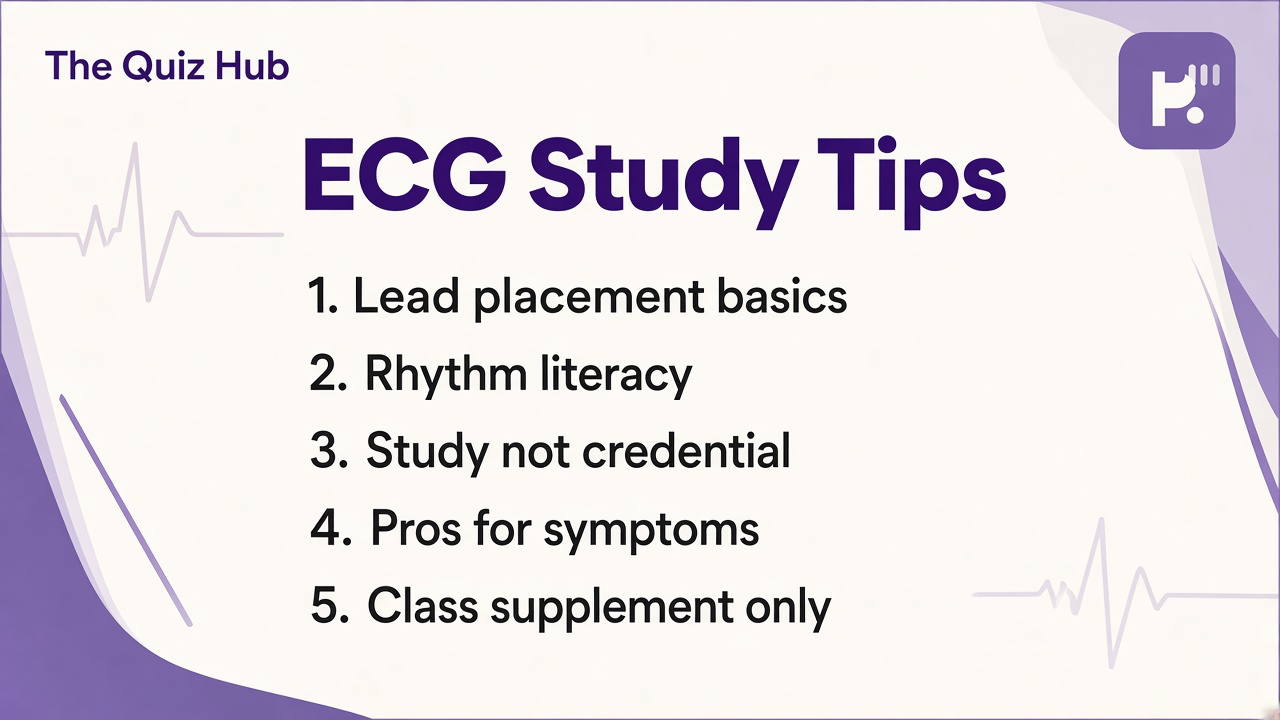
A quick takeaway graphic with topic tips (not your personal quiz scores). Start the quiz for your index, bands, and charts.
What this quiz can and cannot tell you
Can tell you
- Clarify recording basics, lead names, and P-QRS-T vocabulary in plain language
- Highlight common lead placement and rhythm panic myths worth unlearning
- Encourage labeled strip study and retake habits without shame
- Spark better questions during skills lab or introductory cardiology units
Cannot tell you
- Diagnose arrhythmia, ischemia, or electrolyte crisis from trivia answers
- Replace telemetry training, ACLS courses, or hands-on preceptor sign-off
- Certify you for monitored units, dosing, or medical licensing
- Prove your heart is healthy when chest pain, syncope, or sustained palpitations appear
ECG literacy beyond one labeled strip
Students search ECG anatomy when a nursing or physiology unit hands them a strip and every wave blurs together. An electrocardiogram is a time graph of cardiac electrical activity picked up by surface electrodes. Paper speed and calibration turn grid squares into seconds and millivolts instructors expect you to mention on exams. Mixing up one wire with a full 12-lead viewpoint is a trap quizzes flag on purpose.
Leads are labeled viewpoints, not decorative stickers. Limb electrodes and precordial chest positions V1 through V6 belong to skills-lab checklists because poor contact or reversed placement can distort tracings enough to fool beginners. Cleaning skin and avoiding heavy lotion are boring steps that matter before you debate axis or ST segments in advanced courses.
Waveform literacy starts with one cardiac cycle on paper. The P wave ties to atrial depolarization, the QRS complex to ventricular depolarization, and the T wave to ventricular repolarization in introductory language. Sinus rhythm vocabulary usually describes a P before each QRS with a fairly regular rate instructors cite for resting adults. Measuring heart rate from R-R intervals when paper speed is known is a core student skill long before you interpret every arrhythmia in a busy emergency department.
Conduction anatomy belongs in the same study folder. SA node initiation, delay at the AV node, and spread through bundle branches and Purkinje fibers explain why the tracing looks ordered instead of random. That path is physiology literacy, not permission to ignore pulses, symptoms, or preceptor coaching on real patients.
Study limits are the fourth domain because trivia scores tempt overconfidence. Retakes, flashcards, and labeled diagrams are normal class prep; they do not mean you finished medical school or earned telemetry credentialing. Agreeing that a perfect quiz replaces cardiology consult when chest pain or syncope appears is another myth worth rejecting. Use this screener as a warm-up, not a verdict. Pair it with our cardiac axis quiz when you want adjacent ECG recall, or the ear anatomy quiz for another body-system literacy break. Browse the IQ and cognitive test hub for more low-stakes study games. Retake after you can trace one beat from P through T on an unlabeled strip without peeking; literacy grows when layers stay in order, not when you memorize that QRS starts with Q and hope the lead placement chapter never asks where V4 lives.
| Test | Focus |
|---|---|
| Cardiac axis quiz | ECG axis and vector recall, not full lead placement and wave intro on one page |
| Ear anatomy quiz | Hearing pathways and pinna trivia, not cardiac conduction or rhythm strips |
ECG Anatomy and Physiology Quiz FAQ
What does this quiz measure?
It measures how much you agree with introductory ECG anatomy and physiology literacy across recording basics, lead placement, waveforms, and study safety habits. You get an index from 0 to 100 and four bars. It reflects self-reported knowledge on this screener, not a clinical skills exam or IQ score.
Is this quiz enough to diagnose heart problems?
No. It is study trivia and care literacy. Chest pain, fainting, sustained palpitations with dizziness, or trouble breathing need a clinician or emergency care, not a high score here.
Why are some statements worded as myths?
Reverse-worded myths catch overconfidence. Agreeing that ECG lines replace pulse checks, that V4 belongs on the abdomen, that every irregular blip needs immediate defibrillation, or that trivia replaces telemetry credentialing should not inflate your literacy index.
Does this cover every arrhythmia or ACLS detail?
This screener stays at shared intro anatomy and physiology: electrodes, leads, basic waves, rate skills, and clinical humility. Advanced arrhythmia management, drug dosing, and full ACLS pathways belong in dedicated courses and supervised practice.
Who reviewed this quiz?
Dr. James Whitfield, PhD reviewed the educational framing, ECG literacy limits, and result explanations. See our editorial policy for review standards.
Reviewed by