What Female To Female Attraction Signs Quiz measures
This quiz does not diagnose orientation, out anyone, or replace LGBTQ-affirming counseling when shame or safety feels heavy. It measures how much you agree with female-to-female attraction reflection habits grouped four ways: warmth and pull signals about butterflies, admiration, closeness wishes, and separating community warmth from romantic curiosity without instant verdicts; labels optional curiosity about lesbian, bi, pan, queer, or fluid language, mixed seasons, and refusing forced label clocks; consent and privacy about no gossip outings, asking before flirting harder, accepting no, and skipping pressure campaigns; and quiz not orientation verdict about unofficial reflection, private sharing, low bars as timing not faking, and refusing to label strangers from bar height. You rate 22 statements from strongly disagree to strongly agree, with reverse-worded traps so one crush week cannot inflate every bar. Your answers also feed a second chart on closeness and trust habits, because attraction talk and vulnerability often share the same season. The total becomes an index from 0 to 100 where higher means more reported WLW reflection literacy on this screener, not proof you must come out on a deadline.
Warmth and pull signals
Noticing care toward women without instant label courts.
Labels optional curiosity
Room for bi, pan, queer, fluid, or no label seasons.
Consent and privacy
No outing gossip or pressure flirting.
Quiz not orientation verdict
Unofficial reflection; bars not closet clocks.
How it works
Answer 22 agreement items
Rate each statement from Strongly disagree to Strongly agree. Tap Next after each answer.
Answers sort into four domains
Each answer feeds one of four WLW reflection groups, and every item also feeds a closeness and trust layer.
See your index and charts
You get a 0 to 100 index, a band, four domain bars, and a second chart for intimacy habits.
Take the Female To Female Attraction Signs Quiz
Answer 22 short statements to see your female-to-female attraction reflection index, four domain bars, and a closeness and trust chart.
What your result means
Your index is the average of all 22 answers, scaled from 0 to 100, with reverse-worded items flipped first. Read quiz-not-verdict bars together with consent-and-privacy habits before you treat a high score as a coming-out command or a low score as proof you imagined every flutter. Reflection supports kinder talks; affirming counselors still matter when safety is thin.
| Band | Index range | Typical reading |
|---|---|---|
| Quieter WLW attraction sign habits | 0 to 35 | Fewer agreed items on warmth signals, label-optional curiosity, consent privacy, or quiz-not-verdict limits on this screener. |
| Mixed WLW attraction sign habits | 36 to 65 | Solid curiosity in some domains with outing myths, label traps, gossip slips, or verdict cosplay in others. |
| Strong WLW attraction sign habits | 66 to 100 | Frequent agreement with warmth signals, label-optional curiosity, consent privacy, and quiz-not-verdict limits; still reflection only. |
Tips at a glance
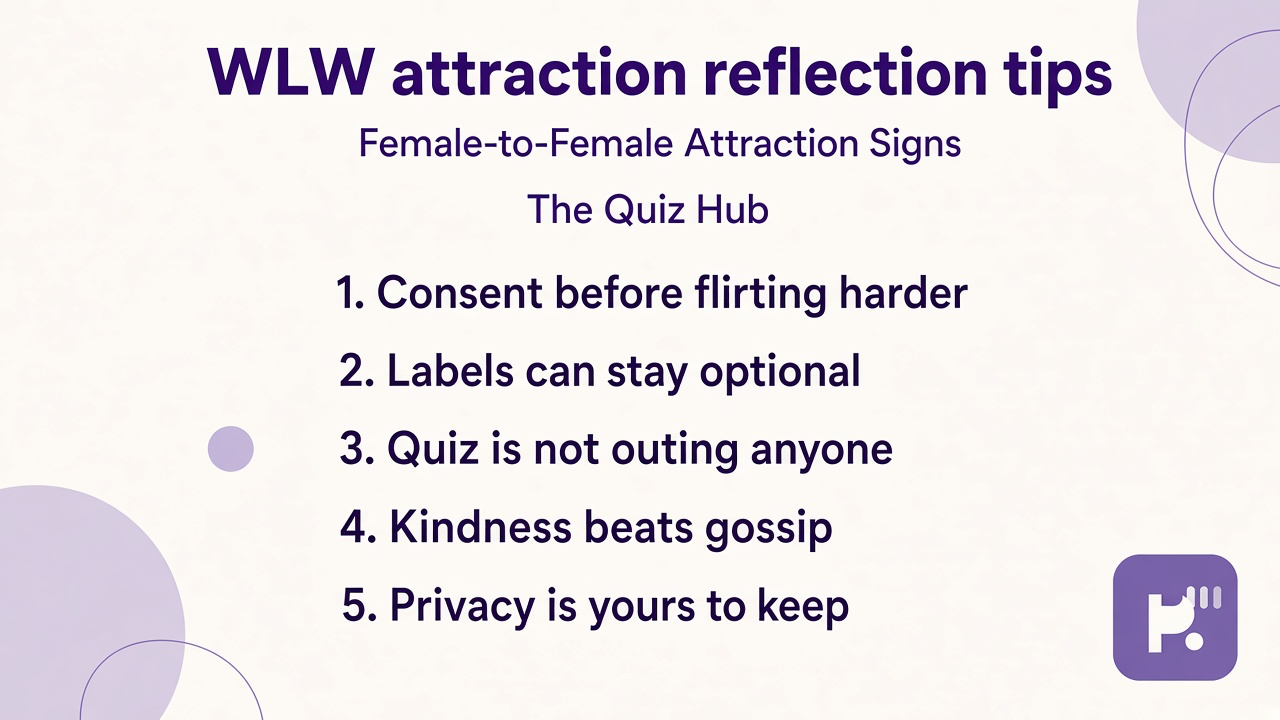
A quick takeaway graphic with topic tips (not your personal quiz scores). Start the quiz for your index, bands, and charts.
What this quiz can and cannot tell you
Can tell you
- Highlight warmth, label, and privacy habits worth revisiting during a calm week
- Separate unofficial reflection from outing gossip or public label trials
- Encourage label-optional curiosity without shame clocks
- Spark honest talk with trusted friends who opted into the conversation
Cannot tell you
- Prove you are lesbian, bi, pan, or straight from one agree screener
- Replace LGBTQ-affirming therapy, mentorship, or safety planning
- License outing jokes, stranger labeling, or pressure flirting from bar height
- Turn attraction scores into pile-ons on women who never consented to speculation
WLW attraction signs before orientation verdict myths
Search traffic around female-to-female attraction sign quizzes usually wants two things: language for butterflies that feel different from friendship, and relief from label panic in group chats. Those goals help when readers notice warmth kindly, keep labels optional, and refuse outing gossip. They hurt when meme scores become lesbian mandates, or when public bar drops shame people who never opted in. Attraction sign language works best when consent habits and unofficial limits stay in the same sentence.
Dr. Priya Sharma reviews relationships-dating reflection screeners with a simple split: reward honest curiosity habits and honest limits on verdict fantasy at the same time. Warmth and pull signals track nervous energy and closeness wishes without treating every compliment as forever identity proof. Labels optional curiosity tracks bi, pan, queer, and no-label seasons without closet clocks. Consent and privacy tracks no gossip outings and slow flirting respect without pressure campaigns. Quiz not orientation verdict keeps screeners, counselors, and safety plans separate from bar height.
Real questioners mix bars. You might score high on warmth while keeping label items moderate, which often describes sapphic pull during a busy friendship month. You might score high on privacy with softer warmth items, which can mean careful sharing yet still occasional crush speculation slips. Reverse items catch sloppy answers: one flutter proving instant coming-out posts, forced labels before dating, pressuring women for certainty, high scores licensing stranger labels, or gossip dressed as support should not inflate charts meant to track layered reflection literacy.
Pair results with siblings on this hub instead of forcing one WLW story. Our am I lesbian quiz narrows toward women-focused same-gender attraction language when you want a sibling lens beyond sign habits on this page. Our am I bisexual quiz angles toward multi-gender attraction patterns when pan or bi overlap matters more than sign lists here. Our does she like me LGBT quiz focuses on reading her cues with queer safety context rather than sorting your own pull. Browse the relationships and dating hub for more reflection screeners. Share scores as private curiosity with consent, not as outing fuel.
Crush seasons refresh faster than label meme threads. When you share results, say privacy beats scoreboard. When you borrow tips, credit friends who refused gossip and counselors who made space for slow language. Retake after one safer month and watch whether consent bars stay high even if warmth rises, which often means you separated flutter from actual outing habits.
| Test | Focus |
|---|---|
| Am I lesbian quiz | Women-focused same-gender attraction reflection rather than broad WLW sign habits on this page |
| Am I bisexual quiz | Multi-gender attraction patterns rather than female-to-female sign language here |
| Does she like me LGBT quiz | Reading her cues with queer safety context rather than your own attraction sign reflection |
Female To Female Attraction Signs Quiz FAQ
What does Female To Female Attraction Signs Quiz measure?
It measures how much you agree with statements about warmth toward women, label-optional curiosity, consent and privacy, and quiz-not-verdict limits. You get an index from 0 to 100 plus four bars. It describes self-reported reflection habits on this screener, not proof you are lesbian or that you must come out.
Does noticing signs mean I have to come out?
No. Warmth items describe curiosity you can explore privately. Consent and privacy items reject pressure timelines. Only you choose when, how, and whether to share your story.
Can I use this to figure out if a friend likes women?
No. This page is about your reflection habits, not decoding someone else orientation. Speculating aloud without consent violates the privacy domain on this screener.
I still date men sometimes. Does that invalidate my answers?
Not automatically. Labels optional items allow bi, pan, queer, fluid, and questioning seasons. Attraction sign language here is not a straight-forever test.
Who reviewed this quiz?
Dr. Priya Sharma reviewed the educational framing, anti-outing limits, and separation from clinical or label-mandate claims. See our editorial policy for review standards.
Reviewed by