What the Does She Like Me LGBT Quiz measures
This quiz does not read her mind or label her orientation for you. It measures how often you have noticed behaviors people list when they wonder if a woman likes them in an LGBT-inclusive context, grouped four ways: respectful attention that honors your identity, alone versus group time when public queer visibility feels risky, queer context and safety including privacy and consent, and mixed signals paired with whether she respects your boundaries. You answer 22 how-often statements about recent weeks, with reverse-worded items so one dramatic week cannot inflate your score. Your responses also feed a second chart on closeness and trust habits, because crush anxiety often overlaps with fear of rejection or rushing before you feel safe being seen. The total becomes an index from 0 to 100 where higher means more reported signals on this screener, not permission to out yourself or her, or to ignore a clear no.
Respectful attention
How often warmth, recall, and compliments feel aimed at you without stereotyping.
Alone vs group time
How often she seeks you one on one versus only in crowd settings.
Queer context and safety
How often privacy, anti-outing respect, and your pace still govern her behavior.
Mixed signals and boundaries
How often gossip, apps, and hot-cold swings align with honoring your limits.
How it works
Answer 22 frequency items
Rate each statement from Never to Very often for recent weeks. Tap Next after each answer.
Answers sort into four domains
Each answer feeds one of four signal groups, and every item also feeds a closeness and trust layer.
See your index and charts
You get a 0 to 100 index, a band, and two bar charts you can compare with a trusted queer-affirming friend.
Take the Does She Like Me LGBT Quiz
Answer 22 short statements to see your queer crush signal index, four domain bars, and a closeness and trust chart.
What your result means
Your index is the average of all 22 answers, scaled from 0 to 100. Higher means more reported signals. Read the four bars before the total, since online warmth can spike while queer safety items still look thin.
| Band | Index range | Typical reading |
|---|---|---|
| Few queer crush signs | 0 to 35 | Little extra warmth, solo time, or safety-aware flirtation beyond ordinary friendship. |
| Mixed queer crush signs | 36 to 65 | Warm moments without steady respect, privacy care, or clear words. |
| Several queer crush signs | 66 to 100 | Repeated warmth and solo time; still choose consent-safe next steps. |
Tips at a glance
A quick takeaway graphic with topic tips (not your personal quiz scores). Start the quiz for your index, bands, and charts.
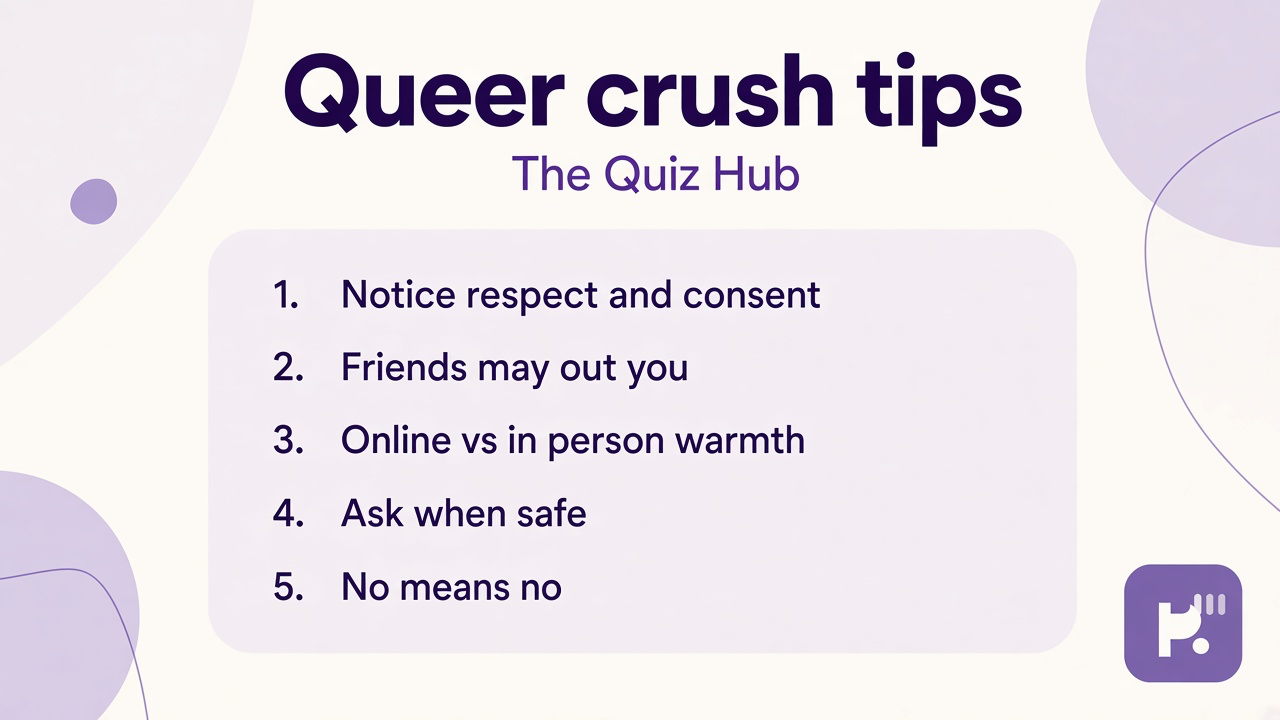
What this quiz can and cannot tell you
Can tell you
- Organize mixed crush moments into four queer-aware domains
- Prompt you to weigh privacy and consent before escalating flirtation
- Highlight when boundary items deserve a direct conversation or step back
- Offer a baseline to retake after you come out to more people or change schools
Cannot tell you
- Prove whether she likes you, is lesbian, bi, pan, or will ask you out
- Replace safety planning for homophobia, transphobia, or family risk
- Tell you to come out on a timeline that feels unsafe
- Separate friendly queer community warmth from romance with certainty
Queer crush signals: respect, privacy, and clear words
Generic crush quizzes assume everyone is straight, out, and safe to flirt in the hallway. Queer crushes often run on different rules: warmth might live in DMs while public hugs stay platonic, and one friend's joke can spread a label you never chose. This quiz separates respectful attention, alone versus group time, queer context and safety, and mixed signals with boundaries so you can think clearly without outing yourself or her by accident.
Respect still matters when interest might be mutual. Compliments that honor your pronouns are different from fetishizing your identity. Remembering your favorite show is different from monopolizing your calendar. One-on-one coffee can be friendship or a date audition; repetition and how she acts when you say slow down tell the story. Reverse-worded items keep one great Pride weekend from dominating, but they cannot replace your memory of whether she protects your privacy.
Outing is not a punchline. Even supportive friends can spread rumors that reach family, coaches, or classmates before you are ready. Someone who likes you should refuse outing jokes, back off when you are not out, and avoid pressuring labels on your first honest conversation. If she only flirts when drunk or only texts after midnight, compare your mixed-signals bar with your safety bar before you romanticize the chaos.
Mixed signals are common when homophobia or transphobia is real in your world. She might be warm online because keyboards feel safer than cafeteria tables. She might go cold in public because she is scared too, not because she hates you. Gossip is still weak proof. Direct words, when you choose the timing and audience, beat decoding story views. If you are not safe to ask yet, a low score does not mean you failed; it may mean the environment is hostile.
If attention ignores your no, mocks you for being queer, or trades secrets for intimacy, step back and talk with someone you trust. Mutual liking should feel exciting, not coercive. Compare your results with our does she like me quiz for parallel wording without queer-context framing, or with am I lesbian quiz if you are sorting your own attraction more than reading hers. Neither page is fortune-telling; both are mirrors for patterns you already half see.
| Test | Focus |
|---|---|
| Does she like me quiz | General crush signals without queer privacy and outing context |
| Am I lesbian quiz | Your own same-gender attraction patterns, not decoding her cues |
Does She Like Me LGBT Quiz FAQ
What does this quiz measure?
It measures how often you have noticed respectful attention, alone versus group time, queer safety habits, and mixed signals with boundaries. You get an index from 0 to 100 and four bars. It reports what you have seen, not her secret orientation or a promise she will date you.
Does a high score mean I should come out to her?
No. Come out only when you choose the timing, audience, and safety plan. A high score describes signals you noticed, not a mandate to disclose or pursue anyone.
What if she is warm online but distant in public?
That is common when being read as queer feels risky. Compare your alone versus group time and queer safety bars. Look for respect in both places, not only intensity.
Can friends outing me count as a crush sign?
Gossip is weak proof and can harm you. This quiz treats friend teasing as a mixed-signal item, not romance advice. Protect your privacy first.
Who reviewed this quiz?
Dr. James Whitfield, PhD reviewed the framing, consent-aware limits, and queer safety disclaimer. See our editorial policy for review standards.
Reviewed by