
What this quiz measures
This quiz does not measure IQ, certify college readiness, or replace SAT, ACT, or classroom courses. It measures how much you agree with algebra factoring habits grouped four ways: GCF and common factor about numeric and variable greatest common factors, negative GCF sign cleanup, grouping four-term polynomials, and finishing with no hidden common terms; trinomial factoring about factor pairs for x squared plus bx plus c, difference of squares, perfect square trinomials, nonzero leading coefficients with ac or grouping habits, and prime factors before solving; check by expanding about FOIL or distribution verification, middle-term sign checks, retrying pairs after failed multiply-back, difference-of-squares recognition, and zero product property only after correct factoring; and quiz not exam about practice reflection, kind retakes, teachers and proctored exams staying primary, and refusing to treat bars as shown-work exemptions. You answer 22 statements from strongly disagree to strongly agree, with reverse-worded myths so agreeing with every shortcut cannot inflate every bar. Your answers also feed a second chart on closeness and trust habits, because math stress sometimes pushes people toward harsh perfectionism instead of calm checking. The total becomes an index from 0 to 100 where higher means more reported factoring habits on this screener, not proof you should skip classes when you need exam prep.
GCF and common factor
Pull GCF first, sign cleanup, grouping, and clean parentheses.
Trinomial factoring
Pair hunting, special patterns, and leading coefficient habits.
Check by expanding
FOIL back, sign checks, and zero product after correct factors.
Quiz not exam
Practice not proctored exams; bars not tutors or credentials.
How it works
Answer 22 agreement items
Rate each statement from Strongly disagree to Strongly agree. Tap Next after each answer.
Answers sort into four domains
Each answer feeds one of four factoring habit groups, and every item also feeds a closeness and trust layer.
See your index and charts
You get a 0 to 100 index, a band, and two bar charts you can compare after a tutoring or homework sprint.
Take the Factoring Quiz
Answer 22 short statements to see your algebra factoring habits index, four domain bars, and a closeness and trust chart.
What your result means
Your index is the average of all 22 answers, scaled from 0 to 100, with reverse-worded items flipped first. Higher means more reported factoring habits on this screener. Read quiz limit bars together with check-by-expanding before you treat the total as exam readiness.
| Band | Index range | Typical reading |
|---|---|---|
| Building algebra factoring habits | 0 to 35 | Fewer agreed facts on GCF, trinomial patterns, multiply-back checks, or quiz limits on this screener. |
| Mixed algebra factoring habits | 36 to 65 | Solid habits in some domains with myths about skipping GCF, random pairs, optional checks, or bars replacing exams. |
| Strong algebra factoring habits | 66 to 100 | Frequent agreement with accurate factoring habits and healthy quiz limits. |
Tips at a glance
A quick takeaway graphic with topic tips (not your personal quiz scores). Start the quiz for your index, bands, and charts.
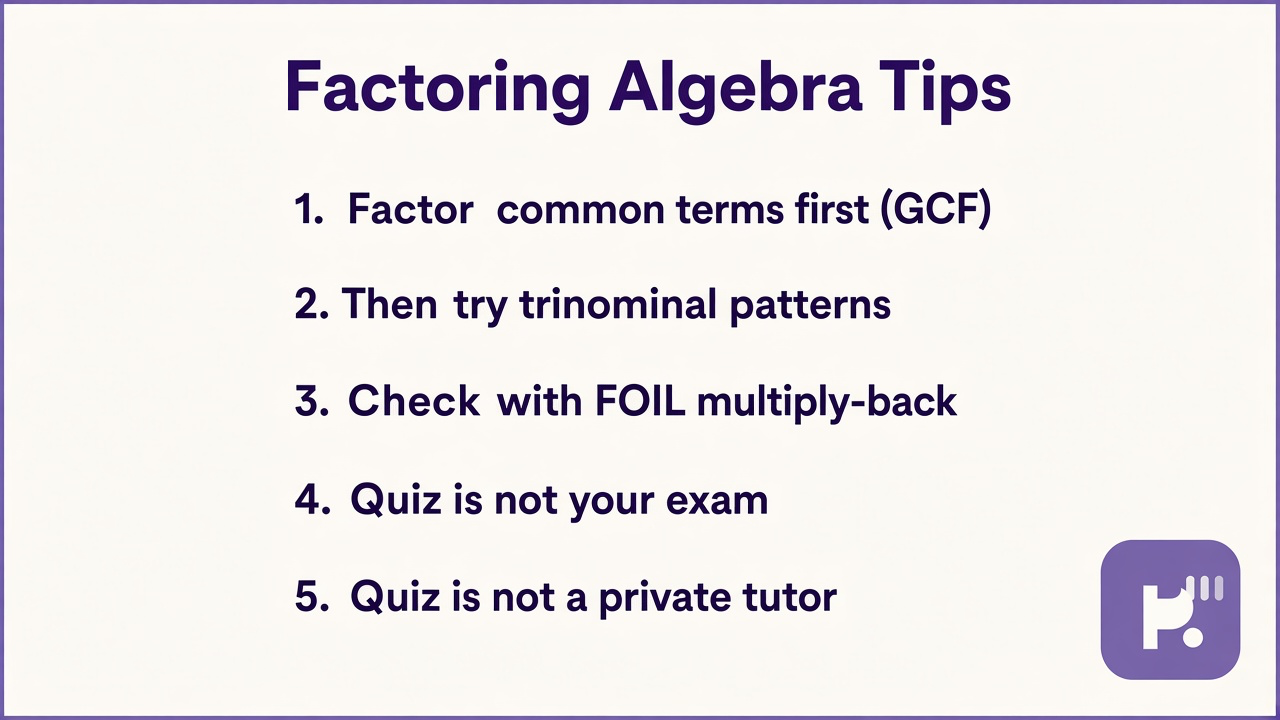
What this quiz can and cannot tell you
Can tell you
- Highlight GCF, trinomial, and multiply-back habits worth practicing in daily algebra
- Separate self-study reflection from formal exam prep in plain language
- Encourage FOIL verification and sign checks without public math shaming
- Spark better questions for tutors, teachers, or study groups
Cannot tell you
- Replace SAT, ACT, school courses, tutors, or employer math assessments
- Prove intelligence rank or college admission readiness from one agree screener
- Diagnose learning disorders or certify job readiness alone
- Justify skipping shown work on tests because trivia bars look high
Algebra factoring habits without credential confusion
Search traffic around factoring quizzes often mixes habit building with test-score hunger. Pulling the greatest common factor before trinomial pair hunting beats guessing binomials that ignore shared terms. Writing each step keeps sign errors visible before they spread through a whole problem.
Trinomial patterns still matter when leading coefficients stay at one: two numbers that multiply to c and add to b remain the classroom backbone. Difference of squares and perfect square trinomials save time when readers recognize minus-between-squares and twice-ab middle terms. Claiming random pairs always work is a myth screeners flag so clarity still counts on homework.
Multiply-back separates factoring from wishful algebra. Expanding with FOIL or distribution catches middle-term sign slips early. The zero product property applies only after factors are correct, which stops half-factored shortcuts from looking like finished solves.
Quiz limits keep this page honest. It is practice reflection, not exam proof. Pair results with our equations quiz when solve-by-factoring units overlap, the algebra quiz when symbolic habits need a warm-up, or the IQ and cognitive test hub for more study games. Retake after a month of deliberate multiply-back checks; habits move slowly and that is normal.
| Test | Focus |
|---|---|
| Equations quiz | Balance and isolate equation habits rather than polynomial factor reflection on this slug |
| Algebra quiz | Broader algebra themes rather than GCF-and-trinomial habit reflection on this page |
Factoring Quiz FAQ
What does this quiz measure?
It measures how much you agree with algebra factoring habits across GCF and common factor, trinomial factoring, check by expanding, and quiz limits. You get an index from 0 to 100 and four bars. It reflects self-reported habits on this screener, not a formal math exam score.
Should I factor GCF before trinomial pairs?
Classroom habit and the stems here treat pulling the greatest common factor first as baseline literacy. Skipping GCF is flagged as a reverse myth because shared terms often block clean pair hunting.
Can I use this quiz instead of a tutor or proctored test?
No. Teachers, tutors, and formal exams own credentials. This screener is habit reflection only and cannot certify test readiness or replace shown-work grading.
Why are some statements worded as myths?
Reverse items catch overconfidence. Agreeing that GCF can always be skipped, that random pairs need no multiply-back, or that online bars replace proctored exams should not inflate bars meant to track layered study habits.
Who reviewed this quiz?
Dr. James Whitfield, PhD reviewed the educational framing, algebra factoring habit limits, and result explanations. See our editorial policy for review standards.
Reviewed by
