What this quiz measures
This quiz does not measure IQ, certify college readiness, or replace SAT, ACT, or classroom courses. It measures how much you agree with algebra equation habits grouped four ways: balance and isolate about keeping equality through each step, inverse operations on both sides, and honest equals signs; operations and order about applying the same operation to both sides, PEMDAS when simplifying, parentheses and distribution, combining like terms, and sign distribution; units and check about labeled unknowns, unit carry-through in word problems, plug-back verification, slope unit stories, and magnitude estimates; and algebra quiz limits about practice reflection, kind retakes, proctored exams staying primary, and refusing to treat bars as shown-work exemptions. You answer 22 statements from strongly disagree to strongly agree, with reverse-worded myths so agreeing with every shortcut cannot inflate every bar. Your answers also feed a second chart on closeness and trust habits, because math stress sometimes pushes people toward harsh perfectionism instead of calm checking. The total becomes an index from 0 to 100 where higher means more reported equation habits on this screener, not proof you should skip classes when you need exam prep.
Balance and isolate
Equal moves, inverse operations, and honest equals signs.
Operations and order
Both sides equally, PEMDAS, parentheses, and sign distribution.
Units and check
Labels, unit carry-through, plug-back, and magnitude sense.
Algebra quiz limits
Practice not proctored exams; bars not credentials.
How it works
Answer 22 agreement items
Rate each statement from Strongly disagree to Strongly agree. Tap Next after each answer.
Answers sort into four domains
Each answer feeds one of four equation habit groups, and every item also feeds a closeness and trust layer.
See your index and charts
You get a 0 to 100 index, a band, and two bar charts you can compare after a tutoring or homework sprint.
Take the Equations Quiz
Answer 22 short statements to see your algebra equation habits index, four domain bars, and a closeness and trust chart.
What your result means
Your index is the average of all 22 answers, scaled from 0 to 100, with reverse-worded items flipped first. Higher means more reported equation habits on this screener. Read quiz limit bars together with units and check before you treat the total as SAT readiness.
| Band | Index range | Typical reading |
|---|---|---|
| Building algebra equation habits | 0 to 35 | Fewer agreed facts on balance, operations, units and check items, or quiz limits on this screener. |
| Mixed algebra equation habits | 36 to 65 | Solid habits in some domains with myths about skipping checks, optional PEMDAS, or bars replacing exams. |
| Strong algebra equation habits | 66 to 100 | Frequent agreement with accurate equation habits and healthy quiz limits. |
Tips at a glance
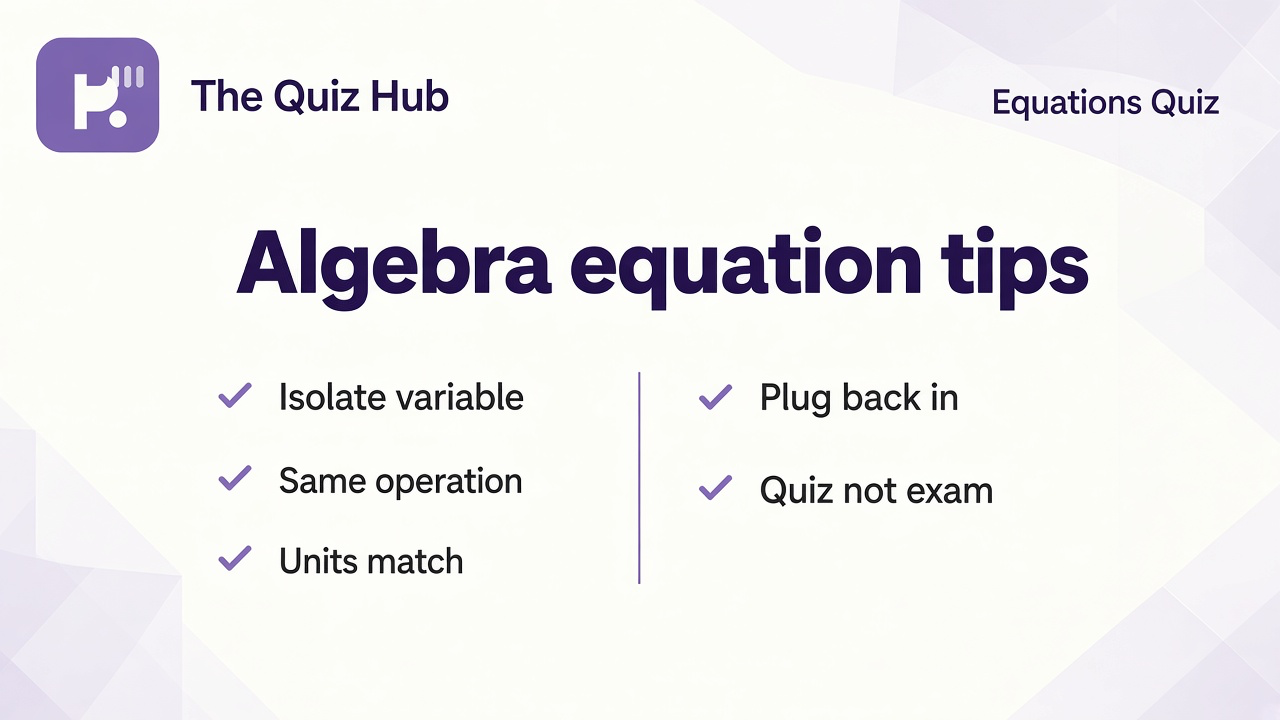
A quick takeaway graphic with topic tips (not your personal quiz scores). Start the quiz for your index, bands, and charts.
What this quiz can and cannot tell you
Can tell you
- Highlight balancing, PEMDAS, and check-work habits worth practicing in daily algebra
- Separate self-study reflection from formal exam prep in plain language
- Encourage plug-back and unit-label habits without public math shaming
- Spark better questions for tutors, teachers, or study groups
Cannot tell you
- Replace SAT, ACT, school courses, or employer math assessments
- Prove intelligence rank or college admission readiness from one agree screener
- Diagnose learning disorders or certify job readiness alone
- Justify skipping shown work on tests because trivia bars look high
Algebra equation habits without credential confusion
Search traffic around equations quizzes often mixes habit building with test-score hunger. Balancing both sides and isolating variables with inverse operations beats guessing moves that break equality. Writing each step keeps sign errors visible before they spread through a whole problem.
Order of operations still matters when parentheses and distribution show up before you combine like terms. Claiming PEMDAS never matters is a myth screeners flag so readers learn clarity still counts on multi-step homework. Negative signs deserve slow passes because they trip skilled students too.
Units and checking separate algebra from arithmetic cosplay. Carrying minutes and hours through word problems stops silent swaps. Plugging solutions back into the original catches extraneous roots early. Magnitude estimates catch typos calculators miss when you tap too fast.
Quiz limits keep this page honest. It is practice reflection, not SAT proof. Pair results with our balancing chemical equations quiz when stoichiometry units overlap, the algebra quiz when symbolic habits need a warm-up, or the IQ and cognitive test hub for more study games. Retake after a month of deliberate checking; habits move slowly and that is normal.
| Test | Focus |
|---|---|
| Balancing chemical equations quiz | Chemistry equation balancing rather than linear algebra habit reflection |
| Algebra quiz | Broader algebra themes rather than isolate-and-check habit reflection on this slug |
Equations Quiz FAQ
What does this quiz measure?
It measures how much you agree with algebra equation habits across balance and isolate, operations and order, units and check, and quiz limits. You get an index from 0 to 100 and four bars. It reflects self-reported habits on this screener, not a formal math exam score.
Can I use this quiz instead of SAT or ACT prep?
No. Formal exams, courses, and tutors own credentials. This screener is habit reflection only and cannot certify test readiness for college admissions.
Does a high score mean I never make algebra mistakes?
No. High scores mean you agreed with many habit statements here. Everyone still benefits from shown work, plug-back checks, and instructor feedback.
Why are some statements worded as myths?
Reverse items catch overconfidence. Agreeing that checks are only for teachers, that PEMDAS never matters, or that online bars replace proctored exams should not inflate bars meant to track layered study habits.
Who reviewed this quiz?
Dr. James Whitfield, PhD reviewed the educational framing, algebra habit limits, and result explanations. See our editorial policy for review standards.
Reviewed by