What Facial Recognition Quiz measures
This quiz does not enroll you in a police watchlist, administer the Cambridge Face Memory Test, or diagnose prosopagnosia from one score. It measures how much you agree with literacy statements grouped four ways: familiar versus novel faces about repeated exposure, crowd glances, and algorithm training limits without identical-effort myths; context cue literacy about hair, lighting, profile views, configural spacing, and pairing faces with voice or location without shame traps; privacy and biometrics about on-device Face ID models, consent for photo directories, and refusing scrape-anyone-face absolutism; and quiz not police file about unofficial screeners, refusing mugshot and courtroom fantasies, and captioning shares as trivia not clearance badges. You rate 22 statements from strongly disagree to strongly agree, with reverse-worded traps so one hot take cannot inflate every bar. Your answers also feed a second chart on closeness and trust habits, because surveillance anxiety and appearance gossip sometimes overlap with how much we let people see our own photo habits. The total becomes an index from 0 to 100 where higher means more reported facial recognition literacy habits on this screener, not proof you passed a background check or that your face memory is clinically perfect.
Familiar versus novel faces
Daily faces versus one-off crowd glances and training-data basics.
Context cue literacy
Angle, light, glasses, and pairing cues without shame traps.
Privacy and biometrics
Face ID, consent, and public matching policy separation.
Quiz not police file
Study trivia only; watchlists and forensic ID stay separate.
How it works
Answer 22 agreement items
Rate each statement from Strongly disagree to Strongly agree. Tap Next after each answer.
Answers sort into four domains
Each answer feeds one of four facial recognition literacy groups, and every item also feeds a closeness and trust layer.
See your index and charts
You get a 0 to 100 index, a band, four domain bars, and a second chart for intimacy habits.
Take the Facial Recognition Quiz
Answer 22 short statements to see your facial recognition literacy index, four domain bars, and a closeness and trust chart.
What your result means
Your index is the average of all 22 answers, scaled from 0 to 100, with reverse-worded items flipped first. Read quiz-not-police-file bars with privacy habits before you treat a high familiar-novel score as forensic expertise. Face-memory distress or sudden recognition change after injury still belongs with licensed clinicians, not only trivia retakes.
| Band | Index range | Typical reading |
|---|---|---|
| Building facial recognition literacy | 0 to 35 | You agreed with fewer familiar-novel, context, privacy, and police-file limit items on this screener. |
| Mixed facial recognition literacy | 36 to 65 | Solid privacy or context habits with familiar-novel myths, CCTV certainty traps, or quiz-as-clearance slips. |
| Stronger facial recognition literacy | 66 to 100 | Frequent agreement with familiar-novel patterns, context cues, privacy habits, and police-file limits; still study only. |
Tips at a glance
A quick takeaway graphic with topic tips (not your personal quiz scores). Start the quiz for your index, bands, and charts.
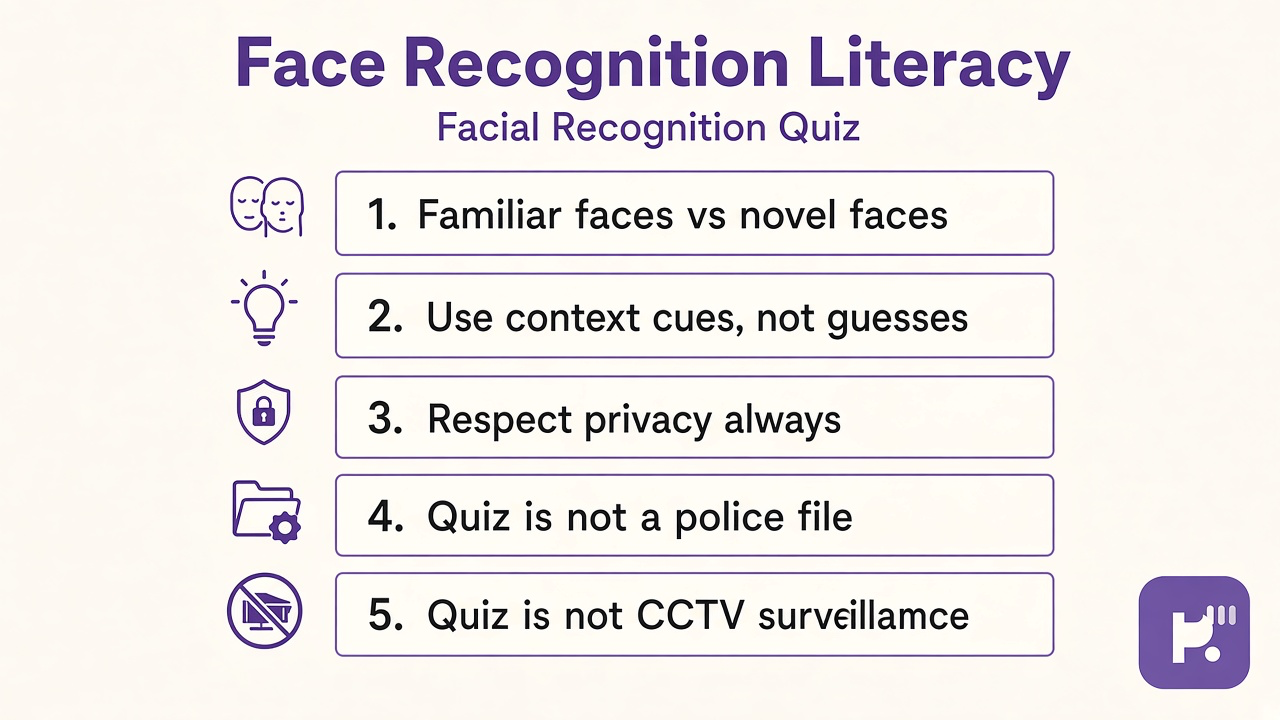
What this quiz can and cannot tell you
Can tell you
- Highlight familiar-novel, context, and privacy habits worth revisiting before CCTV debates
- Separate study literacy from mugshot databases and neuro-exam cosplay
- Encourage Face ID privacy skims and consent questions before photo reuse
- Spark honest talk about unofficial captions on recognition literacy shares
Cannot tell you
- Diagnose prosopagnosia or certify forensic face matching from one online screener
- Replace law-enforcement training, legal advice, or neurologist evaluation
- Prove you should scrape strangers into face-search apps without consent
- Turn literacy scores into harassment, watchlist fantasies, or courtroom testimony claims
Face ID literacy before CCTV cosplay
Facial recognition search intent often blends two needs: understand why familiar faces feel easier than novel crowd glances, and win arguments in chats that treat phone Face ID like stadium surveillance. Those goals help when they spark context cues, privacy skims, and policy questions before reposting mugshot memes. They hurt when one trivia score becomes a license to scrape yearbook photos, or when threads blur consumer Face ID with unregulated public matching.
Dr. James Whitfield reviews iq-cognitive literacy screeners with a simple split: reward honest context and privacy habits and honest limits on forensic pretense at the same time. Familiar versus novel faces tracks repeated exposure and algorithm training basics without identical-effort absolutism or prosopagnosia diagnosis stems on this slug. Context cue literacy tracks angle, lighting, and pairing habits without shame about noticing walk or voice. Privacy and biometrics keeps on-device templates, consent, and scrape-anyone traps visible. Quiz not police file keeps screeners, watchlists, and courtrooms separate from bar height.
Real readers mix bars. You may score high on privacy while keeping familiar-novel moderate, which often describes strong consent talk before crowd-matching vocabulary lands. You may score high familiar-novel with softer limit items, which can mean good science clips plus occasional unofficial caption slips. Reverse items catch sloppy answers: identical-effort myths, context-shame traps, CCTV certainty, consent-free scraping, quiz-as-clearance myths, or dunk threads tied to high bars should not inflate charts meant to track humble literacy habits.
Pair results with siblings instead of forcing one face story. Our face blindness test stays on prosopagnosia awareness and event coping rather than Face ID policy literacy on this page. Our facial expression quiz covers emotion cues separate from identity matching here. Our facial bones quiz stays on skull recall rather than biometric privacy habits. Browse the IQ and cognitive hub for more study screeners. Caption shares study-only, read the room, and skip bait threads on friends who never opted in.
News cycles shift with vendor updates, court rulings, and school photo policies. When you share results, say context cues beat scoreboards. When you borrow tips, credit explainers who separate phone Face ID from street cameras and clinicians who welcome face-memory questions. Retake after one policy headline week and watch whether privacy bars rise even if familiar-novel trivia felt easy, which often means you separated performative surveillance dunking from actual literacy listening.
| Test | Focus |
|---|---|
| Face blindness test | Prosopagnosia awareness and name-tag coping rather than Face ID privacy and familiar-novel science literacy here |
| Facial expression quiz | Emotion and muscle cues rather than identity matching, biometrics, and quiz-not-police-file limits on this slug |
| Facial bones quiz | Maxilla, mandible, and zygomatic recall rather than CCTV policy and consumer Face ID habits |
Facial Recognition Quiz FAQ
What does Facial Recognition Quiz measure?
It measures how much you agree with statements about familiar versus novel face patterns, context cue literacy, privacy and biometrics habits, and unofficial quiz limits. You get an index from 0 to 100 plus four bars. It describes self-reported literacy habits on this screener, not police clearance, forensic certification, or prosopagnosia diagnosis.
Is this the same as the face blindness test?
No. The face blindness test focuses on prosopagnosia awareness and personal coping habits. This quiz focuses on Face ID literacy, familiar-versus-novel science basics, privacy, and refusing to treat trivia like a police file.
Does a high score mean my phone Face ID is secure?
No. High bars describe agreement with literacy statements here, not a security audit of your device. Read vendor security pages and system updates for actual Face ID settings.
Why include familiar versus novel face items?
Readers confuse daily recognition ease with one-glance stranger matching in CCTV clips. Those items keep science vocabulary visible without copying prosopagnosia diagnosis stems from the face blindness sibling.
Can I use these results in court or at a checkpoint?
No. Limit items explicitly reject mugshot, watchlist, and testimony fantasies. Forensic identification belongs to trained workflows and legal process, not online trivia bars.
Who reviewed this quiz?
Dr. James Whitfield, PhD reviewed the educational framing, privacy and CCTV limits, and result explanations. See our editorial policy for review standards.
Reviewed by