What Face Blindness Test measures
This test does not administer the Cambridge Face Memory Test, Benton Facial Recognition, or any licensed neuropsych battery, and it cannot diagnose prosopagnosia from one score. It measures how much you agree with awareness statements grouped four ways: prosopagnosia awareness about face memory strain distinct from moral failure myths; name tags and coping about event habits, gentle friend disclosure, and context cues; familiar versus stranger faces about daily recognition versus crowd glances without absolutist traps; and quiz not neuro exam limits about unofficial screeners, refusing clinic fantasies, and captioning shares as reflection not diagnosis orders. You rate 22 statements from strongly disagree to strongly agree, with reverse-worded traps so one confident week cannot hide shame or mockery slips. Your answers also feed a second chart on closeness and trust habits, because embarrassment about face memory sometimes blocks asking friends for kind reminders. The total becomes an index from 0 to 100 where higher means more reported awareness and coping habits on this screener, not proof a neurologist signed your feed.
Prosopagnosia awareness
Face memory patterns without moral failure dunk culture.
Name tags and coping
Event tools, seating cues, and gentle friend disclosure.
Familiar versus stranger faces
Daily faces versus crowd glances without absolutist myths.
Quiz not neuro exam limits
Unofficial reflection only; clinicians stay separate.
How it works
Answer 22 agreement items
Rate each statement from Strongly disagree to Strongly agree. Tap Next after each answer.
Answers sort into four domains
Each answer feeds one of four face recognition awareness groups, and every item also feeds a closeness and trust layer.
See your index and charts
You get a 0 to 100 index, a band, four domain bars, and a second chart for intimacy habits.
Take the Face Blindness Test
Answer 22 short statements to see your face recognition awareness index, four domain bars, and a closeness and trust chart.
What your result means
Your index is the average of all 22 answers, scaled from 0 to 100, with reverse-worded items flipped first. Read quiz-not-neuro-exam limits with coping bars before you treat a high awareness score as clinical proof. Persistent safety or work disruption deserves neurologist context, not only trivia retakes.
| Band | Index range | Typical reading |
|---|---|---|
| Building face recognition awareness | 0 to 35 | Fewer agreed awareness, coping, familiar-face, or unofficial limit items on this screener. |
| Mixed face recognition awareness | 36 to 65 | Solid coping in some domains with familiar-face myths, shame traps, or neuro-exam fantasy slips in others. |
| Stronger face recognition awareness | 66 to 100 | Frequent agreement with awareness, coping, familiar-face humility, and unofficial limits; still not licensing. |
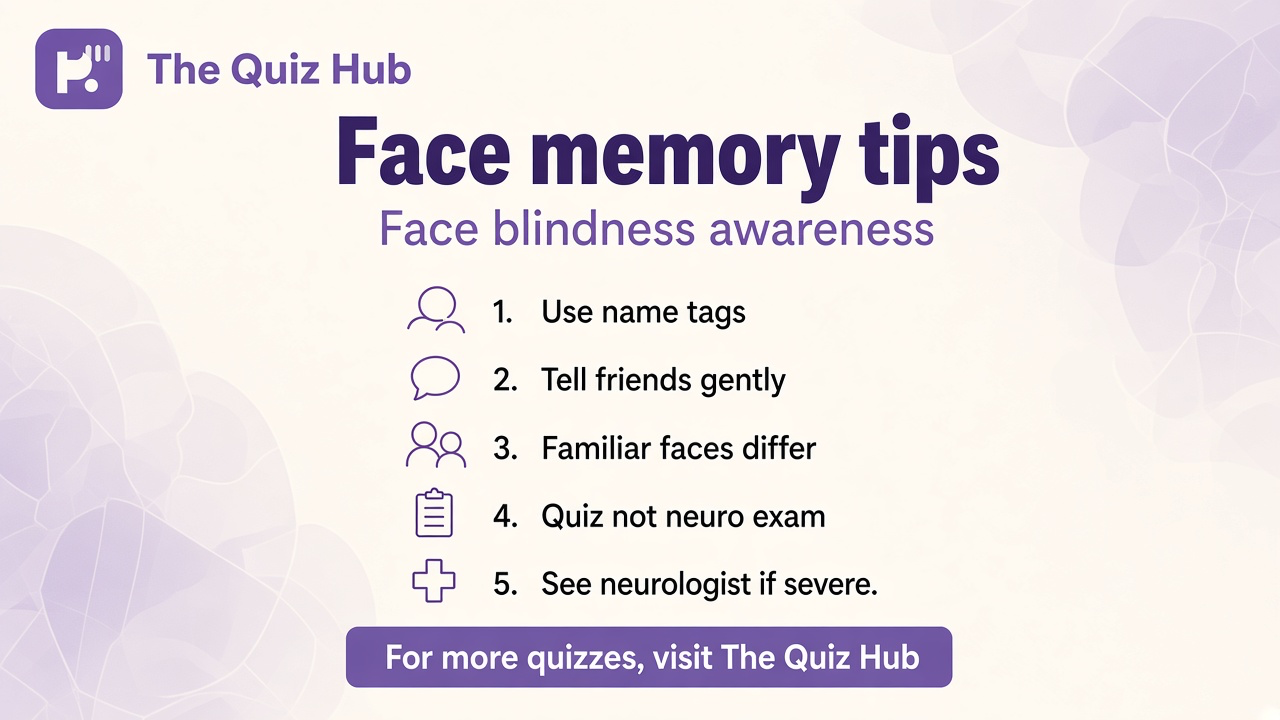
Tips at a glance
A quick takeaway graphic with topic tips (not your personal quiz scores). Start the quiz for your index, bands, and charts.
What this quiz can and cannot tell you
Can tell you
- Highlight awareness and coping habits worth revisiting before big events
- Separate unofficial reflection from Cambridge battery or diagnosis fantasies
- Encourage gentle friend disclosure and name-tag planning
- Spark honest talk about unofficial captions on face memory shares
Cannot tell you
- Diagnose prosopagnosia or rule it out from one online screener
- Replace neurologist, neuropsychologist, or vision specialist evaluation
- Prove you should mock acquaintances who forget faces after brief meetings
- Substitute for emergency care when sudden recognition loss follows head injury
Face memory awareness before neuro-exam cosplay
Face blindness search intent often blends two needs: name when recognition feels unusually hard, and win sympathy in chats that treat forgetfulness like a personality verdict. Those goals help when they spark name tags, gentle friend talk, and neurologist questions when life feels unsafe. They hurt when meme scores become licenses to mock slow recognizers, or when threads blur awareness trivia into skipping clinical evaluation after sudden symptoms.
Dr. James Whitfield reviews iq-cognitive awareness screeners with a simple split: reward honest coping habits and honest limits on clinical pretense at the same time. Prosopagnosia awareness tracks face memory strain distinct from voice and context memory without moral failure traps. Name tags and coping tracks event planning, disclosure, and reminder norms without shame about badges. Familiar versus stranger faces keeps daily recognition separate from crowd glances without absolutist myths. Quiz not neuro exam limits keeps screeners, Cambridge batteries, and neurologists separate from bar height.
Real readers mix bars. You may score high on coping while keeping familiar-face moderate, which often describes strong conference tools before crowd confidence lands. You may score high awareness with softer limit items, which can mean good vocabulary plus occasional unofficial caption slips. Reverse items catch sloppy answers: moral failure labels, name-tag shame, familiar-face absolutism, quiz-as-diagnosis myths, or mockery tied to high bars should not inflate charts meant to track humble awareness habits.
Pair results with siblings instead of forcing one face story. Our emotion recognition test stays on expression and feeling cues separate from identity matching on this page. Our face shape quiz covers grooming and jawline labels rather than prosopagnosia coping on this slug. Our human body quiz stays on broader organ warm-ups when units move fast. Browse the IQ and cognitive hub for more study screeners. Caption shares unofficial, read the room, and skip bait threads on friends who never opted in.
Event seasons shift with lighting, masks, and new teams. When you share results, say gentle reminders beat scoreboards. When you borrow tips, credit advocates who use name tags without dunking slower recognizers and clinicians who welcome evaluation questions. Retake after one conference block and watch whether coping bars rise even if awareness vocabulary felt easy, which often means you separated performative mockery from actual listening.
| Test | Focus |
|---|---|
| Emotion recognition test | Expression and feeling cues rather than identity matching, name tags, and prosopagnosia awareness habits on this page |
| Face shape quiz | Jawline and grooming maps rather than face memory strain, event coping, and neuro-exam limit habits here |
| Human body quiz | Broad organ and system warm-ups rather than familiar versus stranger face recognition patterns |
Face Blindness Test FAQ
What does Face Blindness Test measure?
It measures how much you agree with statements about prosopagnosia awareness, name-tag coping, familiar versus stranger face patterns, and unofficial quiz limits. You get an index from 0 to 100 plus four bars. It describes self-reported awareness habits on this screener, not clinical diagnosis or Cambridge battery scores.
Does a high score mean I have prosopagnosia?
No. High bars describe agreement with awareness and coping statements here, not proof of prosopagnosia. Licensed clinicians and neuropsychologists use interviews, history, and sometimes formal face memory tests. Limit items explicitly reject quiz-as-diagnosis myths.
Is this the Cambridge Face Memory Test?
No. Cambridge and other clinic batteries are separate professional tools. This page stays unofficial reflection with clear not-a-neuro-exam disclaimers.
Why include familiar versus stranger face items?
Readers often report daily faces feel easier than crowded stranger glances. Those items keep context and outfit changes visible without turning trivia into mockery licenses.
When should I see a neurologist?
Consider professional evaluation when face confusion disrupts work, safety, or relationships, or when recognition loss is sudden after injury or illness. This quiz starts reflection; clinicians handle diagnosis and care planning.
Who reviewed this test?
Dr. James Whitfield, PhD reviewed the unofficial framing, neuro-exam limits, and result explanations. See our editorial policy for review standards.
Reviewed by