
What Eysenck's Brief Personality Questionnaire (LOA-K) measures
This quiz does not administer the published Eysenck Personality Questionnaire, reproduce EPQ norms, or issue clinical PEN profiles. It measures how much you agree with unofficial self-report statements in four groups: extraversion energy about social charge, conversation starts, and recovery needs without shaming quiet weeks; neuroticism reactivity about worry, criticism replay, and plan-change stress with room for coping growth; psychoticism lite about edgy humor, novelty appetite, and blunt honesty in the pop-psych sense, explicitly not as psychosis or mental illness labeling; and quiz not clinical EPQ about honest unofficial framing, refusing hiring myths, comparing Big Five language when helpful, and separating adult stems from the JEPI child sibling. You rate 22 statements from strongly disagree to strongly agree, with reverse-worded items so one social season cannot inflate every bar. Your answers also feed a second chart on closeness and trust habits, because trait performance sometimes chases belonging over honest self-report. The total becomes an index from 0 to 100 where higher means more agreement with high-trait statements on this screener, not proof a clinic validated your PEN scores.
Extraversion energy
Social charge, talk initiation, and honest solo recovery needs.
Neuroticism reactivity
Worry, mood linger, and criticism replay without shame labels.
Psychoticism lite
Blunt, novel, edgy edges in PEN slang, not diagnosis.
Quiz not clinical EPQ
Unofficial reflection; not hiring screens or published EPQ.
How it works
Answer 22 agreement items
Rate each statement from Strongly disagree to Strongly agree. Tap Next after each answer.
Answers sort into four domains
Each answer feeds one of four trait groups, and every item also feeds a closeness and trust layer.
See your index and charts
You get a 0 to 100 index, a band, four domain bars, and a second chart for intimacy habits.
Take the Eysenck's Brief Personality Questionnaire (LOA-K)
Answer 22 short statements to see your Eysenck-style trait snapshot index, four domain bars, and a closeness and trust chart.
What your result means
Your index is the average of all 22 answers, scaled from 0 to 100, with reverse-worded items flipped first. Read unofficial EPQ limits with trait bars before you treat totals as clinical cutoffs or team rank. Honest self-report supports better conversations with friends and clinicians; web bars never replace skilled interpretation.
| Band | Index range | Typical reading |
|---|---|---|
| Quieter extraversion pattern | 0 to 35 | Fewer agreed high-extraversion, high-neuroticism, or psychoticism-lite statements; may show strong unofficial limits. |
| Mixed Eysenck-style pattern | 36 to 65 | Social buzz in some domains with worry spikes, blunt edges, or EPQ-overclaim slips in others. |
| Lively Eysenck-style pattern | 66 to 100 | Frequent agreement with high-extraversion, reactive mood, or blunt-edge items; still not clinical EPQ. |
Tips at a glance
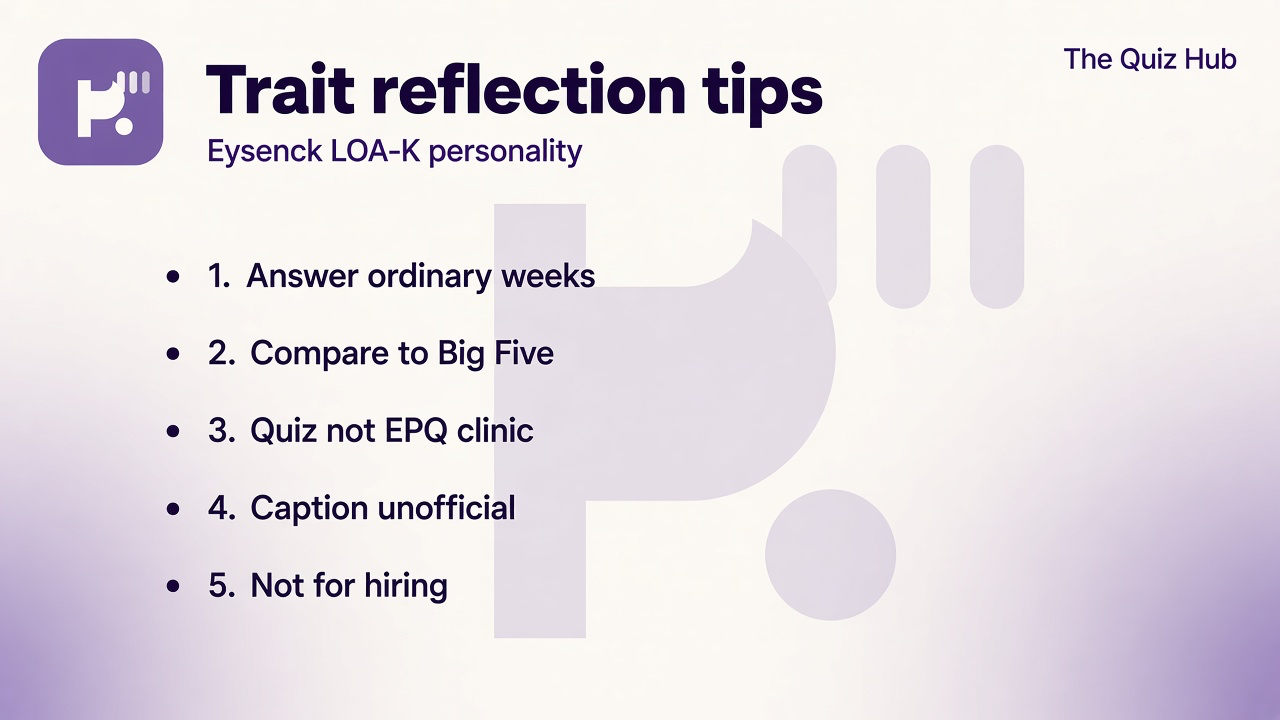
A quick takeaway graphic with topic tips (not your personal quiz scores). Start the quiz for your index, bands, and charts.
What this quiz can and cannot tell you
Can tell you
- Highlight extraversion, neuroticism, and blunt-edge habits you notice on ordinary weeks
- Spark compare-and-contrast talk with Big Five language on the same hub
- Separate unofficial reflection from clinical EPQ and employer screen fantasies
- Encourage humble captions when you share trait bars in group chats
Cannot tell you
- Replace the published Eysenck Personality Questionnaire or licensed PEN interpretation
- Diagnose personality disorders, psychosis, or mood conditions from one fan screener
- Serve as a hiring file, security clearance, or school placement record
- Rank friends as better or worse humans from psychoticism-lite slang on a web page
Answer honestly, compare frameworks, skip the hiring myth
Readers search Eysenck and EPQ language when they want a quick trait story that sounds older than Big Five memes. Hans Eysenck popularized extraversion, neuroticism, and psychoticism as broad dimensions; clinics use validated EPQ forms this page does not touch. This LOA-K themed screener offers 22 adult agree items for couch reflection. The wave115 JEPI child questionnaire sibling uses parent-report frequency stems on a separate bank so the two Eysenck pages never share question wording.
Dr. Sarah Chen reviews personality psychology screeners with a simple split: reward honest self-report and honest limits on instrument overclaim at the same time. Extraversion energy keeps social charge visible without insulting introverts. Neuroticism reactivity keeps worry language visible without calling people weak. Psychoticism lite keeps blunt and novelty edges visible while refusing psychosis slurs or diagnosis cosplay. Quiz not clinical EPQ keeps hiring myths, clinic replacement fantasies, and JEPI confusion out of share threads.
Real adults mix bars. You might score high extraversion with moderate neuroticism, which often describes social buzz plus private replay. You might score high psychoticism-lite with strong limit items, which can mean edgy humor with accountability. Reverse items catch traps: party drain myths stated backward, bounce-back absolutes, rule-following caricatures, employer shortcuts, or psychologist replacement fantasies should not quietly inflate trait pride.
Pair results with siblings instead of forcing one trait story. Our Big Five personality test explores five-factor language when openness and stability maps help more than PEN shorthand. Our Eysenck children questionnaire JEPI sibling targets parent-report child temperament with a distinct bank. Our ambivert test stays on social energy pacing when you want a lighter extraversion lane. Browse the personality and psychology hub for more unofficial screeners. Caption shares unofficial and skip trait dunking on friends who never opted in.
Life seasons move bars faster than one screenshot. Sleep loss, grief, new jobs, and festival weeks can spike neuroticism items without defining you forever. When you share results, say honesty beats scoreboard and clinicians beat fan EPQ cosplay. Retake after a typical month and watch whether limit bars stay high even when extraversion rises, which often marks healthy reflection instead of hiring-file fantasy.
| Test | Focus |
|---|---|
| Big Five personality test | Five-factor openness, conscientiousness, extraversion, agreeableness, and stability language rather than PEN-lite stems here |
| Eysenck children questionnaire JEPI | Parent-report child temperament bank, not these adult self-report LOA-K themed items |
| Ambivert test | Social energy pacing and middle-ground extraversion reflection rather than full PEN-lite domains |
Eysenck's Brief Personality Questionnaire (LOA-K) FAQ
What does Eysenck's Brief Personality Questionnaire (LOA-K) measure?
It measures how much you agree with self-report statements about extraversion energy, neuroticism reactivity, psychoticism-lite edges, and unofficial EPQ limits. You get an index from 0 to 100 plus four bars. It describes habits on this fan screener, not published EPQ scores or clinical labels.
Is this the clinical Eysenck Personality Questionnaire EPQ?
No. The published EPQ uses validated items and norms this page does not provide. Treat results as unofficial reflection and compare with Big Five language when that helps, not as clinic intake.
What does psychoticism lite mean on this page?
Here it follows pop-psych PEN shorthand for blunt, novelty-seeking, or rule-bending edges. It is not a diagnosis of psychosis, personality disorder, or violence risk. If those words scare you, read bars as curiosity language and talk with a clinician for real concerns.
How is this different from the JEPI child quiz on this site?
The JEPI sibling uses parent-report frequency stems about child temperament. This LOA-K themed page uses adult self-report agree items with zero shared question wording.
Who reviewed this quiz?
Dr. Sarah Chen, PhD reviewed the unofficial EPQ limits, psychoticism-lite framing, adult-versus-child bank separation, and result explanations. See our editorial policy for review standards.
Reviewed by
