
What this Eyberg child behavior inventory measures
This page does not administer the licensed Eyberg Child Behavior Inventory from research clinics, and it cannot diagnose conduct problems, oppositional patterns, ADHD, or any other disorder from one score. It measures how often you noticed parent-report habits clinicians and pediatricians often discuss when daily defiance strains family life, organized four ways: requests and rules when ignoring limits, arguing, or stalling followed calm instructions; anger and outbursts when yelling, hitting, property damage, or long meltdowns outran brief frustration; cooperation and praise when your child followed directions, cooled down, or earned specific praise for one named behavior; and parent report limits when unofficial screeners replaced pediatric visits, skipped clinicians when patterns stuck, or ignored crisis and emergency outreach when safety worried you. You answer 22 how-often statements about the past month, with reverse-worded items so one cooperative day, calm-down win, praise moment, or clinician call cannot hide frequent battles on other days. Your responses also feed a second chart on closeness and trust habits, because shame about behavior sometimes blocks asking co-parents or schools for help. The total becomes an index from 0 to 100 where higher means more frequent reported behavior strain on this screener. Your responses suggest intensity to discuss with support; they do not prove your child has a disorder.
Requests and rules
How often limits triggered arguing, ignoring, stalling, or blame instead of age-typical follow-through.
Anger and outbursts
How often tantrums, yelling, hitting, or long upset outran brief coaching and recovery.
Cooperation and praise
How often listening, repair, words for help, and specific praise showed up as small wins.
Parent report limits
How often quiz humility, pediatric planning, and crisis awareness showed up versus label myths.
How it works
Answer 22 frequency items
Rate each statement from Never to Very often for the past month. Tap Next after each answer.
Answers sort into four domains
Each answer feeds one of four behavior groups, and every item also feeds a closeness and trust layer.
See your index and charts
You get a 0 to 100 index, a band, and two bar charts you can bring to a pediatrician or therapist.
Take the Eyberg Child Behavior Inventory
Answer 22 short parent-report statements to see your child behavior frequency index, four domain bars, and a closeness and trust chart.
What your result means
Your index is the average of all 22 answers, scaled from 0 to 100, with reverse-worded items flipped first. Higher means more frequent reported defiance or anger strain on this screener. Read parent report limits with anger bars before you treat any total as diagnostic proof. Safety worries deserve emergency or crisis support, not only parenting tips.
| Band | Index range | Typical reading |
|---|---|---|
| Lower reported behavior strain | 0 to 35 | Fewer frequent arguing, rule refusal, anger outbursts, or limit myths in the past month on this parent-report screener. |
| Mixed reported behavior strain | 36 to 65 | Some calmer stretches alongside arguing, tantrums, cooperation dips, or quiz-as-verdict habits on other days. |
| Higher reported behavior strain | 66 to 100 | Frequent defiance, anger, or safety stress; pediatric and mental health support may help more than another solo retake. |
Tips at a glance
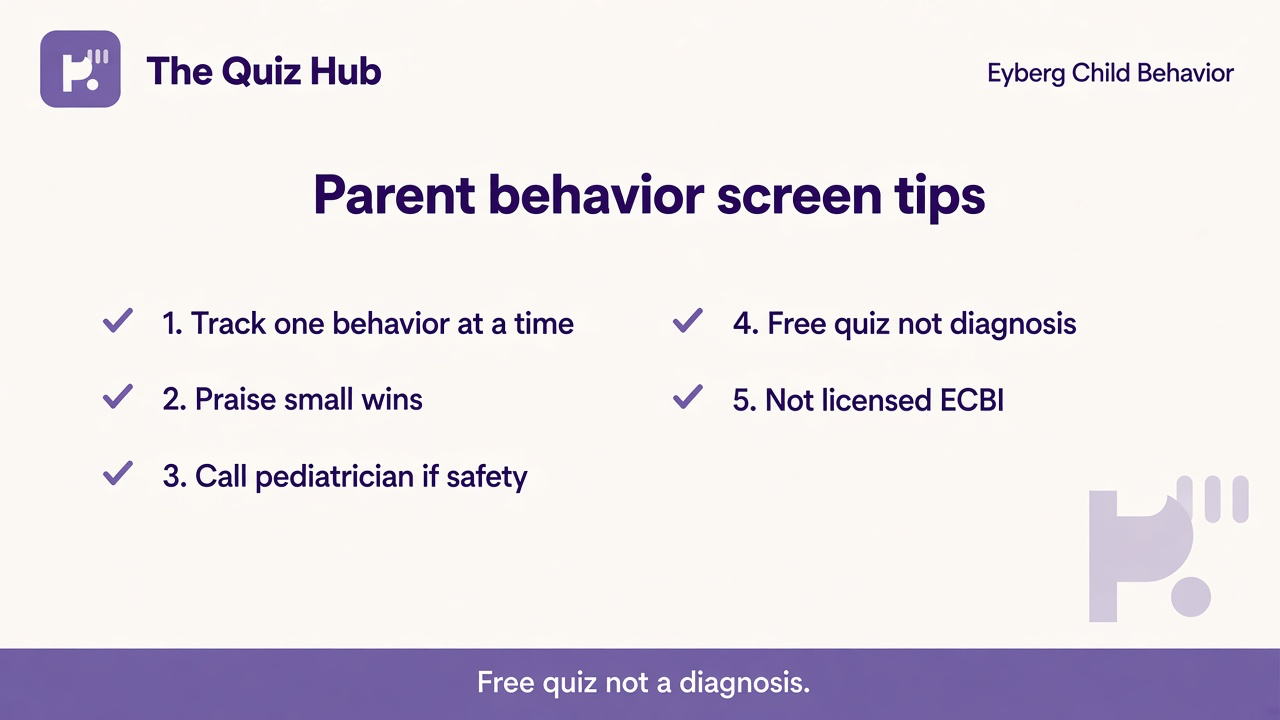
A quick takeaway graphic with topic tips (not your personal quiz scores). Start the quiz for your index, bands, and charts.
What this quiz can and cannot tell you
Can tell you
- Name arguing, tantrum, and cooperation habits in plain language for pediatric or therapy intake
- Highlight when praise, one-behavior focus, or clinician planning habits are missing
- Support honest overlap conversations with clinicians without forcing one online label
- Offer a baseline if you retake after one week of named small wins and calmer limits
Cannot tell you
- Diagnose oppositional, conduct, or ADHD labels from one parent-report score
- Replace the licensed ECBI, school observations, or formal behavioral assessment
- Prove which discipline style you must use from bar height alone
- Substitute for emergency care when injury, weapons, or self-harm talk feels urgent
Defiance spikes, praise wins, and quiz-not-diagnosis limits
Parents open eyberg child behavior inventory pages when mornings feel like negotiations, when teachers send notes home, or when shame whispers that one score defines the whole child. Pediatricians and family therapists discuss defiance and anger as stress-linked patterns that sleep, hunger, bullying, neurodiversity, and caregiver burnout can amplify. This online screener uses that reflection lens unofficially; it cannot replace interview-based assessment with your child present or tell you which single intervention fits without your history.
Requests and rules cover arguing, ignoring, and stalling, not whether your child never tests limits. Calm follow-through after one reminder is a protective signal worth naming in visits, even when personality runs strong. Anger and outbursts cover tantrum length, yelling, hitting, and damage, not whether every disappointed afternoon equals a crisis. Cooling within twenty minutes with coaching is a growth signal therapists track. Cooperation and praise cover listening, repair, asking for help, and specific praise for one named behavior, matching intent brief tips to focus on one habit at a time instead of vague labels.
Real families mix bars. You might score high on anger while moderate on rule refusal, which often describes meltdowns without daily ignoring. You might score high on defiance with low limit outreach, which can mean battles sting yet you still treat web totals as proof of a disorder label. Reverse items catch overconfidence: following daily steps, calming after coaching, listening on rested days, accepting consequences, using words, earning praise, repairing with siblings, refusing licensed-instrument myths, skipping clinician visits when worried, calling pediatricians with examples, and using crisis lines when safety spikes should not inflate a strain index meant to track frequency of difficult behavior.
Pair results with siblings on this hub instead of forcing one label story. Our does my child have anxiety quiz sibling tracks worry and avoidance frequency with a separate stem bank, not defiance wording here. Our aggressive behavior sibling emphasizes hit and tantrum peaks with its own parent-report sentences. Our strengths and difficulties SDQ page frames broader child strengths and strains with distinct limits. Browse the mental health and clinical test hub for more YMYL screeners with study-not-diagnosis framing.
Higher scores mean more frequent self-reported behavior strain on this tool, not proof your child is doomed or that you must parent alone forever. Bring domain bars to intake so visits start with examples, not shame. If safety spikes, skip online debate and prioritize emergency services, your pediatrician, or 988 when caregivers feel overwhelmed. Retake after one week of one-behavior praise focus when safe and compare bars, not only the total.
| Test | Focus |
|---|---|
| Does my child have anxiety quiz | Child worry and avoidance frequency with a separate stem bank; zero shared sentences with this behavior screener |
| Aggressive behavior | Hit burst and tantrum peak parent-report items rather than rule refusal and praise habits here |
| Strengths and difficulties SDQ | Broader strengths and difficulties framing rather than ECBI-theme frequency domains here |
Eyberg Child Behavior Inventory FAQ
What does this Eyberg child behavior inventory measure?
It measures how often you noticed requests and rules strain, anger and outbursts, cooperation and praise habits, and parent report limit habits during the past month. You get an index from 0 to 100 plus four domain bars. Your responses suggest self-reported frequency for reflection, not a clinical diagnosis.
Is this the official licensed Eyberg Child Behavior Inventory?
No. This is an unofficial screener inspired by common ECBI-style behavior themes for self-reflection. It is not the licensed Eyberg instrument and cannot replace a pediatrician or psychologist assessment.
Can this quiz tell me if my child has ODD or a conduct disorder?
No. Only a qualified clinician who meets your child, gathers history, and uses appropriate tools can evaluate behavior disorders. This page describes parent-observed frequency patterns, not diagnostic labels.
Why mention pediatricians and 988 in the limits domain?
Intent brief readers asked for safety honesty. Limit items keep medical and crisis outreach visible so unofficial bars do not replace care when behavior or caregiver stress feels unsafe.
What should I do if my score is high or I feel overwhelmed?
Call emergency services if someone is in immediate danger. Call or text 988 (US) if caregiver crisis feels urgent, or contact your pediatrician or child therapist with domain examples from your results. Prioritize support over retakes when safety fears spike.
Who reviewed this screener?
Dr. Sarah Chen, PhD reviewed the YMYL framing, crisis resources, unofficial ECBI limits, sibling separation, and result explanations. See our editorial policy for review standards.
Reviewed by
