What Exponential Functions Quiz measures
This quiz does not grade AP Calculus, certify college credit, or replace classroom graphing assignments. It measures how much you agree with habit statements grouped four ways: growth and decay about base above one versus between zero and one, percent change stories, and rejecting linear doubling myths; bases and rates about the role of a and b in f(x) = a·b^x, vertical scale versus direction, flat bases at one, and comparing multiplier sizes; graphs and asymptotes about horizontal asymptotes for basic and shifted curves, two-point sketches, reading direction and flattening, and rejecting forced x-axis crossings; and exponential quiz limits about unofficial screeners, refusing AP substitution fantasies, and captioning shares as trivia not grades. You rate 22 statements from strongly disagree to strongly agree, with reverse-worded traps so one hot take cannot inflate every bar. Your answers also feed a second chart on closeness and trust habits, because math stress sometimes pushes perfectionism instead of calm graph practice. The total becomes an index from 0 to 100 where higher means more reported exponential function habits on this screener, not proof teachers approved your feed.
Growth and decay
Base split, percent stories, and rejecting linear doubling traps.
Bases and rates
Parameters a and b, multipliers, and comparing base size.
Graphs and asymptotes
Sketches, shifts, direction, and horizontal asymptote lines.
Exponential quiz limits
Practice reflection only; AP and teacher grades stay separate.
How it works
Answer 22 agreement items
Rate each statement from Strongly disagree to Strongly agree. Tap Next after each answer.
Answers sort into four domains
Each answer feeds one of four exponential habit groups, and every item also feeds a closeness and trust layer.
See your index and charts
You get a 0 to 100 index, a band, four domain bars, and a second chart for intimacy habits.
Take the Exponential Functions Quiz
Answer 22 short statements to see your exponential functions habits index, four domain bars, and a closeness and trust chart.
What your result means
Your index is the average of all 22 answers, scaled from 0 to 100, with reverse-worded items flipped first. Read quiz limit bars together with graphs and asymptotes before you treat a high growth score as permission to skip AP practice. Habits support kinder study talk; teachers still matter for hard graph questions.
| Band | Index range | Typical reading |
|---|---|---|
| Building exponential function habits | 0 to 35 | Fewer agreed facts on growth versus decay, base checks, asymptote reading, or quiz limits on this screener. |
| Mixed exponential function habits | 36 to 65 | Solid habits in some domains with linear-doubling myths, optional asymptotes, or bars replacing AP practice. |
| Strong exponential function habits | 66 to 100 | Frequent agreement with growth, base, asymptote, and humble quiz limits; still not licensing. |
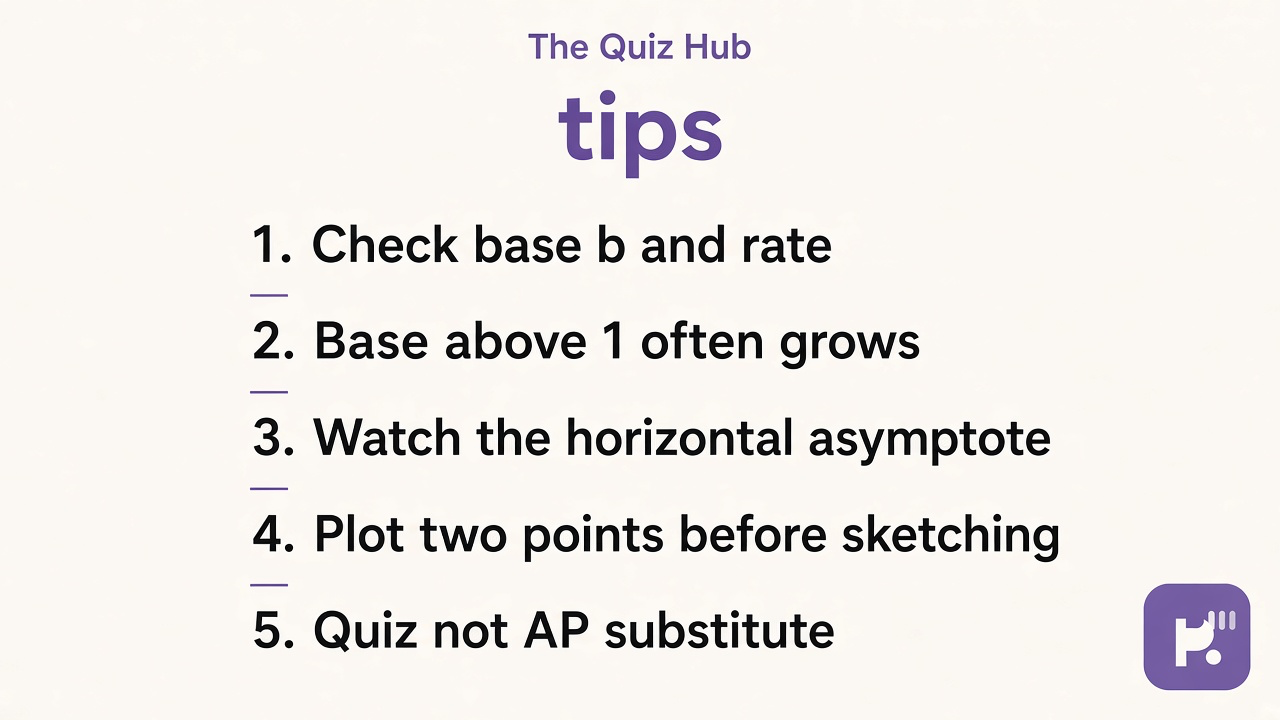
Tips at a glance
A quick takeaway graphic with topic tips (not your personal quiz scores). Start the quiz for your index, bands, and charts.
What this quiz can and cannot tell you
Can tell you
- Highlight growth, decay, base, and asymptote habits worth revisiting before graph units
- Separate unofficial reflection from AP exams and teacher grade files
- Encourage two-point sketches and asymptote labels before calculator-only work
- Spark honest talk with friends about unofficial captions on shares
Cannot tell you
- Replace AP Calculus, AP Precalculus, school courses, or proctored unit tests
- Award course credit or certify college readiness from one agree screener
- Substitute for instructor feedback on graphing assignments
- Turn habit scores into harassment, pile-ons, or purity tests in math threads
Exponential graphs before AP score cosplay
Exponential function search intent often blends two needs: prove you can read growth and decay for class, and claim a share lane that feels smart in mixed chats. Those goals help when they spark base checks and calm sketches. They hurt when meme scores become licenses to skip homework, or when threads blur trivia bars into proof someone finished an AP unit.
Dr. James Whitfield reviews iq-cognitive math screeners with a simple split: reward honest graph habits and honest limits on exam pretense at the same time. Growth and decay tracks whether you split bases above one from bases between zero and one before you label tables. Bases and rates keeps a and b roles straight without turning every story into symbol soup. Graphs and asymptotes rewards horizontal asymptote awareness and two-point plots. Exponential quiz limits keeps screeners, AP offices, and teacher gradebooks separate from bar height.
Real students mix bars. You may score high on growth while keeping asymptote items moderate, which often describes strong table work before shift homework lands. You may score high on graphs with softer limit items, which can mean good sketch habits plus occasional unofficial caption slips. Reverse items catch sloppy answers: doubling treated as linear, bases never compared, exponentials forced to hit zero, AP substitution fantasies, or pile-ons tied to high bars should not inflate charts meant to track humble study habits.
Pair results with siblings instead of forcing one math story. Our exponent rules quiz covers product, power, and zero-exponent laws when symbolic manipulation needs its own lane. Our exponents quiz leans negative powers, radicals, and fractional exponents when rewrite fluency is the goal separate from graph stories. Our equations quiz stays on balance, PEMDAS, and plug-back habits when linear solving still needs warm-up. Browse the IQ and cognitive hub for more study screeners. Caption shares unofficial, read the room, and skip bait threads on friends who never opted in.
Graph units shift faster than one weekend binge. When you share results, say context and kindness beat scoreboard. When you borrow tips, credit partners who plot two points and teachers who welcome questions. Retake after a precalc or algebra 2 block and watch whether asymptote bars rise even if growth vocabulary felt easy, which often means you separated performative posts from actual sketch practice.
| Test | Focus |
|---|---|
| Exponent rules quiz | Product, power, and zero-exponent laws rather than growth-decay graphs and asymptotes |
| Exponents quiz | Negative, fractional, and radical rewrite fluency rather than f(x) = a·b^x graph habits |
| Equations quiz | Linear equation balance and check habits rather than exponential curve reading |
Exponential Functions Quiz FAQ
What does Exponential Functions Quiz measure?
It measures how much you agree with statements about growth and decay, bases and rates, graphs and asymptotes, and unofficial quiz limits. You get an index from 0 to 100 plus four bars. It describes self-reported graph and story habits on this screener, not AP readiness or teacher grades.
Is this an AP Calculus or AP Precalculus practice test?
No. AP programs, schools, and proctored exams own official scores. This screener is habit reflection only and cannot award course credit.
Does a high score mean I should skip graphing homework?
No. High bars mean you related to habit statements here. Sketch practice, shifted asymptotes, and instructor feedback still matter on real assignments.
Why include growth and asymptote items together?
Exponential study blends story labels with graphs. Asymptote items keep sketch habits tied to base direction without turning trivia into grade claims.
Who reviewed this quiz?
Dr. James Whitfield, PhD reviewed the educational framing, math habit limits, and result explanations. See our editorial policy for review standards.
Reviewed by