
What this Existential Search Scale measures
This page does not administer a validated Existential Search Scale from research clinics, and it cannot diagnose depression, OCD, or any spiritual crisis label from one score. It measures how often you noticed habits counselors and chaplains often discuss when meaning seeking strains daily life, organized four ways: meaning search habits when tabs, podcasts, or threads multiplied while pauses felt impossible; values grounding when you named values before new gurus, paired insights with weekday acts, or refused trendy maps that dishonored relationships; comparison feed limits when highlight reels, stranger origin stories, or late-night quote threads fed a race to feel sorted; and search scale limits when unofficial screeners replaced therapy, skipped counselors when spirals stuck, or ignored 988 when hopelessness peaked. You answer 22 how-often statements about the past month, with reverse-worded items so one journal list, values check, mute button, or counselor plan cannot hide frequent hopping or feed comparison on other days. Your responses also feed a second chart on closeness and trust habits, because shame about searching sometimes blocks asking for help. The total becomes an index from 0 to 100 where higher means more frequent reported search strain on this screener. Your responses suggest intensity to discuss with support; they do not prove you failed at meaning.
Meaning search habits
How often tabs, podcasts, or threads multiplied while pauses, rest, or trusted asks felt scarce.
Values grounding
How often you named values before trends, paired insights with acts, or refused guru maps that cut relationships.
Comparison feed limits
How often highlight reels and quote threads fed a race instead of offline conversation and sleep.
Search scale limits
How often quiz humility, counselor planning, and 988 awareness showed up versus label myths.
How it works
Answer 22 frequency items
Rate each statement from Never to Very often for the past month. Tap Next after each answer.
Answers sort into four domains
Each answer feeds one of four meaning search groups, and every item also feeds a closeness and trust layer.
See your index and charts
You get a 0 to 100 index, a band, and two bar charts you can bring to a therapist or counselor.
Take the Existential Search Scale
Answer 22 short statements to see your existential search scale index, four domain bars, and a closeness and trust chart.
What your result means
Your index is the average of all 22 answers, scaled from 0 to 100, with reverse-worded items flipped first. Higher means more frequent reported restless search or comparison strain on this screener. Read search scale limits with meaning search bars before you treat any total as diagnostic proof. Persistent hopelessness or safety worries deserve crisis support, not only philosophy tips.
| Band | Index range | Typical reading |
|---|---|---|
| Lower reported search strain | 0 to 35 | Fewer frequent restless search loops, comparison-feed races, values drift, or scale-as-verdict habits in the past month. |
| Mixed reported search strain | 36 to 65 | Some steadier stretches alongside restless search, values drift, comparison feeds, or limit myths on other days. |
| Higher reported search strain | 66 to 100 | Frequent restless search, values drift, or comparison-feed strain; professional support and crisis lines may help more than another solo retake. |
Tips at a glance
A quick takeaway graphic with topic tips (not your personal quiz scores). Start the quiz for your index, bands, and charts.
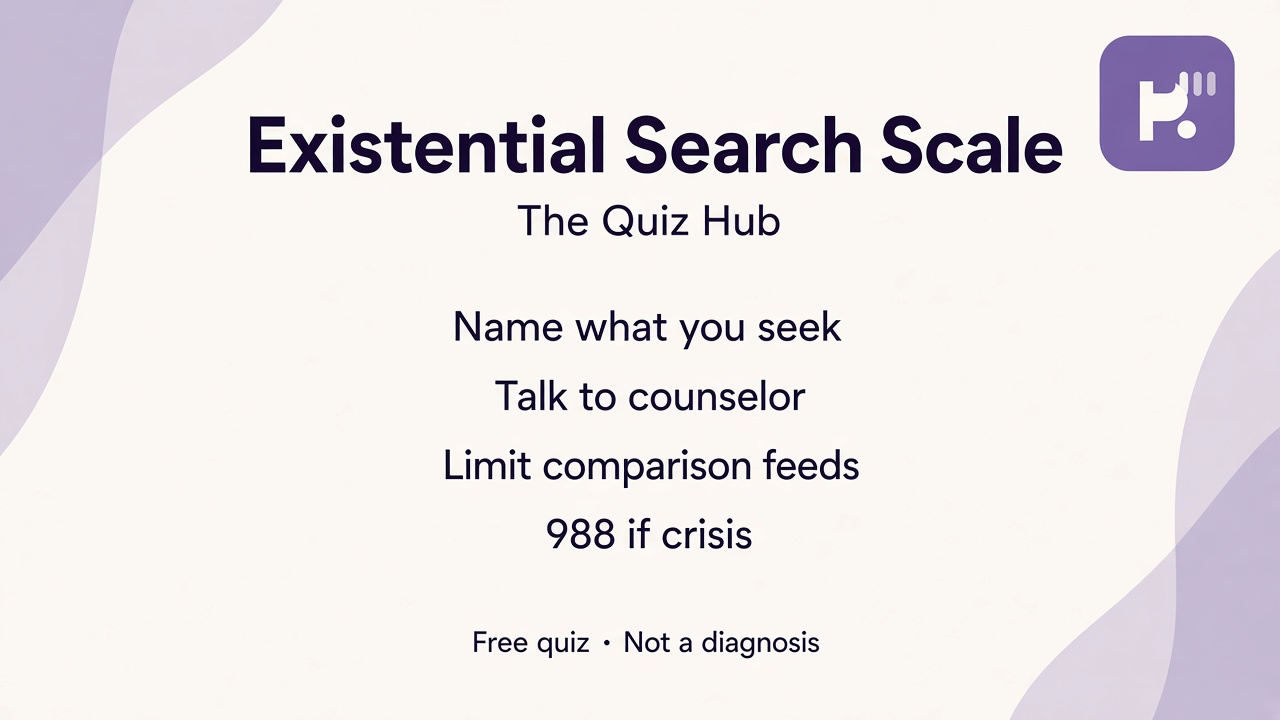
What this quiz can and cannot tell you
Can tell you
- Name restless search, values drift, and comparison-feed habits in plain language for therapy intake
- Highlight when values grounding, counselor planning, or crisis outreach habits are missing
- Support honest overlap conversations with clinicians without forcing one online label
- Offer a baseline if you retake after one week of feed limits and values-aligned actions
Cannot tell you
- Diagnose depression, OCD, or spiritual crisis from one score
- Replace pastoral care, logotherapy, grief counseling, or medication decisions
- Prove which belief system you must adopt from bar height
- Substitute for crisis care when hopelessness or safety fears feel urgent
Restless search, values grounding, and quiz-not-therapy limits
People search existential search scale pages when philosophy tabs multiply, when deconstruction seasons outrun sleep, or when feeds make everyone else look spiritually sorted first. Clinicians and campus chaplains discuss meaning seeking as normal human work that grief, transitions, algorithm diets, and mood conditions can amplify into restless loops. This online screener uses that reflection lens unofficially; it cannot replace interview-based assessment or tell you which single path fits without your history.
Meaning search habits cover hopping between frameworks, not whether you ever read deeply. Journal lists, trusted asks, and deliberate pauses are protective signals worth naming in therapy, even when curiosity stays high. Values grounding covers naming what you already stand for before new gurus arrive, pairing insights with weekday acts, and refusing trendy maps that ask you to abandon people who still matter. Comparison feed limits cover highlight reels and quote threads that turn purpose into a scoreboard, not whether you must delete every app forever.
Real readers mix bars. You might score high on meaning search while moderate on comparison feeds, which often describes curious reading without reel races. You might score high on comparison with low limit outreach, which can mean feeds sting yet you still treat web totals as identity proof. Reverse items catch overconfidence: keeping question lists, asking mentors without copying them, pausing to rest, writing values before books, muting scoreboard accounts, taking offline blocks, refusing clinic-instrument myths, looking up 988, and planning counselor visits should not inflate a strain index meant to track frequency of restless search.
Pair results with siblings on this hub instead of forcing one label story. Our existential anxiety scale ECQ sibling tracks mortality and void frequency with a separate stem bank, not search-habit wording here. Our existential anxiety questionnaire EAQ sibling uses its own past-month worry bank with zero shared sentences. Our experiencing an existential crisis page frames acute crisis habits with distinct limits. Browse the mental health and clinical test hub for more YMYL screeners with study-not-diagnosis framing.
Higher scores mean more frequent self-reported search strain on this tool, not proof you must keep hunting alone forever. Bring domain bars to intake so sessions start with examples, not shame. If hopelessness spikes, skip online debate and prioritize 988 or a clinician. Retake after one week of feed limits and values micro-acts when safe and compare bars, not only the total.
| Test | Focus |
|---|---|
| Existential anxiety scale ECQ | Mortality salience and meaning void frequency with a separate stem bank; zero shared sentences with this search scale |
| Existential anxiety questionnaire EAQ | Past-month existential worry themes with its own wording, not meaning search habit items here |
| Experiencing an existential crisis | Acute crisis habit framing rather than restless search and feed comparison frequency here |
Existential Search Scale FAQ
What does this existential search scale measure?
It measures how often you noticed meaning search habits, values grounding, comparison feed limits, and search scale limit habits during the past month. You get an index from 0 to 100 plus four domain bars. Your responses suggest self-reported frequency for reflection, not a clinical diagnosis.
Is this a validated Existential Search Scale from research?
No. This is an unofficial, inspired screener for self-reflection. It is not a validated clinic form and cannot replace a licensed clinician assessment.
How is this different from the existential anxiety scales on this hub?
EAQ and ECQ siblings track mortality, void, and worry frequency with their own stem banks. This search scale page uses entirely different sentence wording focused on restless seeking and feed comparison; the tests share zero duplicate stems. Compare totals only as separate mirrors, not as one combined verdict.
Why mention 988 and counseling in the limits domain?
Intent brief readers asked for crisis honesty. Limit items keep outreach visible so unofficial bars do not replace professional care when hopelessness or safety fears spike.
What should I do if my score is high or I feel overwhelmed?
Call or text 988 (US) if crisis feels immediate, or contact a licensed clinician or counselor with domain examples from your results. Prioritize support over retakes when hopelessness or safety fears spike.
Who reviewed this scale?
Dr. Sarah Chen, PhD reviewed the YMYL framing, crisis resources, unofficial scale limits, wave112 sibling separation, and result explanations. See our editorial policy for review standards.
Reviewed by
