What Excretory System Quiz measures
This quiz does not diagnose kidney disease, interpret real urinalysis panels, or grade your worth as a student. It measures how much you agree with introductory excretory system study literacy grouped four ways: kidney filter role about blood filtration, waste removal, water and electrolyte balance language, ureter transport, and rejecting kidney-as-backpack storage myths; bladder store role about urine holding until voiding, ureter connections, stretch-and-release intro stories, separating storage from filtration, and hydration habits without replacing clinicians; nephron basics about functional units, glomerulus and tubule segments, filtration-reabsorption-secretion arrows, flow tracing, and rejecting liver-only or identical-tubule myths; and quiz not urologist limits about study screeners, rejecting diagnosis and stranger urinalysis fantasies from web scores, citing class sources over dunk threads, and keeping academic integrity when symptoms persist. You rate 22 statements from strongly disagree to strongly agree, with reverse-worded myths so agreeing with bladder blood filtration, kidney urine backpacks, nephrons only in liver, or high bars as urology credentials cannot inflate every bar. Your answers also feed a second chart on closeness and trust habits, because health anxiety sometimes chases organ scores over honest clinician visits. The total becomes an index from 0 to 100 where higher means more reported excretory study literacy on this screener, not proof you aced anatomy lab or earned urology board status.
Kidney filter role
Blood filtration, waste removal, and water balance at intro depth.
Bladder store role
Storage, ureters, voiding paths, and filter versus store separation.
Nephron basics
Functional units, glomerulus, tubules, and flow tracing habits.
Quiz not urologist limits
Class prep; no diagnosis, labs, or thread dunks from bars.
How it works
Answer 22 agreement items
Rate each statement from Strongly disagree to Strongly agree. Tap Next after each answer.
Answers sort into four domains
Each answer feeds one of four excretory study literacy groups, and every item also feeds a closeness and trust layer.
See your index and charts
You get a 0 to 100 index, a band, and two bar charts you can use before an anatomy unit test or midterm week.
Take the Excretory System Quiz
Answer 22 short statements to see your excretory system study literacy index, four domain bars, and a closeness and trust chart.
What your result means
Your index is the average of all 22 answers, scaled from 0 to 100, with reverse-worded items flipped first. Higher means more reported excretory study literacy on this screener. Read quiz-not-urologist limits with nephron bars before you treat a high kidney filter score as exam immunity or symptom diagnosis.
| Band | Index range | Typical reading |
|---|---|---|
| Building excretory study literacy | 0 to 35 | Fewer agreed facts on kidney filter roles, bladder storage, nephron basics, or quiz-limit items on this screener. |
| Mixed excretory study literacy | 36 to 65 | Solid facts in some domains with bladder filter myths, nephron all-or-nothing traps, urology fantasies, or thread dunk habits in others. |
| Strong excretory study literacy | 66 to 100 | Frequent agreement with accurate excretory study trivia and healthy class prep limits; still not urology certification. |
Tips at a glance
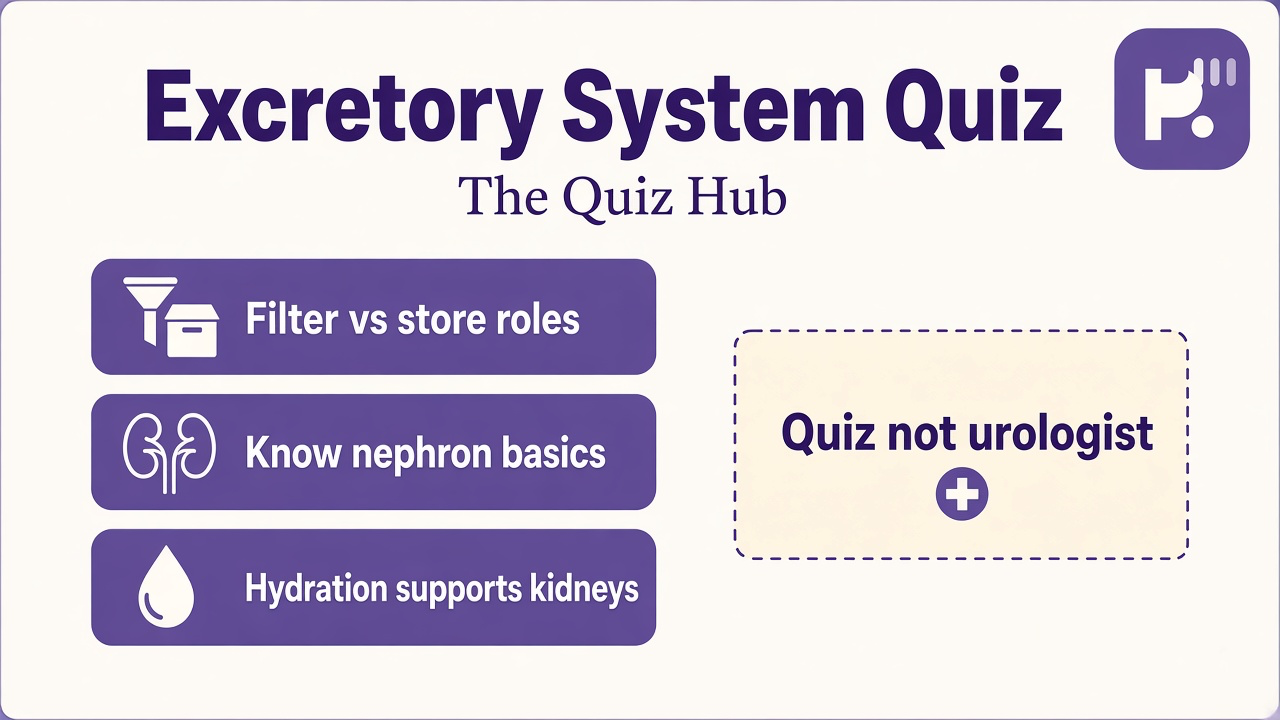
A quick takeaway graphic with topic tips (not your personal quiz scores). Start the quiz for your index, bands, and charts.
What this quiz can and cannot tell you
Can tell you
- Clarify kidney filter versus bladder store vocabulary in plain high school language
- Highlight nephron flow and filter-storage myths worth unlearning before tests
- Encourage diagram tracing and hydration study habits without shame
- Spark better questions during anatomy lectures and study groups
Cannot tell you
- Diagnose kidney disease, UTIs, or stones from one online screener
- Replace urology visits, imaging, or clinician-interpreted urinalysis
- Authorize ignoring burning urination or flank pain because trivia bars looked high
- Turn study scores into harassment, fake lab reads, or dosing advice for strangers online
Excretory system study before urology self-diagnosis threads
Students search excretory system quizzes when kidney and bladder charts tangle, nephron labels pile up, and social feeds promise detox clarity from twenty agree items. Those goals help when readers treat bars as a study map for filter versus store roles, not as urinalysis interpretation or urology permission slips. They hurt when people label symptoms from trivia, skip clinicians because nephron stems felt easy, or debate classmates with bladder filters blood myths.
Dr. James Whitfield reviews iq cognitive study screeners with a simple split: reward honest agreement with widely taught kidney, bladder, and nephron facts and honest limits on urology hype at the same time. Kidney filter role keeps blood filtration, waste removal, and water balance language visible beside trap items about kidneys as long-term urine backpacks. Bladder store role keeps storage, ureter transport, and voiding paths visible beside myths that bladders manufacture blood cells or filter plasma. Nephron basics keep functional unit flow, glomerulus and tubule tracing, and reabsorption arrows visible beside liver-only or identical-plumbing jokes. Quiz not urologist limits keep screeners, symptoms, clinicians, and academic integrity visible beside comment-section diagnosis fantasies.
Real students mix bars. You might score high on kidney filters while keeping nephron flow moderate, which often describes organ name memory before tubule tracing lands. You might score high on bladder storage with moderate quiz limits, which can mean solid compare charts yet little humility on symptoms. Reverse items catch sloppy answers: bladder filtration, kidney backpacks, nephrons only in liver, or web scores authorizing stranger diagnoses should not inflate bars meant to track layered study habits.
Pair results with siblings instead of forcing one study story. Our endocrine system quiz covers hormone feedback loops and gland roles when your syllabus overlaps homeostasis and water balance weeks. The enzyme quiz reinforces enzyme reaction vocabulary and active site habits when biochem units sit beside excretion labs. Browse the IQ and cognitive test hub for more low stakes study screeners. Caption shares as class practice and skip urinary symptom dunking on friends who never asked for a diagnosis.
Units move faster than one chart photo. New lab stories, dialysis mentions, and clinical correlations shift while old nephron sketches still sit in camera rolls. When you share results, say diagram tracing and clinician questions beat scoreboard. When you borrow study tips, credit instructors who enforce limits on self-diagnosis from social quizzes. Retake after one exam cycle and watch whether nephron bars rise even if bladder trivia lags, which often means you separated performative scoring from actual syllabus work.
| Test | Focus |
|---|---|
| Endocrine system quiz | Hormone feedback loops and gland roles rather than dedicated kidney filter and nephron flow stems on this page |
| Enzyme quiz | Enzyme reaction, active site, and inhibitor literacy rather than urinary organ compare habits here |
| Anatomy and physiology quiz | General A and P study literacy rather than four-domain excretory study habits with quiz-not-urologist limits |
Excretory System Quiz FAQ
What does Excretory System Quiz measure?
It measures how much you agree with excretory study literacy across kidney filter roles, bladder store roles, nephron basics, and quiz not urologist limits. You get an index from 0 to 100 and four bars. It reflects self-reported knowledge on this screener, not a clinical workup, urinalysis interpretation, or urology board exam.
Is this the same as my anatomy lab practical?
No. This page builds study-habit and concept reflection aligned with common high school excretory units. Official lab practicals and your instructor govern models, diagrams, and graded dissection work.
Why include bladder versus kidney trap items?
Many students still mix filtration and storage jobs. Reverse-worded myths catch shortcuts so bars track what you actually understand, not catchy organ bingo alone.
Does a high score mean my kidneys are healthy?
No. High bars mean you related to study statements here. Real kidney health questions need history, exam, and appropriately ordered labs with licensed clinicians, not agree-quiz bars.
Who reviewed this quiz?
Dr. James Whitfield, PhD reviewed the educational framing, excretory study literacy limits, and result explanations. See our editorial policy for review standards.
Reviewed by