What Enzyme Quiz measures
This quiz does not certify lab techs, grade AP exams alone, or replace instructor safety briefings. It measures how much you agree with study statements grouped four ways: substrate and active site about specificity, induced fit, product release, and myths that every protein catalyzes everything; pH and temperature about optimal ranges, denaturation, and rate curves; inhibitors and cofactors about competitive versus noncompetitive blocks, helpers, allosteric hints, and feedback; and enzyme quiz limits about study screeners, refusing data fabrication, and separating learning from dunk culture. You rate 22 statements from strongly disagree to strongly agree, with reverse-worded myths so one lucky guess cannot inflate every bar. Your answers also feed a second chart on closeness and trust habits, because performative genius talk sometimes chases belonging over honest study. The total becomes an index from 0 to 100 where higher means more reported enzyme literacy on this screener, not proof you passed a licensing exam.
Substrate and active site
Specificity, induced fit, and product release without universal speed myths.
pH and temperature
Optimal ranges, denaturation, and rate curves tied to real conditions.
Inhibitors and cofactors
Competitive blocks, helpers, allosteric hints, and pathway feedback.
Enzyme quiz limits
Study screener only; labs, PPE, and integrity stay primary.
How it works
Answer 22 agreement items
Rate each statement from Strongly disagree to Strongly agree. Tap Next after each answer.
Answers sort into four domains
Each answer feeds one of four enzyme literacy groups, and every item also feeds a closeness and trust layer.
See your index and charts
You get a 0 to 100 index, a band, four domain bars, and a second chart for intimacy habits.
Take the Enzyme Quiz
Answer 22 short statements to see your enzyme literacy index, four domain bars, and a closeness and trust chart.
What your result means
Your index is the average of all 22 answers, scaled from 0 to 100, with reverse-worded items flipped first. Read enzyme limits with inhibitor bars before you treat a high active-site score as permission to skip lab prep. Literacy supports better study talk; benches still need your instructor rubric.
| Band | Index range | Typical reading |
|---|---|---|
| Building enzyme literacy | 0 to 35 | Fewer agreed facts on active site, pH, inhibitors, or enzyme limit items on this screener. |
| Mixed enzyme literacy | 36 to 65 | Solid recall in some domains with denature myths, inhibition traps, or lab fantasy slips in others. |
| Strong enzyme literacy | 66 to 100 | Frequent agreement with active site, pH, inhibitor, and limit habits; still not licensing. |
Tips at a glance
A quick takeaway graphic with topic tips (not your personal quiz scores). Start the quiz for your index, bands, and charts.
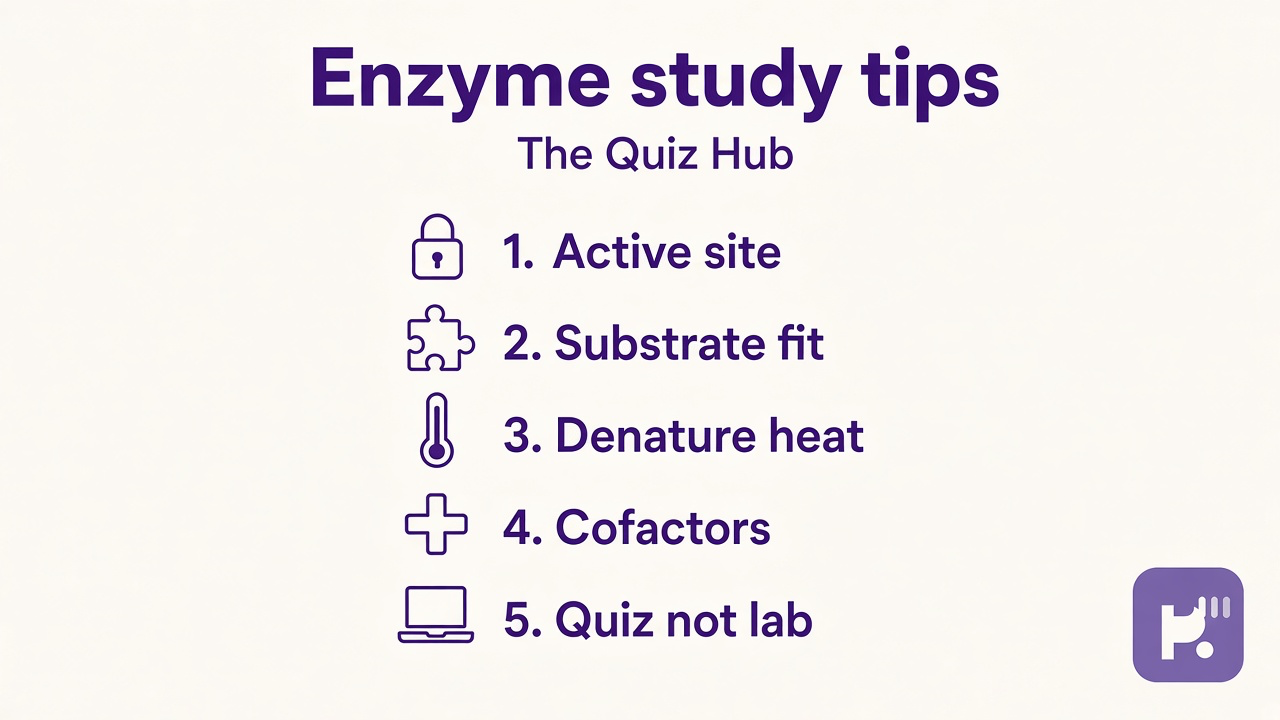
What this quiz can and cannot tell you
Can tell you
- Highlight active site, pH, and inhibitor habits worth revisiting before tests
- Separate class study literacy from lab licensing fantasies
- Encourage integrity and safety language before wet labs
- Spark better study group talk about specificity and feedback
Cannot tell you
- Issue lab technician licenses or employer credentials from one online screener
- Replace supervised labs, PPE rules, or notebook integrity policies
- Prove intelligence rank or authorize fabricating assay data
- Turn literacy scores into excuses to ignore instructor safety stops
Enzyme study habits before lab cosplay
Enzyme search intent often blends two needs: sound prepared before unit tests without rereading every slide, and check whether active-site language still matches inhibitor homework. Those goals help when readers treat bars as a study map. They hurt when people treat scores like lab licenses, skip PPE because trivia felt easy, or dunk classmates whose pH graphs are still messy.
Dr. James Whitfield reviews iq cognitive study screeners with a simple split: reward honest agreement with widely taught enzyme facts and honest limits on lab and dunk hype at the same time. Substrate and active site tracks specificity and induced fit without every-protein-catalyzes-everything myths. pH and temperature keeps denaturation separate from unlimited-speed folklore. Inhibitors and cofactors keeps competitive blocks and helpers visible without permanent-poison-only stories. Enzyme quiz limits keeps screeners, notebooks, and safety visible beside thread-war stress.
Real readers mix bars. You might score high on active site while keeping inhibitors moderate, which often describes strong cartoon memory before vocabulary cards land. You might score high on pH with softer cofactor items, which can mean good graph habits yet fuzzy coenzyme names. Reverse items catch sloppy answers: universal speed myths, boiling-temperature identity, irreversible-only inhibition, or inventing data from quiz scores should not inflate bars meant to track layered study habits.
Pair results with siblings on this hub instead of forcing one biology story. Our biology quiz spans broader life-science recall when your syllabus moves past enzymes. The chemistry quiz stays on reaction and bonding warm-ups when units stack. Browse the IQ and cognitive test hub for more study screeners. Caption shares as study practice and keep kindness in homework help threads.
Syllabi shift faster than one titration week. When you share results, say active-site clarity beats scoreboard. When you borrow study tips, credit lab partners who label units and instructors who stop unsafe shortcuts. Retake after inhibitor homework and watch whether cofactor bars rise even if pH trivia lags, which often means you separated performative genius talk from actual notebook habits.
| Test | Focus |
|---|---|
| Biology quiz | Broader life-science recall rather than enzyme active-site and inhibition depth |
| Chemistry quiz | General reaction and bonding warm-ups rather than enzyme specificity and cofactor lanes |
Enzyme Quiz FAQ
What does Enzyme Quiz measure?
It measures how much you agree with statements about substrate and active site fit, pH and temperature, inhibitors and cofactors, and enzyme quiz limits. You get an index from 0 to 100 plus four bars. It describes self-rated study literacy on this screener, not lab licenses or intelligence rank.
Is this a lab certification exam?
No. This page builds study-habit reflection aligned with common class themes. Supervised labs, licensing pathways, and your instructor govern real bench work.
Does a high score mean I can skip safety gear in lab?
No. High bars mean you related to study statements here. PPE, supervision, and notebook integrity still govern every wet lab.
Why include inhibitor and cofactor items?
Intro biochem units ask you to distinguish block types and helpers, not only memorize lock-and-key cartoons. Inhibitor habits stay separate from dunk culture; learning means asking method questions, not mocking peers.
Who reviewed this quiz?
Dr. James Whitfield, PhD reviewed the educational framing, lab-not-cert limits, and result explanations. See our editorial policy for review standards.
Reviewed by