
What this evidence law quiz measures
This quiz does not provide attorney-client advice, predict trial outcomes, or certify bar exam readiness. It measures how much you agree with introductory evidence law literacy grouped four ways: relevance foundation about probative value, materiality, character propensity limits, unfair prejudice balancing, and rejecting interesting-equals-admitted myths; hearsay basics about out-of-court statements offered for truth, declarant roles, non-hearsay purposes, and rejecting live-testimony and gossip shortcuts; exceptions awareness about excited utterance, present sense impression, business records elements at intro depth, dying declaration and forfeiture families, impeachment limiting instructions, and rejecting one-nickname free passes; and quiz not bar exam limits about unofficial study framing, anti-fake-lawyer behavior, federal versus state code humility, and refusing comment-section verdicts. You answer 22 statements from strongly disagree to strongly agree, with reverse-worded myths so viral shortcuts cannot inflate every bar. Your answers also feed a second chart on closeness and trust habits, because study shame sometimes pushes people toward false certainty online. The total becomes an index from 0 to 100 where higher means more reported evidence law literacy on this screener, not proof you should represent anyone at trial.
Relevance foundation
Probative value, materiality, prejudice balancing, and anti-admission myths.
Hearsay basics
Out-of-court statements, truth of the matter, declarants, and purpose analysis.
Exceptions awareness
Named exception families, elements at intro depth, no text-message free passes.
Quiz not bar exam limits
Study mirror only, no bar credentials, no comment-section verdicts.
How it works
Answer 22 agreement items
Rate each statement from Strongly disagree to Strongly agree. Tap Next after each answer.
Answers sort into four domains
Each answer feeds one of four evidence law literacy groups, and every item also feeds a closeness and trust layer.
See your index and charts
You get a 0 to 100 index, a band, and two bar charts you can use before opening your casebook hypos.
Take the Evidence Law Quiz
Answer 22 short statements to see your evidence law literacy index, four domain bars, and a closeness and trust chart.
What your result means
Your index is the average of all 22 answers, scaled from 0 to 100, with reverse-worded items flipped first. Higher means more reported evidence law literacy on this screener. Read quiz-not-bar-exam bars together with hearsay basics before you treat the total as counsel.
| Band | Index range | Typical reading |
|---|---|---|
| Building evidence law literacy | 0 to 35 | Fewer agreed facts on relevance, hearsay labels, exception awareness, or quiz-not-bar-exam items. |
| Mixed evidence law literacy | 36 to 65 | Solid recall in some domains with myths about admissibility, witness testimony as hearsay, or quiz-as-counsel. |
| Stronger evidence law literacy | 66 to 100 | Frequent agreement with relevance, hearsay, exception awareness, and quiz-not-bar-exam humility. |
Tips at a glance
A quick takeaway graphic with topic tips (not your personal quiz scores). Start the quiz for your index, bands, and charts.
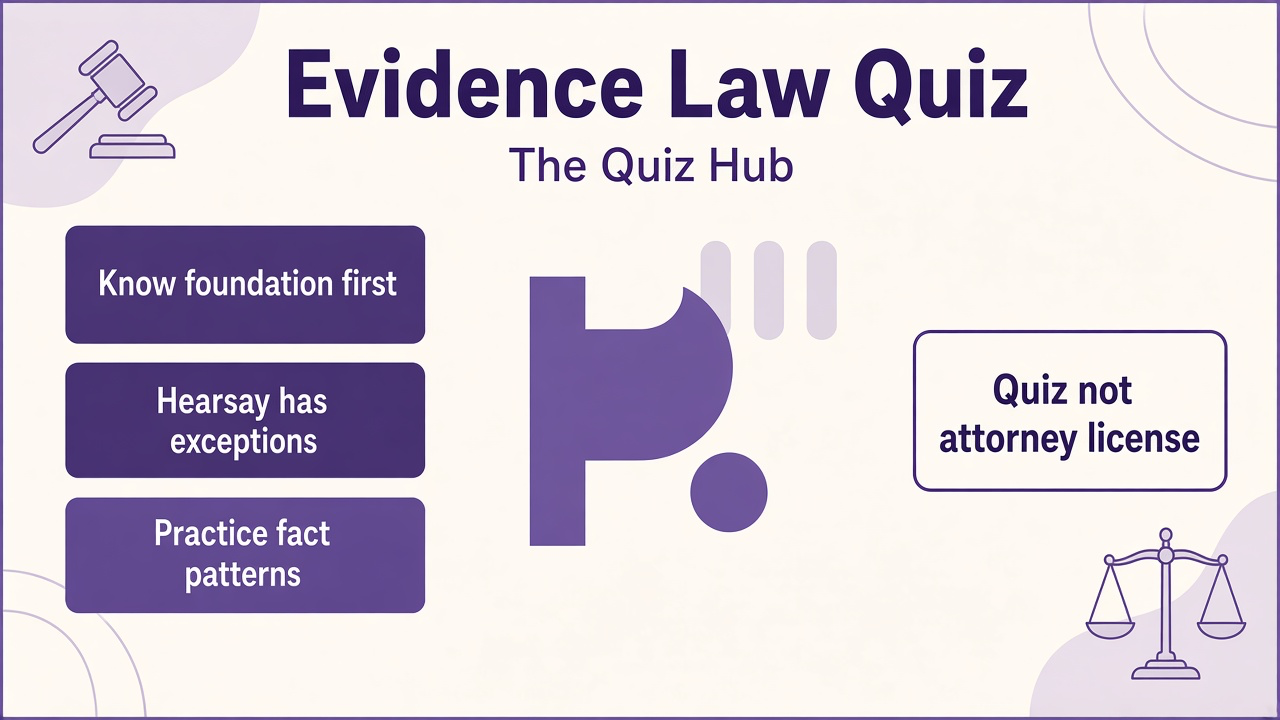
What this quiz can and cannot tell you
Can tell you
- Introduce relevance, hearsay, and exception vocabulary in plain intro course language
- Highlight common admissibility and hearsay label myths worth unlearning before hypos
- Encourage federal versus state code awareness and instructor office hours on hard problems
- Spark better questions in first-year evidence or paralegal study units
Cannot tell you
- Provide legal advice, file motions, or predict judge rulings on objections
- Replace licensed attorneys, bar exam courses, or courtroom experience
- Certify bar exam readiness or authorize representation of parties
- Capture every jurisdiction-specific privilege, authentication, or confrontation rule in one screener
Evidence law literacy without fake bar exam vibes
Students search evidence law quizzes when hearsay definitions, relevance charts, or mock trial objections collide with drama clips and comment threads. Relevance language is real in every evidence course, yet it is not a cartoon free pass to admit every fact jurors find gripping. Hearsay analysis starts with purpose: truth of the matter asserted versus notice, impeachment, or effect on the listener. Literacy language works when it points to casebooks and instructors instead of thread verdicts.
Dr. James Whitfield reviews IQ and cognitive hub study screeners by pairing honest recall about common themes with honest not-legal-advice limits. Relevance foundation tracks probative value, materiality, and prejudice balancing without interesting-equals-admitted myths. Hearsay basics tracks out-of-court statements, declarants, and purpose fights without mislabeling live testimony. Exceptions awareness tracks named families from excited utterance to business records without text-message free passes. Quiz not bar exam limits keeps study framing separate from fake credentials and public dunking.
Real learners mix bars. You might score high on relevance instinct while low on exception elements, which often describes careful readers who have not yet charted hearsay flows. You might score high on hearsay labels while studying outside the U.S., which means you still need local code counsel, not this page alone. Reverse items catch overconfidence: believing relevance equals admission, that live witnesses are hearsay, that gossip needs no rules, that every office text is a business record, or that quiz bars authorize objections should not inflate domains meant to track study habits.
Pair results with siblings on this hub instead of forcing one courtroom fantasy. Our employment law quiz sibling covers workplace documentation, reporting paths, and overtime literacy when your study week mixes statutes with trial proof themes. Browse the IQ and cognitive test hub for more study-style screeners that skip credential posing. Share syllabus links with classmates in disputes; do not play lawyer from bar charts.
Assignments and rule amendments change. An exceptions bar might shift after a new business-records hypo while relevance habits stay steady. Retake after you complete one evidence problem set and notice whether quiz-not-bar-exam bars stay high even when content bars rise, which often marks ethical study habits. Evidence law literacy is a map to instructors and licensed professionals, not a substitute for them.
| Test | Focus |
|---|---|
| Employment law quiz | Workplace rights, documentation, and overtime literacy rather than hearsay and relevance hypos on this page |
| IQ and cognitive hub | More study screeners when you want habits beside evidence trivia |
Evidence Law Quiz FAQ
What does this evidence law quiz measure?
It measures how much you agree with introductory evidence law literacy about relevance foundations, hearsay labels, exception awareness, and study-not-bar-exam limits. You get an index from 0 to 100 and four bars. It reflects self-reported awareness on this screener, not legal advice.
Is this legal advice for my case or mock trial round?
No. This is educational literacy with general themes that vary by jurisdiction and assignment. Consult a licensed attorney, your instructor, or official bar prep materials for advice on live disputes, objections, and exam strategy.
Does a high score mean I passed the bar evidence section?
No. Bars describe habits you reported here. Bar exams test timed application, local codes, and privileges this screener does not teach. Quiz-not-bar-exam items explicitly reject licensing myths.
How is this different from the employment law quiz?
The employment law sibling focuses on workplace handbooks, documentation, harassment reporting paths, and overtime basics. This page focuses on relevance, hearsay purpose, exception naming, and trial literacy limits with a separate stem bank.
Who reviewed this quiz?
Dr. James Whitfield reviewed the not-legal-advice framing, study literacy limits, and result explanations. See our editorial policy for review standards.
Reviewed by
