What this quiz measures
This quiz does not provide attorney-client advice, predict case outcomes, or certify bar exam readiness. It measures how much you agree with introductory employment law literacy grouped four ways: at-will and exceptions about handbook language, contracts, protected-class and retaliation themes needing professional review, and rejecting lawless-firing myths; documentation and reporting about dated notes, handbook routes, preserving messages when policy allows, and rejecting perfect-notes-guarantee-win fantasies; harassment and overtime basics about policy reporting paths, jurisdiction-specific overtime tests, official agency lookups, serious safety escalation, and contractor versus employee distinction at a high level; and not legal advice about unofficial study framing, anti-fake-lawyer behavior, statutory change humility, and planning licensed counsel when wages, safety, or immigration status are at stake. You answer 22 statements from strongly disagree to strongly agree, with reverse-worded myths so viral shortcuts cannot inflate every bar. Your answers also feed a second chart on closeness and trust habits, because workplace conflict sometimes pushes people toward dunking or false certainty online. The total becomes an index from 0 to 100 where higher means more reported employment law literacy on this screener, not proof you should represent anyone in court.
At-will and exceptions
Handbook limits, contracts, protected-class themes, retaliation caution, and anti-free-pass myths.
Documentation and reporting
Dated notes, handbook routes, message preservation, and limits of vent-only strategies.
Harassment and overtime basics
Reporting paths, duty tests, official agency checks, safety escalation, classification awareness.
Not legal advice
Study mirror only, no bar credentials, no comment-section verdicts, counsel for high stakes.
How it works
Answer 22 agreement items
Rate each statement from Strongly disagree to Strongly agree. Tap Next after each answer.
Answers sort into four domains
Each answer feeds one of four employment law literacy groups, and every item also feeds a closeness and trust layer.
See your index and charts
You get a 0 to 100 index, a band, and two bar charts you can use before opening official agency FAQs.
Take the Employment Law Quiz
Answer 22 short statements to see your employment law literacy index, four domain bars, and a closeness and trust chart.
What your result means
Your index is the average of all 22 answers, scaled from 0 to 100, with reverse-worded items flipped first. Higher means more reported employment law literacy on this screener. Read not-legal-advice bars together with jurisdiction basics before you treat the total as counsel.
| Band | Index range | Typical reading |
|---|---|---|
| Building employment law literacy | 0 to 35 | Fewer agreed facts on at-will limits, documentation, harassment or overtime basics, or not-legal-advice items. |
| Mixed employment law literacy | 36 to 65 | Solid recall in some domains with myths about at-will immunity, salaried overtime exemption, or quiz-as-counsel. |
| Strong employment law literacy | 66 to 100 | Frequent agreement with at-will limits, documentation, reporting paths, and not-legal-advice humility. |
Tips at a glance
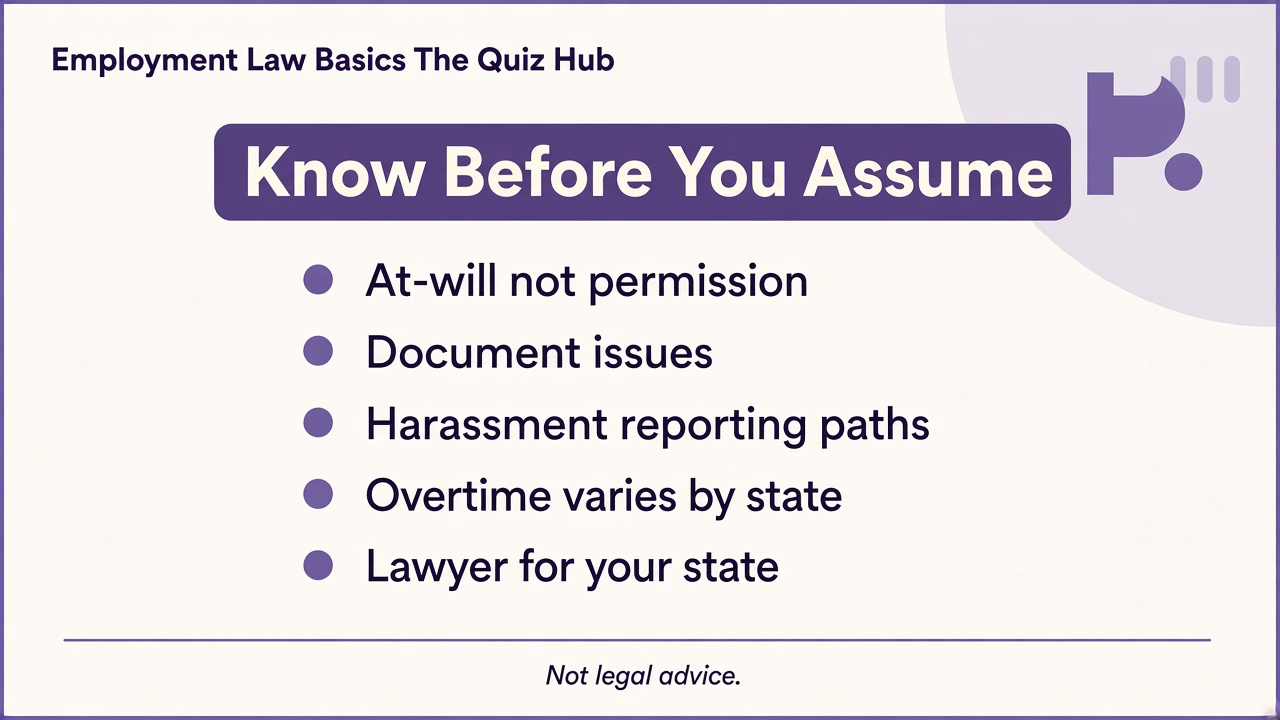
A quick takeaway graphic with topic tips (not your personal quiz scores). Start the quiz for your index, bands, and charts.
What this quiz can and cannot tell you
Can tell you
- Introduce at-will, documentation, and reporting vocabulary in plain language
- Highlight common overtime and harassment path myths worth unlearning
- Encourage official agency bookmarks and attorney consults on live disputes
- Spark better questions in intro business or civics study units
Cannot tell you
- Provide legal advice, file agency claims, or predict litigation outcomes
- Replace licensed employment attorneys or official labor agency determinations
- Certify bar exam readiness or authorize representation of others
- Capture every jurisdiction-specific rule in one short screener
Employment law literacy without fake bar exam vibes
Workers search employment law quizzes when a handbook phrase, layoff rumor, or overtime paycheck sparks fear and argument threads. At-will language is real in many U.S. workplaces, yet it is not a cartoon free pass to ignore wage, safety, anti-discrimination, or contract limits. Documentation habits matter because memory fades and timelines drive agency reviews. Literacy language works when it points to official sources and counsel instead of comment-section verdicts.
Dr. James Whitfield reviews IQ and cognitive hub study screeners by pairing honest recall about common themes with honest not-legal-advice limits. At-will and exceptions tracks handbook context, agreements, and protected-class caution without lawless firing myths. Documentation and reporting tracks dated notes, internal routes when safe, and limits of vent-only strategies. Harassment and overtime basics tracks reporting paths, duty tests, and official lookups without universal salaried exemption lore. Not legal advice keeps study framing separate from fake credentials and public dunking.
Real learners mix bars. You might score high on documentation instinct while low on overtime duty tests, which often describes organized employees who have not yet read state agency FAQs. You might score high on at-will literacy while living outside the U.S., which means you still need local counsel, not this page alone. Reverse items catch overconfidence: believing at-will deletes all statutes, that perfect notes guarantee wins, that every salaried worker is overtime-exempt, or that quiz bars authorize representing coworkers should not inflate domains meant to track study habits.
Pair results with siblings on this hub instead of forcing one courtroom fantasy. Our employment fit quiz explores values and interview humility on the personality hub when you want role-fit reflection without statute depth here. The employment, freelancing, and entrepreneurship quiz angles toward W2 versus 1099 tradeoffs and boundaries, not harassment reporting timelines. Browse the IQ and cognitive test hub for more study-style screeners. Share official links with friends in disputes; do not play lawyer from bar charts.
Policies and statutes change. An overtime bar might shift after a duty change or state law update while documentation habits stay steady. Retake after you read one official agency page and notice whether not-legal-advice bars stay high even when content bars rise, which often marks ethical study habits. Employment law literacy is a map to professionals, not a substitute for them.
| Test | Focus |
|---|---|
| Employment fit quiz | Role values and interview reflection, not statute literacy or reporting timelines on this page |
| Employment, freelancing, and entrepreneurship quiz | W2 versus 1099 path tradeoffs, not harassment reporting or overtime duty tests here |
Employment Law Quiz FAQ
What does this quiz measure?
It measures how much you agree with introductory employment law literacy about at-will limits, documentation, harassment reporting paths, overtime basics, and study-not-counsel limits. You get an index from 0 to 100 and four bars. It reflects self-reported awareness on this screener, not legal advice.
Is this legal advice for my workplace dispute?
No. This is educational literacy with general themes that vary by jurisdiction. Consult a licensed employment attorney or official labor agency in your location for advice on live disputes, deadlines, and filings.
Does at-will employment mean I can be fired for any reason?
Handbooks often use at-will language, yet statutes, contracts, union agreements, protected-class rules, retaliation doctrines, and public-policy themes can still matter. Specific facts need professional review; this page only introduces why the myth is oversimplified.
Why include overtime and harassment items together?
Both topics drive search traffic with viral oversimplifications. Literacy includes knowing reporting paths and jurisdiction-specific overtime tests exist, even though this screener cannot teach every rule.
Who reviewed this quiz?
Dr. James Whitfield reviewed the not-legal-advice framing, study literacy limits, and result explanations. See our editorial policy for review standards.
Reviewed by