What this Europe 1919 map quiz measures
This page does not certify peace conference attendance, replace reading full treaty articles, or prove legal expertise from one agree screener. It measures how much you agree with statements in four groups: treaty border shifts about Alsace-Lorraine, German trims, Ottoman shrinkage, and Baltic independence framing without pretending every 1919 chart equals today's EU list; new states on maps about Poland, Czechoslovakia, Yugoslavia, split Austria and Hungary, and careful spelling without denying postwar dots exist; compare 1914 habits about atlas dates, side-by-side outlines, separate alliance versus redraw legends, kind correction instead of dunking, and retakes after units; and quiz not treaty text about map literacy only, rejecting mockery myths, refusing nationalist rank games, and refusing fan totals as archivist replacements. You rate 22 statements from strongly disagree to strongly agree, with reverse-worded myths so autopilot responding cannot inflate every bar. Your answers also feed a second chart on closeness and trust habits, because border shame sometimes blocks asking classmates for legend help. The total becomes an index from 0 to 100 where higher means more endorsed postwar map literacy on this screener, not formal credentials or harassment license.
Treaty border shifts
Alsace-Lorraine, German trims, Ottoman shrinkage, and Baltic frames on postwar keys.
New states on maps
Poland, Czechoslovakia, Yugoslavia, and split Austria-Hungary dots with spelling care.
Compare 1914 habits
Atlas dates, side-by-side outlines, kind legend help, and retakes after units.
Quiz not treaty text
Map literacy only, not full articles, dunk rights, or archivist substitutes.
How it works
Answer 22 agreement items
Rate each statement from Strongly disagree to Strongly agree. Tap Next after each answer.
Answers sort into four domains
Each answer feeds one of four postwar map literacy groups, and every item also feeds a closeness and trust layer.
See your index and charts
You get a 0 to 100 index, a band, and two bar charts you can compare after one compare-atlas week.
Take the Europe 1919 Map Quiz
Answer 22 short statements to see your Europe 1919 map literacy index, four domain bars, and a closeness and trust chart.
What your result means
Your index is the average of all 22 answers, scaled from 0 to 100, with reverse-worded myth items flipped first. Read quiz-not-treaty-text with new-state bars before you treat any total as legal proof or nationalism bait. Persistent shame about map class deserves instructor help, not only meme reframes.
| Band | Index range | Typical reading |
|---|---|---|
| Building Europe 1919 map literacy | 0 to 35 | Fewer agreed facts on treaty redraws, new states, compare-1914 habits, or quiz limit statements on this screener. |
| Mixed Europe 1919 map literacy | 36 to 65 | Solid redraw recall in some domains with new-state traps or compare-date myths in others. |
| Stronger Europe 1919 map literacy | 66 to 100 | Frequent agreement on redraws, new states, compare habits, and quiz limits; still not treaty certification. |
Tips at a glance
A quick takeaway graphic with topic tips (not your personal quiz scores). Start the quiz for your index, bands, and charts.
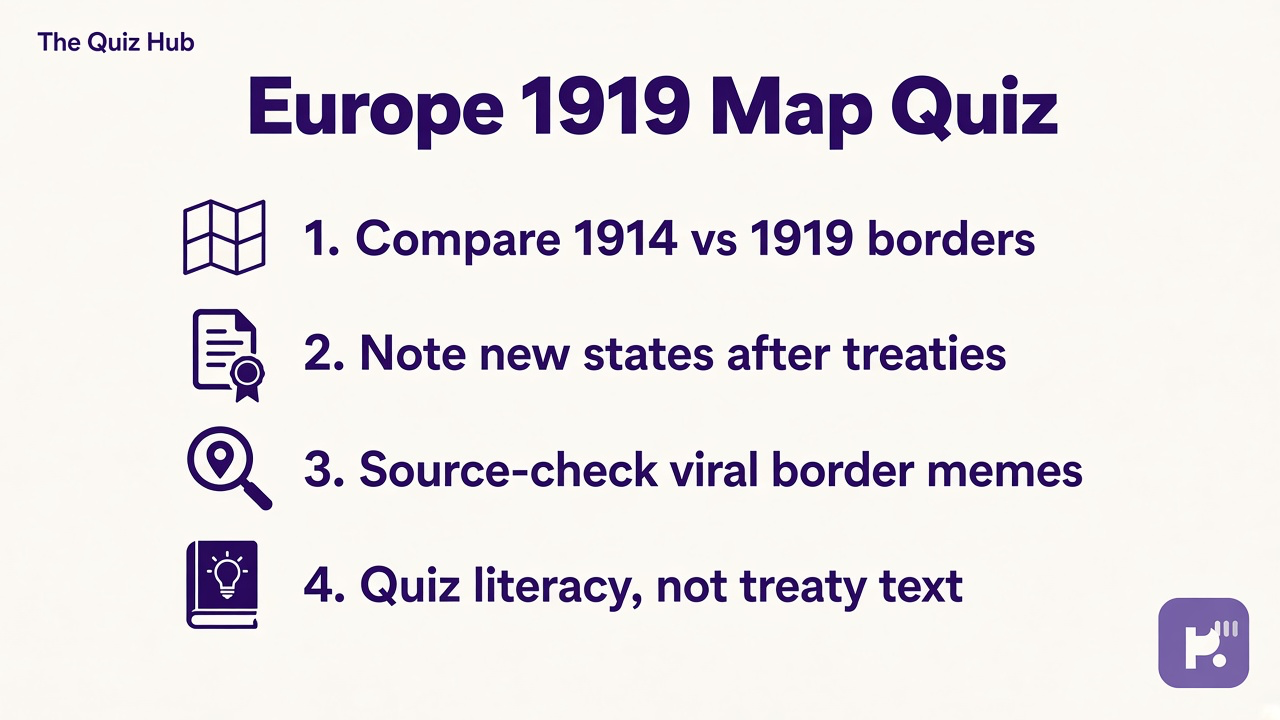
What this quiz can and cannot tell you
Can tell you
- Highlight postwar redraw and new-state habits worth trying after your WWI unit
- Separate unofficial literacy from treaty articles, legal briefs, and archivist work
- Encourage compare-1914 atlas discipline without nationalist rank dunking
- Spark better study questions without web score hiring or shame claims
Cannot tell you
- Replace reading full treaty text, AP essays, or university history grading
- Prove you understand every mandate or minority clause from one agree screener
- Excuse border harassment because redraw bars scored high once
- Substitute for therapy when online nationalism arguments disrupt sleep and friendships
Postwar redraws, new states, and quiz-not-treaty-text limits
Students search Europe 1919 map quizzes when Poland dots return, Habsburg blobs split, and social threads still show July alliance colors. Those goals help when bars stay reflection notes for compare-atlas habits. They hurt when people treat fan totals like peace conference credentials or bait nationalism from redraw screenshots.
Dr. James Whitfield reviews IQ and cognitive literacy screeners with a simple split: reward honest agreement with widely taught postwar map facts and honest limits on credential overclaim at the same time. Treaty border shifts keeps Alsace, German trim, and Ottoman shrinkage visible beside unchanged-EU-border myths. New states on maps keeps Poland, Czechoslovakia, Yugoslavia, and split Austria-Hungary visible beside denial that postwar dots exist. Compare 1914 habits keeps atlas dates and side-by-side legends visible beside meme-only border trust. Quiz not treaty text keeps full article reading and archivist work honest so readers know legal depth differs from fan pages.
Real readers mix bars. You might score high on treaty shifts while new-state bars wobble, which often describes redraw readers who notice Alsace yet forget Yugoslavia labels. You might score high on new states with moderate compare bars, which can mean dots stick before date discipline hardens. Reverse items catch sloppy answers: unchanged EU borders on every 1919 chart, denying Czechoslovakia and Yugoslavia, trusting memes without legends, mockery licenses from high bars, or fan totals replacing archivists should not inflate bars meant to track layered literacy habits.
Pair results with siblings on this hub instead of forcing one postwar story. Our Europe 1914 map quiz stays on July alliances and neutral outbreak coloring with zero shared stems on this page. The Europe map quiz sibling stays on modern outlines when present-day placement helps without treaty dates. Browse the IQ and cognitive hub for more study screeners. Caption shares as compare-atlas practice, not treaty badges.
Chapters move faster than trending border memes. Redraw units arrive after alliance weeks, but date checking stays useful all year. When you share results, say 1919 is not 1914. When you borrow tips, credit teachers who made you open two atlas pages side by side. Retake after one compare week and watch whether quiz-not-treaty-text bars stay high even when new-state bars rise, which often means you separated performative nationalism from actual sourced map habits.
| Test | Focus |
|---|---|
| Europe 1914 map quiz | July alliances and neutral outbreak maps rather than postwar redraw stems here |
| Europe map quiz | Modern country outlines rather than 1919 treaty redraw depth on this page |
| Europe physical map quiz | Relief and physical features rather than postwar political border stems here |
Europe 1919 Map Quiz FAQ
What does this Europe 1919 map quiz measure?
It measures how much you agree with statements about treaty border shifts, new states on maps, compare 1914 habits, and quiz not treaty text limits. You get an index from 0 to 100 plus four bars. It describes self-rated postwar map literacy on this screener, not peace conference credentials.
How is this different from the Europe 1914 map quiz?
The 1914 sibling focuses on July alliances, neutral shading, and prewar empire outlines. This page focuses on postwar redraws, new states, and compare-atlas habits. Stems are written to stay distinct with zero shared questions between the two slugs.
Does a high score mean I understand every Versailles clause?
No. High bars mean you related to map literacy statements here. Full treaty articles, legal analysis, and primary sources still matter. Quiz not treaty text items explicitly reject replacing footnotes with fan totals.
Why include compare 1914 habit items?
Search intent blends postwar redraws with alliance memes that use wrong dates. Split bars keep 1919 dots separate from July coloring so results stay honest about which dated habits you endorse.
Who reviewed this quiz?
Dr. James Whitfield, PhD reviewed the postwar map literacy framing, stem separation from 1914, and result explanations. See our editorial policy for review standards.
Reviewed by