What this Europe 1914 map quiz measures
This page does not grade AP history exams, replace primary source essays, or certify you to debate treaty law online. It measures how much you agree with statements in four groups: alliance blocs about Triple Entente and Central Power coloring, Italy later entry, Belgium routes, and Serbia Balkan lanes without day-one United States myths; neutrals at outbreak about Switzerland, Scandinavia, Netherlands, Spain, and careful legend reading before later wartime joins; prewar empire outlines about Austria-Hungary bulk, Ottoman Balkan reach, Russian scale, German Alsace-Lorraine, and rejecting modern Poland on every 1914 chart; and quiz not historian about study-only framing, rejecting perfect-bar insult myths, and refusing web totals as historian rank. You rate 22 statements from strongly disagree to strongly agree, with reverse-worded myths so autopilot responding cannot inflate every bar. Your answers also feed a second chart on closeness and trust habits, because map shame sometimes blocks asking classmates for legend help. The total becomes an index from 0 to 100 where higher means more endorsed July 1914 map literacy on this screener, not formal credentials or political license.
Alliance blocs
Entente, Central Powers, Italy timing, Belgium routes, and Serbia Balkan lanes on dated charts.
Neutrals at outbreak
Swiss and Scandinavian shading, Spain outside blocs, and legend care before later entries.
Pre-war empire outlines
Habsburg bulk, Ottoman reach, Russian scale, and 1914 versus 1919 border caution.
Quiz not historian
Study reflection, not AP proof, dunk rights, or footnote substitutes from bars.
How it works
Answer 22 agreement items
Rate each statement from Strongly disagree to Strongly agree. Tap Next after each answer.
Answers sort into four domains
Each answer feeds one of four July 1914 map literacy groups, and every item also feeds a closeness and trust layer.
See your index and charts
You get a 0 to 100 index, a band, and two bar charts you can compare after one dated outline session.
Take the Europe 1914 Map Quiz
Answer 22 short statements to see your Europe 1914 map literacy index, four domain bars, and a closeness and trust chart.
What your result means
Your index is the average of all 22 answers, scaled from 0 to 100, with reverse-worded myth items flipped first. Read quiz-not-historian with alliance bars before you treat any total as AP proof or dunk license. Persistent shame about map class deserves instructor help, not only meme reframes.
| Band | Index range | Typical reading |
|---|---|---|
| Building Europe 1914 map literacy | 0 to 35 | Fewer agreed facts on alliance blocs, neutrals, prewar outlines, or quiz limit statements on this screener. |
| Mixed Europe 1914 map literacy | 36 to 65 | Solid alliance or neutral recall in some domains with empire outline traps or historian myths in others. |
| Stronger Europe 1914 map literacy | 66 to 100 | Frequent agreement on alliances, neutrals, prewar outlines, and quiz limits; still not AP certification. |
Tips at a glance
A quick takeaway graphic with topic tips (not your personal quiz scores). Start the quiz for your index, bands, and charts.
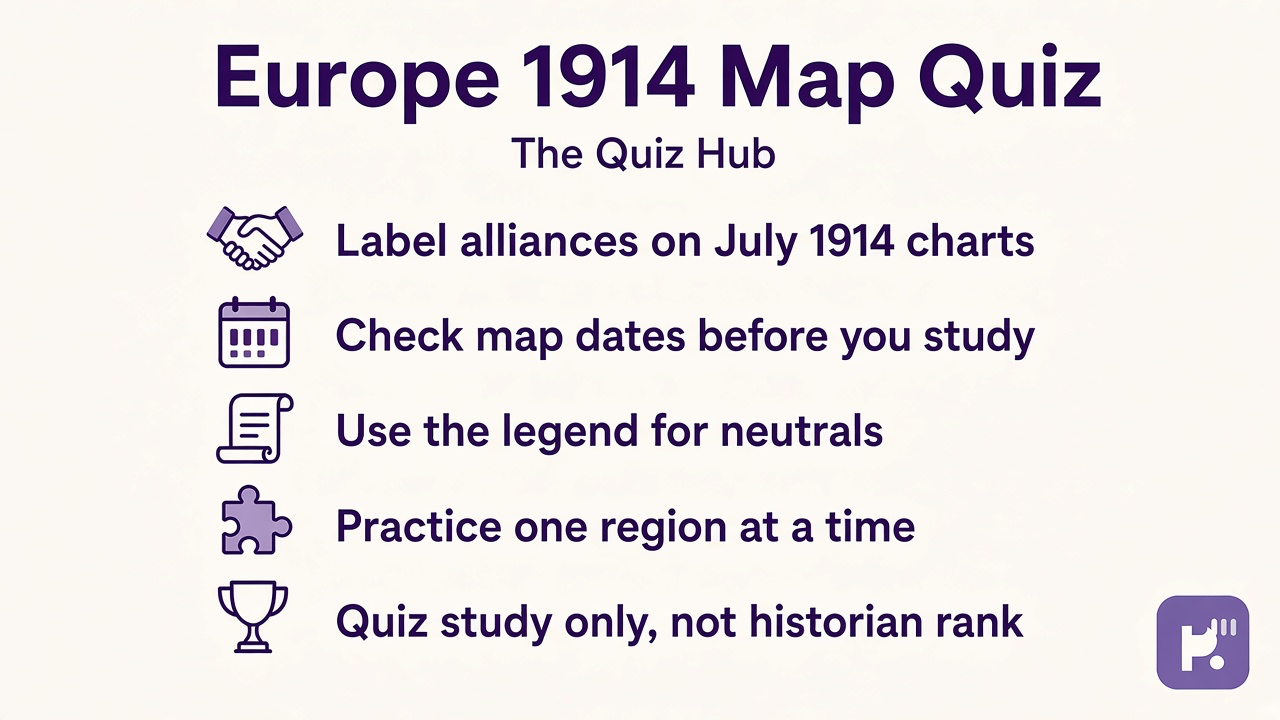
What this quiz can and cannot tell you
Can tell you
- Highlight July 1914 alliance and neutral legend habits worth trying before the next map unit
- Separate unofficial literacy from AP rubrics, graded papers, and museum work
- Encourage dated atlas checks without political rank dunking
- Spark better study questions without web score hiring or shame claims
Cannot tell you
- Replace AP history exams, university coursework, or primary source grading
- Prove you read every treaty clause or battlefield order from one agree screener
- Excuse online harassment because alliance bars scored high once
- Substitute for therapy when map arguments or perfectionism disrupt sleep and friendships
July 1914 alliances, neutrals, and quiz-not-historian limits
Students search Europe 1914 map quizzes when alliance colors blur, neutral shading gets skipped, and social threads paste 1919 borders onto July atlases. Those goals help when bars stay reflection notes for dated legend habits. They hurt when people treat fan totals like AP scores or dunk classmates who are still learning bloc colors.
Dr. James Whitfield reviews IQ and cognitive literacy screeners with a simple split: reward honest agreement with widely taught July 1914 map facts and honest limits on credential overclaim at the same time. Alliance blocs keeps Entente and Central coloring visible beside day-one United States myths. Neutrals at outbreak keeps Swiss and Scandinavian shading visible beside assume-everyone-fought traps. Pre-war empire outlines keeps Habsburg and Ottoman bulk visible beside modern Poland on every 1914 poster fantasies. Quiz not historian keeps AP and footnote language honest so readers know graded work differs from fan pages.
Real readers mix bars. You might score high on neutrals while alliance bars wobble, which often describes legend readers who notice Switzerland yet mix Italy timing. You might score high on alliances with moderate empire bars, which can mean bloc colors outran Habsburg bulk tracing. Reverse items catch sloppy answers: day-one United States beside Russia, neutral labels as excuse to skip sources, modern Poland on every 1914 chart, perfect bars as insult license, or web totals as historian rank should not inflate bars meant to track layered literacy habits.
Pair results with siblings on this hub instead of forcing one WWI story. Our Europe 1919 map quiz stays on postwar redraws and new states with a separate stem bank, not July alliance repeats. The Europe map quiz sibling stays on modern country outlines when you want present-day placement without 1914 dates. Browse the IQ and cognitive hub for more study screeners. Caption shares as dated map practice, not historian badges.
Units move faster than trending map memes. Alliance charts arrive once a semester, but legend reading stays useful all year. When you share results, say July 1914 dates matter. When you borrow tips, credit teachers who made you color neutrals before bloc debates. Retake after one outline week and watch whether quiz-not-historian bars stay high even when alliance bars rise, which often means you separated performative dunking from actual dated map habits.
| Test | Focus |
|---|---|
| Europe 1919 map quiz | Postwar redraws and new states rather than July 1914 alliance and neutral outbreak lanes here |
| Europe map quiz | Modern country outlines rather than prewar alliance coloring on this page |
| Europe bodies of water quiz | Seas and rivers literacy rather than WWI bloc map stems here |
Europe 1914 Map Quiz FAQ
What does this Europe 1914 map quiz measure?
It measures how much you agree with statements about alliance blocs, neutrals at outbreak, prewar empire outlines, and quiz not historian limits. You get an index from 0 to 100 plus four bars. It describes self-rated July 1914 map literacy on this screener, not AP exam grades.
How is this different from the Europe 1919 map quiz?
This page focuses on July 1914 alliances, neutral shading, and prewar empire outlines. The 1919 sibling focuses on postwar redraws, new states, and treaty-era border shifts. Stems are written to stay distinct so you can take both without duplicate questions.
Is this an AP World History or AP European History exam?
No. This is unofficial study literacy inspired by common classroom map themes. It does not replace AP rubrics, graded primary source work, or instructor exams.
Why include reverse-worded myth statements?
Myth items catch overconfidence. Agreeing that the United States fought from day one, that neutrals excuse skipping sources, that modern Poland appears on every 1914 chart, or that perfect bars grant dunk rights should not inflate your literacy index.
Who reviewed this quiz?
Dr. James Whitfield, PhD reviewed the July 1914 map literacy framing, sibling separation from 1919 stems, and result explanations. See our editorial policy for review standards.
Reviewed by